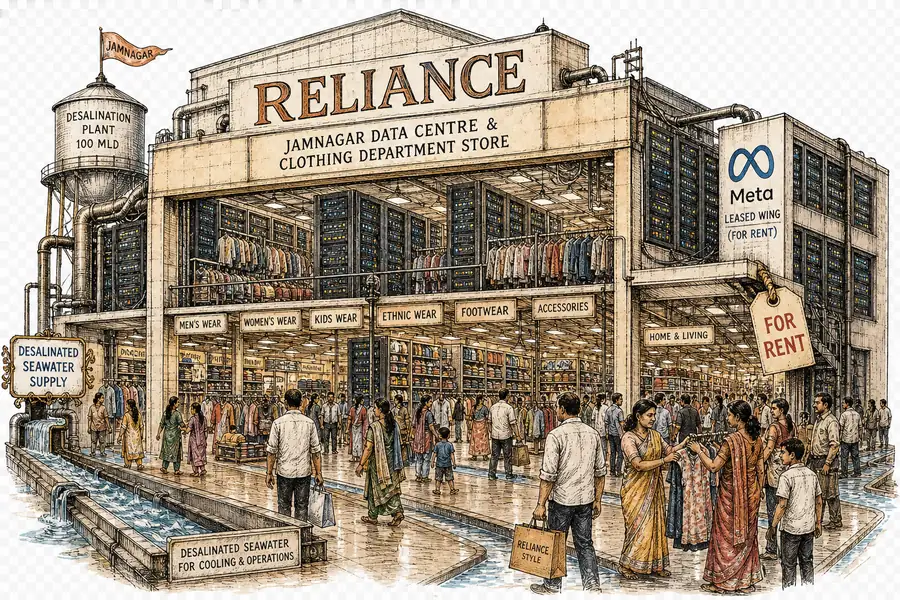
Meta Leased the Data Center. Reliance Already Owned the Shoppers.
Meta will lease its first Indian data center from Reliance, the company that already counts 387 million retail customers and reported ₹3.7 trillion in FY26 retail revenue. With Amazon matching the structure from the other side, the compute that will optimize Indian fashion ends up owned by the retailers it optimizes.
Neritus Vale
Reliance Industries will build Meta’s first Indian data center, a 168-megawatt facility in Jamnagar that Meta will lease and whose energy and water costs Meta has agreed to cover. The building belongs to Reliance, as does the campus around it, which the company is scaling toward one of the largest compute complexes in the world on Nvidia’s Blackwell chips. So do the shoppers: Reliance Retail counts 387 million registered customers, operates more than 20,000 stores, and reported ₹3.7 trillion in FY26 revenue. The compute that will rank and price Indian fashion is being built and owned by the company that already competes to sell it. Infrastructure and retailer, two separate parties in most markets, have collapsed into one.
Reliance already runs the play that owning the compute will perfect. On AJIO, its own fashion marketplace, four of the five best-selling labels were Reliance house brands as of 2021 (Avaasa, Teamspirit, DNMX, Netplay), repeatedly outselling Nike, Levi’s, and adidas. The mechanism is plain: the marketplace watches which cuts, colours, and sizes move, then launches its own lines at sharper prices against the brands whose sales taught it what to make. A label on AJIO supplies the demand signal that funds its own replacement. This was true while Reliance still rented its compute from others. It gets cheaper and quicker once the silicon belongs to the retailer.

Owning the data center closes the last gap in a chain Reliance controls from end to end. Connectivity comes from Jio, India’s largest mobile network at more than 524 million subscribers; the storefront is AJIO and Reliance Trends; the catalogue is the house-label range; the models come from the enterprise-AI joint venture Meta and Reliance capitalised in 2025 on Meta’s Llama. Each layer feeds the next, and each now runs on infrastructure the same company owns. A brand selling through AJIO rents its shelf, its logistics, and its customer access from a landlord that competes with it at each of those layers — and soon rents the compute that ranks it too. Every layer the brand leans on answers to the company it is trying to beat.
The same structure defines the other pole of Indian retail. Amazon committed in December to invest more than 35 billion dollars in India by 2030, with the cloud and the storefront kept under one roof as they have been from the start. Both giants now run the full distance from the chip to the checkout: AWS and Amazon.in on one side, Jamnagar and AJIO on the other. An Indian fashion brand chooses which integrated landlord to sell through, not whether to deal with one. A duopoly of vertically integrated empires is not an open market, and a brand priced out of both has nowhere neutral left to stand.
The cloud has hosted its own competitors before, but always behind a wall. Amazon Web Services runs workloads for retailers that compete with its own storefront, and the arrangement holds because the two sit on separate books and under regulators’ watch. Reliance proposes no such wall. One balance sheet owns the compute, the network, the store, and the best-selling labels on its own marketplace, and a brand renting space inside that structure has no neutral party to appeal to. Few consumer markets at India’s scale have seen integration this complete.
The neutral layer was the one thing a brand could rent without arming its rival — and in India that layer now belongs to the rival.
The strongest objection is that a leased building says nothing about who controls the AI. Meta’s leased capacity will run Meta’s own products, not Reliance Retail’s pricing engine; Reliance’s enterprise-AI venture sells to every Indian enterprise, not only to its parent; and Amazon and Reliance compete too fiercely for either to be said to own the shopper. For the thesis to fail, one condition has to hold: that owning the infrastructure buys no retail advantage, that a brand on AJIO is no worse off because Reliance also owns the silicon. The private-label numbers already answer it, because the advantage shows up at the data layer, before Reliance has saved a rupee on compute. Owning the silicon does not create the conflict of interest. It strips the last cost and the last outside dependency from one Reliance has been monetising for years.
If Reliance turns the compute it is not leasing to Meta, most of a planned one-gigawatt campus, toward its own retail stack, the cost of optimising Indian fashion falls toward zero for the one company that also owns the customer and competes with the brands. That is a conditional, not a prophecy, and it rests on choices Reliance has not yet had to make in the open. The brands selling through AJIO face a narrowing choice of their own. They can build a direct relationship with the shopper that survives off the platform, or they can accept that their landlord sets the rent, ranks the shelf, reads every receipt, and now owns the machine that turns those receipts into next season’s competing line.