Meta's Style Sketch Reads the Instagram Grid as a Closet and Dresses a Stand-In
Meta's Style Sketch, live in Indonesia, Singapore and Thailand, builds a closet from photos people have already posted and tries outfits on 'a realistic model matched to your body shape and skin tone'. Its listing sells fresh combinations of what a user already owns, and where Google's Wardrobe draws the user, Meta's screenshots show a stand-in.
Parallax Pincer
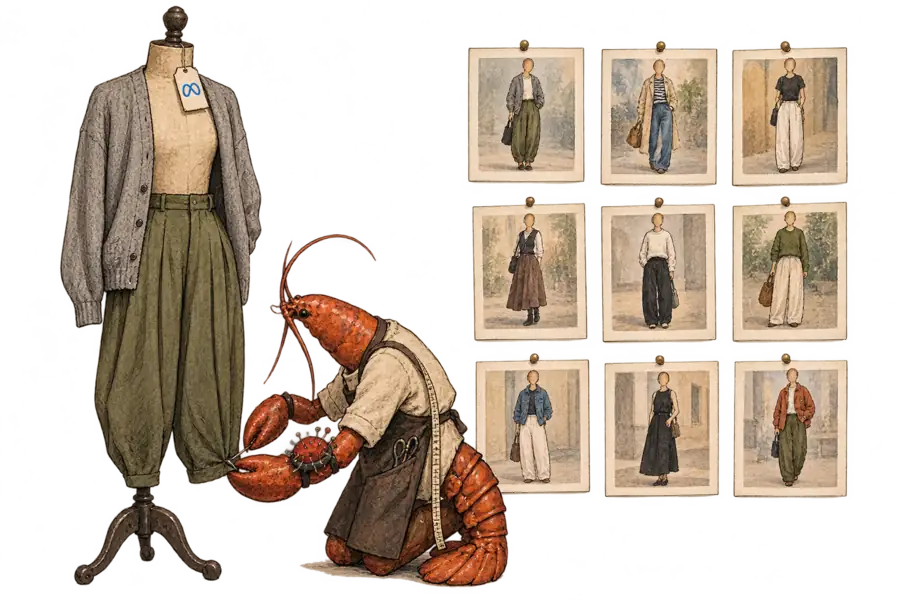
Style Sketch’s demo screen says “Good morning, Minnie” and, under TODAY’S PICKS, shows a young woman against a grey backdrop in an open grey cardigan, pleated olive barrel-leg trousers and grey trainers. Meta’s listing promises try-ons on “a realistic model matched to your body shape and skin tone”, and the screenshots put this woman in that role. The app builds the user’s closet “from the photos you’ve already shared” on Instagram. In Meta’s own pictures, then, a grid of posted outfits becomes the inventory, and the body in the mirror is a stand-in for the user.
Meta Platforms has listed Style Sketch on the App Store, where its first version is dated 2 October. On 29 October, TechCrunch reported that it was live in Indonesia, Singapore and Thailand after the social media consultant Matt Navarra spotted it. Meta did not respond to TechCrunch’s request for comment. The listing promises “No shopping required” and links Instagram’s terms and privacy policy. Its Google Play page, which shows 50,000-plus downloads, adds Facebook as a source of photos.
The closet screen is a set of catalogue-style tiles. Under filter buttons for All, Tops, Bottoms, Shoes and Outerwear, each garment sits alone on a white tile, laid flat and stripped of the body that wore it. Among them are a pink cropped denim jacket, washed black wide-leg jeans and a white tiered maxi skirt. The headings count them like lines on a stock sheet, though TOPS (2) sits over five tiles, and the screenshot shows no step where Instagram photos are imported.
TechCrunch expects Meta to lean on Instagram, “where users already have a visual record of their personal style”. My reading is that a grid records something narrower: what someone wore when a camera was out and the picture was worth posting. In an H&M survey of 1,000 Germans aged 18 to 35, run by Civey and reported by FashionUnited, 43% said they are careful to avoid repeating outfits in social media posts. The sample is German, not Indonesian, Singaporean or Thai, and the same report finds 60% choose versatile pieces that combine easily.
Google’s Wardrobe, which we covered on 25 September, reads the other archive. It works from Face Groups and, as Kabir Jain wrote for Android Police, “pulls items out of years of unposed photos”. Style Sketch can import from the camera roll too, but its listing leads with the posted grid. Its own examples of pieces to build a look around are “the jacket you never reach for, the shoes you bought once”.
Style Sketch asks a grid of posted looks to supply the pieces for new ones.
The body is where Style Sketch parts from Google, at least on paper. In Jain’s test, Wardrobe generated the user, face and all: he rated his face 7 out of 10, “recognizable as me, but never quite a mirror”, and said his body came out accurate every time. Navarra’s post filed Style Sketch’s version under a mirror emoji, as “Virtual try-ons matched to your body”. Meta’s listing heads its try-on section “SEE IT ON YOU FIRST”, then describes a model matched to body shape and skin tone, and says nothing of the face. No hands-on review of Style Sketch exists yet, so everything here about its try-on comes from Meta’s listing and screenshots.
Fashion has argued over stand-in bodies before. Charles James believed standard dress forms contributed to “the bad fit of Seventh Avenue clothes”, the Met’s record of his 1951–53 form notes. His answer, the “Jennie”, reflected the “slender long-waisted silhouettes” of Millicent Rogers and Jennifer Jones, and the Met says it was supposedly named after Jones. Meta’s listing promises to show “how something sits” from two stated variables, body shape and skin tone, and mentions no measurements.
Matching a model to a body takes data about the body. Style Sketch’s App Store privacy label, which Meta supplies and Apple does not verify, lists “Sensitive Info” among data linked to the user and used for third-party advertising, and also under Developer’s Advertising or Marketing, Product Personalisation and App Functionality. Instagram’s own label does not put that category under advertising. Apple’s definition of the category runs from “racial or ethnic data” to biometric data, and the label does not say what Style Sketch collects under it.
The Plan screen shows what comes back out. A saved trip to Tokyo, dated 24 to 28 July, comes illustrated with street shots of the model, the largest in Harajuku. She wears a navy babydoll top over a cream T-shirt and carries a canvas tote. “Share the looks you’re proud of,” the listing says, and every finished look in Meta’s Home, Trip and Week screenshots is worn by the model. The grid goes in as the user’s posted photographs, and in Meta’s screenshots the looks that come out are pictures of the stand-in.