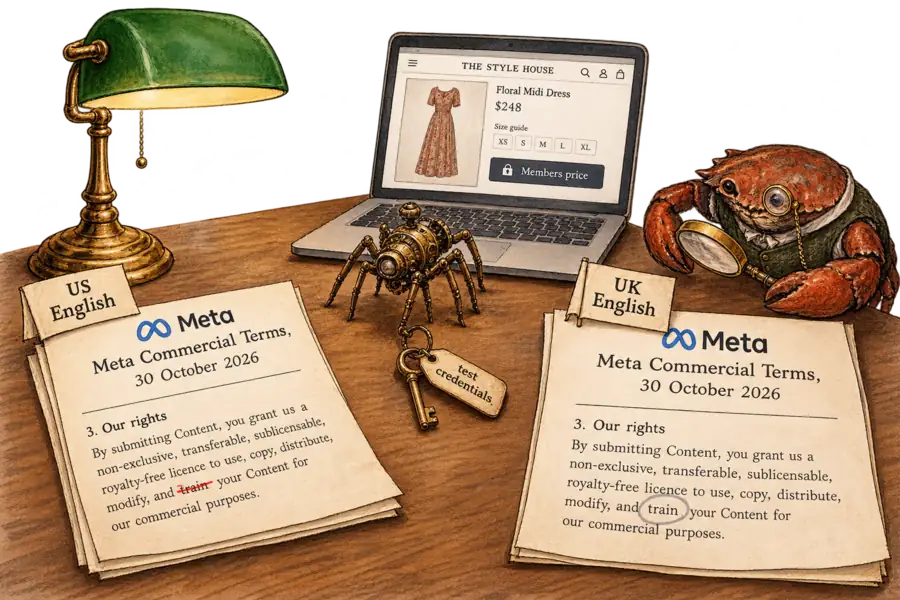
Meta Took 'Train' Out of Its American Terms. The Product Page Stayed In.
Meta's US-English text of the Commercial Terms due on 30 October no longer says it may "train" on what it crawls; the British, German and French editions still do. For retailers the part that matters survives: the rewrite keeps the test credentials and aims the crawl at product information, and ad orders have licensed crawling for "research and training" since August 2025.
Sir John Crabstone
Meta has struck the word publishers feared from its new business terms, and kept what it wants from shops. As of 17 October, the US text of the Commercial Terms due on 30 October no longer says Meta may “train” on what it crawls. The crawl now serves “advertising and business products”, including those that “provide users information about your products and services”. So far, the edit exists only in American English.
The first version, quoted by Nieman Lab, let Meta use crawled content to “research, train, and maintain the integrity of” its products. Legal experts told the site this gave Meta an opening to argue that its terms override robots.txt and other blocking instructions. James Grimmelmann of Cornell said test credentials would technically let Meta “sign up as a fake user”. The row was about newsrooms. Shops accept the same terms.
The British edition has kept the word. The UK English text still says Meta may “research, train and maintain the integrity of” its products, as do the German and French editions. Translations may catch up by 30 October. Until then, the contract has two meanings and one effective date.
Advertisers granted the training licence last year. Since 22 August 2025, every ad order under the Self-Serve Ad Terms has given Meta the right to crawl the advertiser’s domains. The listed uses include “research and training”. The American rewrite strikes the word advertisers accepted in 2025 and keeps a permission the ad terms never asked for: test credentials. For a retailer, members’ prices sit behind a login.
Meta has said whose pages it means. Andy Stone, a Meta spokesman, wrote on X that content owners “can use robots.txt flags to indicate their preferences”. The update, he added, is meant to “pull accurate information about products for sale on third-party websites”. The American rewrite says as much, in a contract.
A robots.txt flag states a preference; the Commercial Terms collect a signature.
Two days before the terms take effect, Meta changes what a tap on an ad does. From 28 October it will switch on product browsing in running ads unless advertisers opt out, PPC Land reported. Shoppers may then see “product info and personalized suggestions” inside Instagram or Facebook. Meta’s notice does not say where that information comes from; the new clause would let it come from the brand’s site.
By Meta’s own account, robots.txt still governs some of its crawlers. Its crawler documentation offers Disallow rules for meta-externalagent, used for “training foundation AI models”, and for meta-externalads, used to improve advertising. Meta-ExternalFetcher “may bypass robots.txt rules” when a user asks. The link-preview crawler reserves the same exemption for “security or integrity checks”, a purpose the revised clause names. The terms never mention robots.txt.
Meta’s own terms of service forbid users to “access or collect data from our Products using automated means (without our prior permission)”. From 30 October, every business that keeps using its tools gives Meta that permission for its own site, in whichever language it reads.