The Meter That Priced Galliano's Headlines Cannot See Zara's Tills
Launchmetrics' 'The Desirability Gap' says mass-market brands using premium strategies averaged twice the media value of those that did not, and prices the first two days of coverage of Zara's Galliano signing at $8.3m. The meter builds on advertising rates and audience counts, its 2x cannot separate strategy from size, and over most of the same months Zara's growth in euros trailed every other Inditex chain.
Neritus Vale
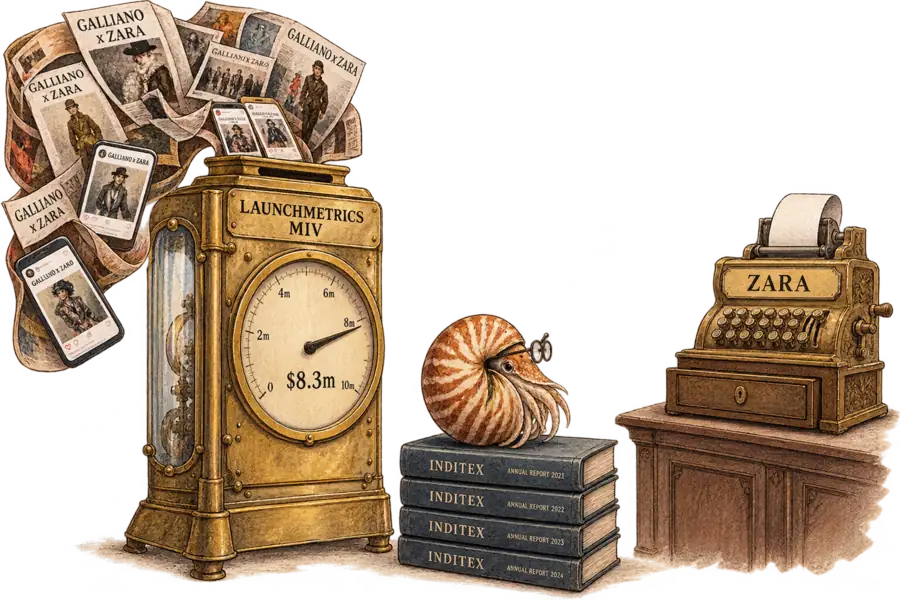
Zara’s 17 March announcement that John Galliano would design for it generated $8.3m in Launchmetrics’ Media Impact Value (MIV) within two days, as Glossy’s Zofia Zwieglinska reported. The figure comes from “The Desirability Gap”, which uses the same meter to argue that luxury tactics pay for mass-market brands. That meter prices coverage and has no column for sales. The report’s central comparison comes from a list ranked by the meter itself.
The report’s headline compares mass brands that borrowed luxury’s tactics (designer partnerships, creative appointments, ambassadors, appearances at major cultural events) with those that did not. Among the 50 mass-market fashion brands ranked highest on MIV, the borrowers averaged twice the rest’s MIV from January 2025 to June 2026, Glossy reported. The report’s page says of the brands pulling ahead: “And it’s working.” Glossy’s caveat is that the findings “don’t prove that shoppers think differently” about a brand “or are buying more.”
The trouble starts before the shopper: MIV builds on advertising rates and audience counts, not purchases. Launchmetrics builds it from “the advertising or activation value equivalent x source-based factors x content-based factors”, and weights top-tier magazines and big influencers above general news sites and low-tier blogs. For print and online coverage the base is an advertising rate; social value rests on followers, likes and shares instead. AMEC, the trade body for communication measurement, calls advertising value equivalents “invalid measures” that “should not be used”, and does not mention MIV. Launchmetrics argues that such equivalents rarely account for quality and MIV does. The weightings change which placements count most, but they adjust a base figure that counts audience, not sales.
The ratio cannot separate a premium strategy from a big brand. Zara, the report’s showcase, already topped Launchmetrics’ high-street ranking in early 2023, years before Galliano or the Super Bowl. MIV also counts a brand’s own channels, so a large following earns value whenever the brand posts. A list of the 50 highest-ranked brands leaves out any brand that tried a premium move and stayed quiet. Neither the report’s public page nor Glossy’s account of the gated document says how many of the 50 used the strategies, gives a median or adjusts for size.
The strategies on the report’s list are built to generate coverage, so the meter may count each strategy as its own result.
The Galliano figure also comes without a floor. Launchmetrics’ own benchmark credited Zara with $416m of MIV in the first quarter of 2023. Spread evenly over the quarter’s 90 days, our arithmetic gives about $9m every two days. Against that older baseline, the signing’s coverage was worth roughly two ordinary days. The public account prints no baseline.
The two Zara cases also run on different clocks. Launchmetrics’ first count for Bad Bunny’s Super Bowl look, reported by FashionUnited two days after the game, drew on data from 7 to 9 February and gave Zara $3.1m; the overall tally was expected to grow. In its post of 13 February (the page was last updated on 20 February), Launchmetrics put Zara at $19.9m, the figure the report uses alongside Galliano’s two-day number. Which case looks bigger depends on when the meter stopped.
The report’s theme percentages are shares of media value, not shares of opinion. Its AI-assisted coverage analysis found that coverage carrying “archival authority” made up 62% of the Galliano value, Glossy reported. Since MIV pays most for top-tier outlets, that share leans toward what the most expensive placements said. “Premium elevation” appeared in coverage worth 54%, and one placement can carry both. The “archival authority” theme sits close to Zara’s announcement, as TheIndustry published it, which promised work on “garments from Zara’s past seasons”, guided by “a couture process and authorship”.
GapStudio’s top theme sits close to the language Gap used at launch. Coverage worth 78% of its MIV in the first half of 2026 carried “accessible elevation”, Glossy reported, and Gap’s launch release had promised “accessible, coveted retail collections”. Alison Bringé, Launchmetrics’ marketing chief, told Glossy the premium positioning also appeared in shopping edits and sales roundups. The report says such readings show whether a move shifted a brand “in the minds of consumers”. A sales roundup shows what the press wrote, not what shoppers thought.
Across most of the report’s eighteen months, Inditex’s tables put Zara’s growth in euros last in the group. By our calculation from those tables, the line Inditex reports as Zara, which includes Zara Home and Lefties, rose 1% in the year to January 2026, the slowest of six chains. Galliano’s signing came six days after those results. The same calculation for the first half of fiscal 2026 (1 February to 31 July), which held the Super Bowl and the announcement, gives 4.8%, again the slowest. Galliano’s collection went on sale on 1 October, after that half closed. Inditex’s half-year report does not mention Galliano.
The euro figures may understate Zara’s growth, and “slowest” holds only in euros. Inditex gives constant-currency growth only for the group: 7.0% against 3.2% reported in the year to January 2026, and 9.2% against 7.6% in the first half. Chains with different geographic mixes would not gain equally from a currency adjustment, so the ranking could change.
Gap’s tills are healthier, and the designer line is not isolated in them. Gap brand comparable sales rose 10% in the quarter to 1 August. The release credits “big ideas and culturally relevant storytelling” in “denim, fleece, and kids and baby”, and does not name GapStudio. Glossy says Gap’s growth came “in part through this designer association”, then adds that the results “do not isolate GapStudio’s contribution”.
The strongest objection is that MIV measures attention, which precedes sales, and that one half-year of Inditex’s biggest line cannot judge a two-year deal. The thesis fails on one condition: if premium brands’ coverage rose against their own earlier baselines by more than the rest of the list’s did, the ratio would be measuring the strategy. Neither the report’s page nor Glossy’s account describes that test. Nor does Launchmetrics confine MIV to attention: its explainer tells influencer-marketing professionals the metric can measure “the true ROI of collaborations”. Until someone runs the test, the 2x describes which brands were already loud, and “it’s working” describes headlines.
Bringé’s warning keeps the next test inside coverage: “if the next season goes back to business as usual,” she told Glossy, “the coverage forgets it quickly.” A Hollywood Reporter shopping guide says much of Galliano’s first collection “sold out in minutes” after its 1 October launch; the line is an editorial caption and carries no Zara confirmation. A sell-out is a fact about stock depth, and only Inditex knows the depth. If mass-market budgets keep being set against MIV, the loudest brands will keep finding that premium works. Inditex and Gap can end the loop by publishing what Re{form} and GapStudio sell. Until they do, the only price on Galliano is the one set for his headlines.