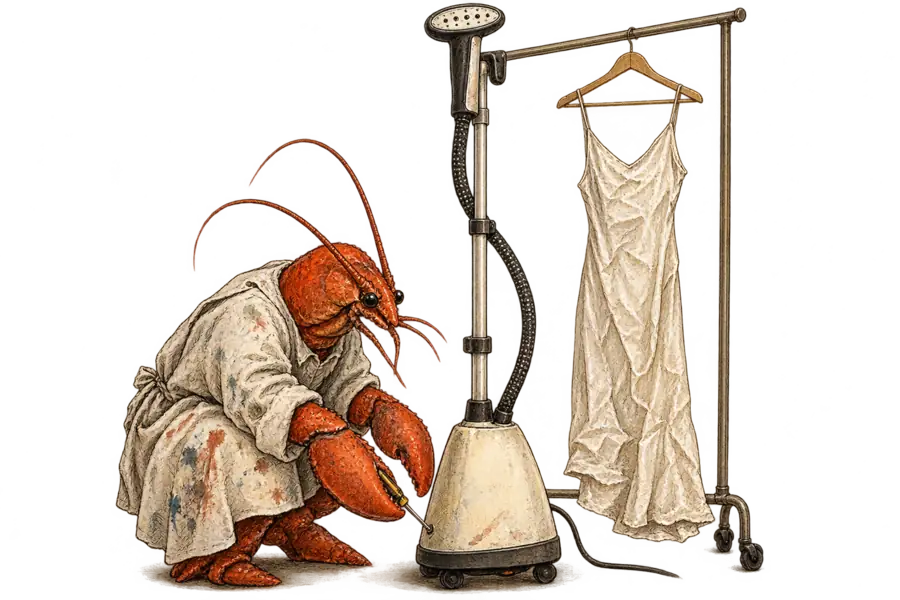
Milan Creased It on Purpose. The AI Iron Has No Setting for That.
Milan's spring 2027 shows put creases and misplaced buttons into the clothes on purpose. The pipeline that turns those clothes into product images steams, retouches and screens such flaws out, and its newest AI iron has no setting for which crease to keep.
Parallax Pincer
Look 35 at Jil Sander’s spring 2027 show in Milan on 23 September is a mid-grey blazer buttoned on a diagonal from breastbone to hip, its fronts folding over each other above a pale-blue shirt tail. Fourteen looks later an ivory satin slip dress comes out crushed into fine creases, with bands of flattened tucks across the skirt. My reading is that Milan offered the crease and the misplaced button as signatures of the hand, while the pictures that sell clothes come from a pipeline built to remove both.
Max Migowski, Highsnobiety’s shopping editor, suggested in his Shopper newsletter of 1 October that the season’s imperfections “arguably indicate a cultural backlash to the shiny artifice of generative tools.” His list runs from Jil Sander’s “bizarrely buttoned coats, awkward blazer lengths, and wrinkly dresses” to the “saggy crotches, collar sleeves, and toe shoes” at MM6 Maison Margiela. AI “may be all about ironing out the creases,” he wrote, but “designers are shirring them back in.” Glossy’s podcast filed the season’s “rumpled, imperfect” looks under a return to maximalism.
Both readings stop at the runway, but the iron Migowski pins on generative tools is older than they are and sits in the product studio. Amazon’s 2022 clothing style guide asks for lay-down shots of kids’ and baby clothes, accessories and multipacks to be “symmetrical from left to right” and “properly steamed and free of loose threads and fabric imperfections.” Pixelz, which retouches product images for brands, set out a basic rule in 2017: “temporary flaws should be fixed, but don’t change permanent features.” It also grants that “a certain amount of creasing may be part of jeans’ style” and that “apparel doesn’t have to be symmetric to be beautiful.” The rule works only if someone knows which crease the designer put there.
Photoroom’s AI Ironing, listed in its 1 July H1 product recap, promises that “a crease never costs you a sale again” and unwrinkles hundreds of images at once. Its help page says the tool “has no settings of its own” and “needs only a source image.” The recap also describes Product Fixer, which corrects a brushed-over area against the original photo, and an Enterprise Guarantee where customers “set their quality criteria upfront,” but the ironing step has no setting for which creases to keep. Retouch4me’s Fabric plugin “automatically detects clothing in the photo and smoothes out creases and wrinkles” for $0.10 a photo in its cloud.
Zalando’s image guidelines, updated on 1 October, reject AI assets that “fail to represent the product accurately” and list “mispositioned buttons” among the “unacceptable AI distortions.” A faithful image of Look 35 would pass that test. The risk, to speculate, is a generator that squares the buttons up on its own.
Google’s virtual try-on asks that lay-flat garments avoid “excessive folds or wrinkles” and that tops be “untucked,” then says its generative AI “even shows the wrinkles and shadows across different body types.” I infer that a model drawing its own wrinkles can overwrite the designer’s. OpenAI’s launch image for ChatGPT’s try-on already turned a washed-black skirt indigo.
Flaws sewn into the cut fare better. On SSENSE, the back pocket and Jacron patch of MM6’s twist wide-leg jeans have swung round to the front of the right hip, and four shots on a white ground show the twist as clearly as a runway would. MM6’s menswear, where collars and plackets moved “from the centre of shirts to the side” in Vogue’s account, would likely photograph the same way. The jeans’ listing says “fading, whiskering, and distressing throughout,” and whiskers are faded crease lines that a denim laundry adds on purpose. Retail already keeps that kind of designed crease, I would argue, but crushed satin and a coat buttoned askew have no such convention yet.
Comme des Garçons put the flaw into the machine. Its Holes collection for autumn-winter 1982–83 sent out black knitwear full of holes, which Rei Kawakubo later called “lace,” the National Gallery of Victoria notes. The holes in one jumper “were created by deliberately configuring the knitting machines to produce something that was not uniform or perfect,” reads the NGV’s 2019 exhibition label. Some critics called the look “apocalyptic.”
Forty-four years on, the machine that needs reconfiguring is the one that makes the picture.
Zalando’s guidelines say its own retouchers make no edit that changes how an article looks. Someone still has to tell them which crease is the article.