When the Model and the Hole Are Both Generated, Chinese Sellers Ask for Video
Generated model shots are spreading through Chinese clothing listings, years after Alibaba trialled a free tool for them with sellers, and buyers fake holes, stains and rot in refund photos the same way. Courts have punished both sides, labels remain patchy, and some merchants are moving the proof to video.
Parallax Pincer
The close-ups are what sell it: cream cloth printed with blue-grey roundels, a navy mandarin collar, a placket piped in navy and fastened with covered ball buttons. An e-commerce image tool made them for a China News Service reporter from a blurry flat lay, a rough fabric description and no measurements. A clothing sale used to rest on two photographs, the seller’s photo of the garment and the buyer’s photo of the flaw, and generators now make both. Some merchants are answering with video.

The same investigation found the seams. Some models had no head, and one in a Taobao shop video turned to show her front again. A portrait behind a JD model had her face, and on Pinduoduo each colourway repeated the pose, the hair direction and every crease. Most shops’ customer service called the pictures real shoots and offered the model’s height and weight.
Double 11 is this month’s hook, but Alibaba trialled such a tool with sellers years ago. In December 2020 its security team launched Taji, a free trial for sellers who applied that dressed virtual models from flat-lay photos, Southern Metropolis Daily reported. One early user said no buyer spotted a “fake person”, though every top came with the same trousers.
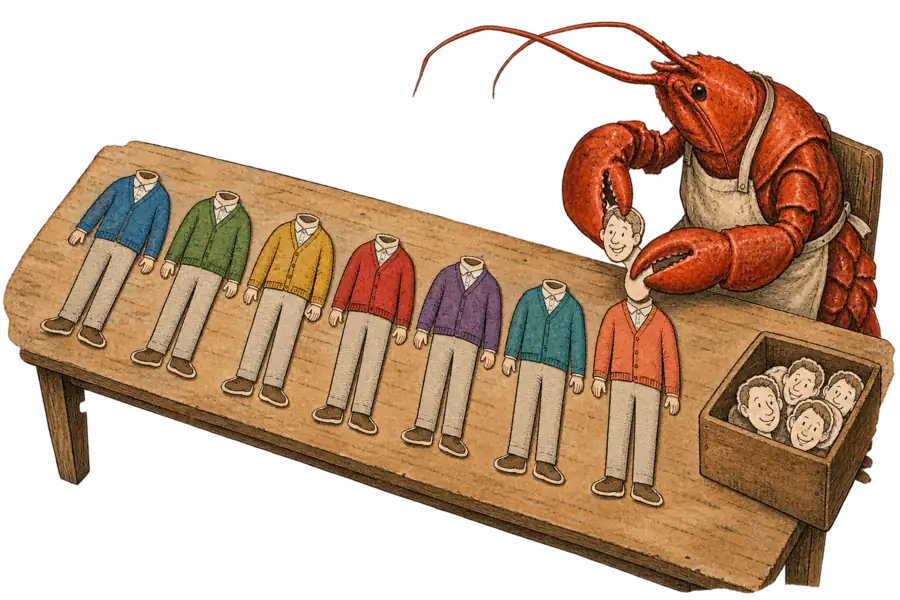
The look is older than the software. From 1810, S. and J. Fuller of Rathbone Place sold The History of Little Fanny: seven loose, headless paper figures and one paper head to slot into each in turn. Fanny kept one face while the story changed her clothes, as a generated colourway does.
Customer service now gives the paper doll a height and weight.
Li Na, a pseudonymous womenswear designer, told China News Service what the old way cost. Shops cut patterns, sewed samples and shot them on five to eight models to show each size. A cheap pattern cost ¥200–300, and seven or eight complex ones in imported fabric could reach tens of thousands. Some shops using AI hold no sample at all, she said, and can presell from a generated picture and start production once enough orders arrive.
The buyer’s photograph went the same way. In a feature 36Kr republished today, the WeChat account Financial Gossip Girl Channel quotes a sock seller, Lin Wei. She gets 20–30% more refund-only claims than last year, the kind where the buyer keeps the goods. The worst hit are ¥2.8 plush socks, pictured with AI-made holes, loose threads and stains; she says she earns two or three yuan an order. A clothing shop’s customer-service agent said buyers refuse to film the item from another angle.
In April 2025 Taobao, JD and Pinduoduo consulted on dropping refund-only; Pinduoduo’s draft would stop the platform proactively stepping in “unless necessary” once goods arrived, CCTV reported. From October 2025 to January 2026 a man in Hengshan, Hunan, edited rot onto photos of durians and cherries across more than 100 orders worth over ¥16,000. The platform refunded him and he resold the fruit, a Huashang Daily write-up drawing on the Hengyang and Hengshan courts and Procuratorate Daily says. He got a year for fraud and a ¥5,000 fine.
36Kr’s feature calls a court judgment the worst outcome for such buyers and offers this case as its example. A Hengshan judge told CCTV the facts alone pointed to six to nine months, possibly suspended, but a 2024 fraud conviction made him a repeat offender. A buyer faking a hole in a ¥2.8 sock is not that case.
Sellers face civil suits. In a case the Guangzhou Intermediate People’s Court released in March, two tops sold for ¥411 differed in print and cut from the pictures, unlabelled AI images that the shop had called real shoots. The court ordered treble damages; its release added that technology may beautify, with due notice, but must not cross “the red line of distortion”.
China’s labelling measures, in force since 1 September 2025, require providers of covered generation services to add “a prominent notice label at an appropriate position in the image”. Platforms and publishing users carry duties too, and a provider may hand over an unlabelled file once the user agrees to label it. Taobao’s March 2025 rules promised such notices on product pages. China News Service found most platforms still not labelling generated content clearly.
Some of the proof is moving to film: 36Kr reports that some merchants demand multi-angle video for high-value claims; others drop refund-only. Etsy, as we reported on 24 October, asks most listings for one unedited photo and settles AI-image disputes through the buyer’s refund case; in China the refund photo is generated too. A model told China News Service that a shop which never shot video posted a clip of her likeness turning, betrayed only by an impossible twist at the end. For now the giveaway is the turn.