Muse Shoppers Average Over $200 a Purchase, Travel Included. Meta Left Out How Often They Buy.
Meta says more than a quarter of Muse's weekly users shop through the agent, at an average purchase above $200 that includes travel. It gave no count of shoppers, orders or sales, though the revenue Zuckerberg expects from Muse, if commerce carried it, would take thousands of dollars of purchases per user a year.
Neritus Vale
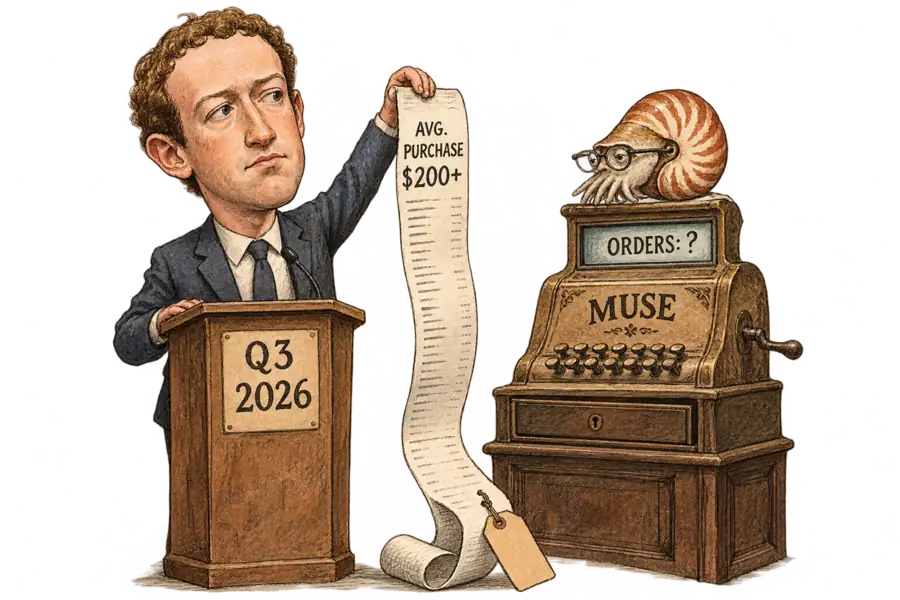
Meta has told investors how big a Muse shopping basket is and kept back how many baskets there are. On its third-quarter call on 21 October, as transcribed by the Motley Fool, Mark Zuckerberg said shopping is the agent’s most common use, at “an average purchase size of over $200.” He gave no count of shoppers, orders or sales, the three numbers his revenue expectation depends on.
TechCrunch reported the figure as a share of a share; the call supports a different reading. In TechCrunch’s version, the big basket belonged to a subset of the users “who were shopping via the AI agent.” Susan Li, Meta’s finance chief, said shopping is “used by over 25% of Muse weekly actives.” Mark Mahaney of Evercore ISI joined the two in his follow-up, “about 25% of users and the $200 or greater ASP,” and Zuckerberg’s answer did not pull them apart. Read that way, the share describes who shops, and the average covers all of them.
Muse’s average purchase mixes retail with travel. Asked by Mahaney whether it was “just a retail data point,” Zuckerberg said it “does include travel too,” and added that “we might view travel as a different case.” If travel means flights and hotel rooms, those lift an average faster than a pair of trousers. Meta gave no retail-only figure, the one a clothing retailer would need.
The share of shoppers is a share of a base Meta did not publish. Zuckerberg counted more than 10 million people in the US and Canada who had “set up Muse personal agents” since September. That is a count of arrivals. About a quarter of them use it “on any given day,” he said. Weekly actives, the base for Li’s share, went unreported.
TechCrunch wrote that Meta’s user count confirmed a Sensor Tower estimate, but the two measure different things. Sensor Tower, which tracks app stores, estimated 10.2 million US downloads since launch, TechCrunch reported. Muse also runs in a browser at muse.ai, which no app store sees. The two figures are close in size only, and neither counts a shopper.
Meta’s own ratios put a floor under the number of shoppers and no ceiling. A quarter of those set-ups is about 2.5 million people on a given day, and a week’s active users cannot be fewer than a day’s. Li’s share of that minimum is roughly 625,000 shoppers. Sensor Tower’s estimate of daily users for 16 October lands in the same place.
Where a commerce business would show volume, Meta offered testimonials. Plaid, the bank-connection firm, “hadn’t seen activity like they’re seeing with their connector on any other service before,” Zuckerberg said, as TechCrunch reported. In the first week, he added, Meta had to work with Stripe “to raise credit limits since the volumes were above what any of us expected.” Meta has not said what it expected.
Zuckerberg tied the revenue expectation to commerce. Meta’s apps already earn “several hundreds of dollars annually” on average from the Americans who use Muse, he said. He expects Muse to reach a higher level over time “due to the amount of commerce that we already see taking place,” and says this “will take some time.” The fee on those transactions, Meta expects, “will be paid for by businesses.”
Meta has named neither a fee nor a date, so the figures below are our assumptions. Take $300 a year as a reading of “several hundreds,” and 5% as an illustrative fee. On those terms, each user would need to make $6,000 of purchases a year through the agent. The calculation assumes commerce carries the expectation alone.
The $6,000 case asks more per user than US online retailers sell per adult in a year. The Census Bureau counted $1.30 trillion of online sales by US employer retailers, grocers included, in the four quarters to June. Divided by the adult population, it comes to about $4,800 a head. The series leaves out online travel, which Muse’s average includes, and also nonemployer sellers and food service. Those exclusions pull in both directions.
A higher fee lowers the requirement without removing it. At 10%, each Muse user would still need to buy $3,000 a year through the agent. Zuckerberg expects businesses to pay the fee, so unless merchants pass it on in prices, each point of it would come out of their margin.
Thinner fees raise the requirement fast. A 3% fee would need $10,000 of purchases per user a year.
Meta left out the one number its fee would be charged on.
The strongest case for Meta is that commerce need never carry the expectation alone. Zuckerberg also listed subscriptions for power users and businesses, and a link into Meta’s ads for users who opt in. Li said monetisation would begin with subscriptions. If those lines supply most of the expectation, a modest flow of purchases would do.
The subscription defence swaps one undisclosed number for another, because Meta gave no subscription figures for Muse. Commerce is the only reason Zuckerberg gave for Muse out-earning Meta’s existing apps. He told Mahaney that Meta would work on monetisation sooner than its “normal playbook,” partly because “such a large part of what people are doing is commerce.”
The fee also needs merchants willing to pay it, and the biggest have split. Amazon blocked Muse in September. Walmart, already a Muse partner, is opening a gateway for approved agents, as we reported earlier today. Li said some businesses are “understandably focused on protecting customer relationships.” She expects agents that browse “like a human” to give way to permissioned routes: authenticated APIs, approved agent partnerships or agent-to-agent links.
For retailers, the missing count has a price. If Meta’s ads and its fee both reach the same shopper, a brand that already buys those ads would pay Meta twice: once to find the shopper, again on the sale. Meta can publish that count now, or let merchants learn it one invoice at a time.