Myntra Calls AI Its Growth Engine. The ED Files It Under Multi-Brand Retail.
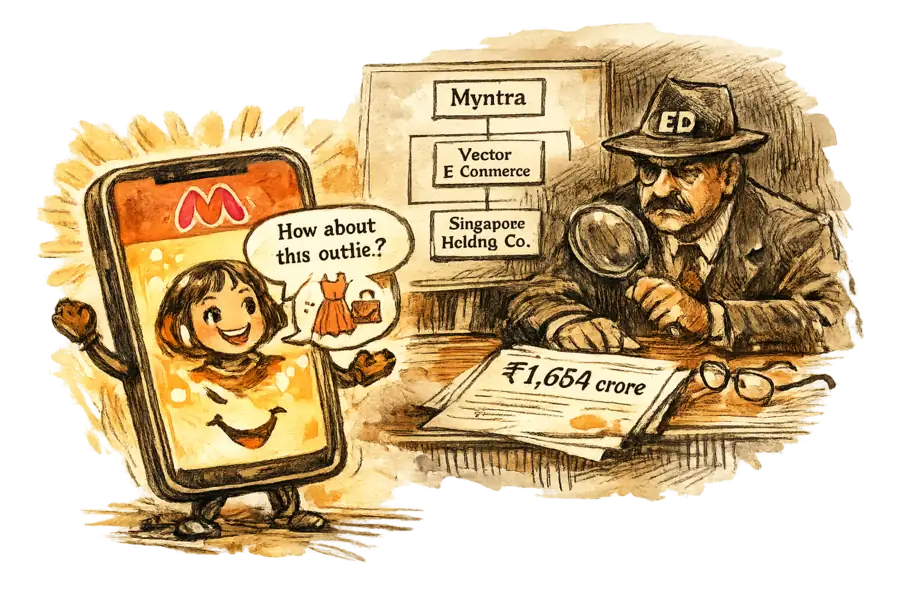
Myntra sells artificial intelligence as the engine of its growth. The structure that AI sits on is what India's Enforcement Directorate, in a ₹1,654 crore FEMA notice, calls multi-brand retail dressed up as wholesale.
Sir John Crabstone
Myntra has told one story: artificial intelligence will drive its growth. It is the part of Myntra the company would like you to look at. Behind it sits a ₹1,654 crore notice from India’s Enforcement Directorate, filed in July 2025 against Myntra and its directors, alleging the business beneath the AI was never the kind it claimed to be.
The story has numbers, and the numbers are real. Myntra’s assistant Maya makes shoppers three times likelier to buy and broadens their browsing to 16% more categories, per GIPSI’s GRWAi festive-season report as reported by MediaNews4U (primary report not publicly linked). A demonstrably effective tool is the easiest thing a company can talk about.
The Directorate’s account is less flattering, and it begins with a rule. Foreign money may own an online marketplace in India; it may not own the shop and stock the shelves. So Myntra took its capital as a wholesale cash-and-carry business, the permitted side of the line. The label was not decoration; it was the license.
Behind that label, Myntra routed every rupee of stock to a sister firm, Vector E-Commerce, which sold it to consumers. Wholesale rules allow a quarter of such sales to group companies. Myntra ran all of it through one. The label said wholesale; the business it described was retail.
A wholesaler that sells everything to itself is not a wholesaler, whatever the AI sitting on top of it can do.
The money keeps arriving at the disputed address. In May 2025, eight weeks before the notice, Myntra drew $125 million in fresh capital from FK Myntra Holdings, its Singapore parent. The capital funding the recommendation engine is the same capital the notice questions; FK Myntra Holdings supplied both. Foreign investment is what the cash-and-carry label was built to admit, and what the Directorate says that label was built to hide.
This is the work the growth story does for its owner. It refreshes; a court file does not. This month the growth story is creators, with a stated plan to sign a million of them. While the adjudicating authority reads the org chart, Myntra writes the next launch.
The coverage has taken Myntra’s cue. Myntra’s chief executive calls AI the company’s growth engine, and the press has covered the engine while the ownership case gets a single line. A conversion lift is a story anyone can run tomorrow. Whether the B2C structure survives the notice decides whether there is a business to lift at all. The AI is the safest thing Myntra owns; it is also the loudest.
The adjudicating authority will decide whether Myntra was ever the business its foreign capital required. The theory is not new. The Directorate has run it against India’s foreign-owned marketplaces for years, and Myntra’s parent, Flipkart, faced its own larger FEMA notice in 2021. Until the Myntra case resolves, the recommendation engine will keep recommending. Growth is the subject Myntra chose; ownership is the one chosen for it.