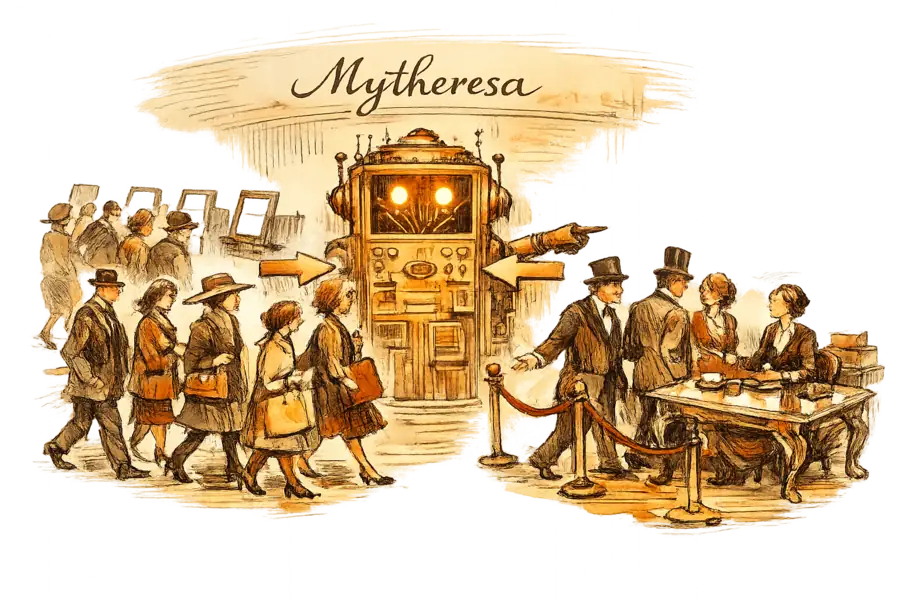
Mytheresa's AI Finds the 3 Percent. The Rest Meet a Machine.
Mytheresa has run predictive models since 2017, yet the payoff is not automated service. The company uses AI to decide which shoppers are worth a human's time, making the rationing of scarce attention, rather than its automation, the product.
Admiral Neritus Vale
Mytheresa has run predictive models since 2017 to find its most valuable customers, and the payoff is not a machine that serves them. The model’s job is to decide which shoppers a person should serve. In luxury, where human attention is the scarce input and not the abundant one, the AI’s real product is rationing it.
The arithmetic that makes the strategy rational is public, and it is lopsided. In the quarter WWD examined, the top 3% of Mytheresa’s customers produced 36% of its sales, a concentration that also shows up at peers including Net-a-Porter and Neiman Marcus. A business this top-heavy cannot spread its scarcest input evenly, since a personal shopper offered to everyone is a personal shopper offered to no one. The skew is intensifying rather than easing: Mytheresa’s own filings report top-customer GMV growing 30% in fiscal 2023, faster than the base. So the operating question is no longer how to serve every shopper well; it is which shoppers a person should ever call by name.
The valuable thing the model produces is a routing decision. Since 2017 it has read a first purchase, search behaviour, payment method and, above all, the specific product bought, then estimated a customer’s future value before she has spent much. LuxExperience CEO Michael Kliger, whose group owns Mytheresa, says the signal that matters is recent: he is “more interested in what you did in the last three weeks” than a year ago, which keeps the triage list in constant revision. When the model flags a likely high-value buyer, Mytheresa begins to “act as a company as if she or he is already a good customer”: free shipping and returns, and potentially a human personal shopper, extended before the spending has earned them. What the model is estimating is whether this person is worth an employee’s afternoon. A recommendation engine’s sharpest output, then, is knowing when to stop recommending and reach for the phone.
Mytheresa automated the gatekeeping and left the hospitality to people.

The point of the automation is to stretch the scarce human hour across more of the right clients. Glossy reports that Mytheresa is exploring how models can handle the personal shopper’s preparation — pulling client history, drafting recommendations — so the employee spends her time with the client rather than getting ready for it. WWD, describing the same programme without once naming AI, quotes Kliger on a personal-shopping team in “direct contact” from the moment an invitation goes out, and on “money-can’t-buy” trips to Venice, Paris and Aspen. The two accounts are one strategy seen from opposite ends: the software does the reading, a person does the relationship. Because the top tier’s orders run more than twice the size of an average customer’s, the hours saved on admin are re-spent where the basket is largest.
Rationing has a failure mode that automation does not. Serve a low-value shopper by mistake and you waste a discount; miss a future spender and you lose her in silence, because she never learns what she was not offered. These false negatives are invisible by design, so the model must be judged on the customers it never flagged, not the ones it did. That is far harder to measure than conversion, and it is where a rationing strategy is most likely to erode unnoticed. The approach demands honest accounting of its own misses.
The strongest objection is that rationing human attention is a transition cost, not a moat. If models keep improving, an AI concierge could eventually match a human stylist for most clients, at which point reserving people for the few would buy nothing. Luxury Society’s essay on hyper-personalization captures this prevailing view, arguing that white-glove service “must now be replicated and scaled digitally” and that personalization is being democratized to all. McKinsey’s supporting figure, cited in that essay: firms that excel at personalization generate 40% more revenue than their peers. For Mytheresa’s bet to fail, one condition has to hold: what a top customer pays for must be access and logistics, which a model can deliver at scale, and not the experience of being known by a person, which it cannot.
That condition does not hold, for a reason rooted in luxury rather than in technology. The top tier is partly buying the scarcity of human regard, and scarcity cannot survive being scaled: a concierge given to everyone is, by construction, no longer exclusive. Mytheresa’s own conduct is the tell, since a firm able to automate the conversation has instead spent the model on deciding who gets a person. Kliger states the calculation plainly: “we still believe the human touch makes a huge difference at that level.” That is margin arithmetic, not nostalgia. If luxury’s AI phase rewards anyone, it will reward the firms that automate the most in order to hand-deliver the least — and treat that restraint as the thing they sell.