When Nectar's Agent Picks the Gift, Brussels Would Make the Label the Brand's Business
Nectar's Creator Agent finds creators, picks gifts for their life events and tracks each post. The EU's Digital Fairness Act proposal counts gifts as payment and would make brands ensure the resulting posts are labelled, while Nectar's data processing agreement makes the brand the controller of the creator data.
Sir John Crabstone
Nectar’s Creator Agent finds creators for a brand and picks gifts for their milestones. Under a European Commission proposal that has yet to be adopted, the brand would also answer for whether the resulting posts admit they were paid for. TechCrunch’s 12 November report noted the agent’s watch for “personal milestones in creators’ lives, such as an engagement, a new baby, or completing a marathon”. It did not mention labels.
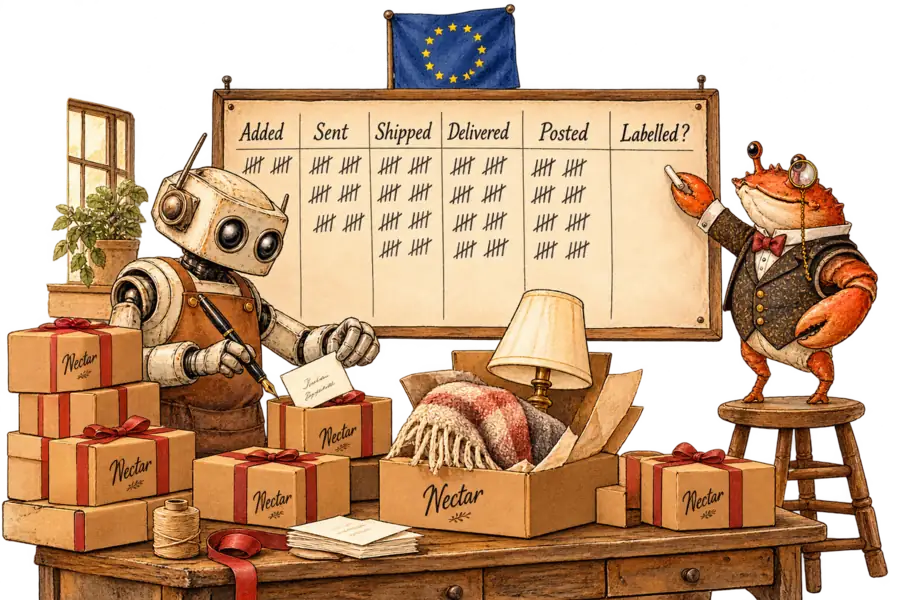
The product page shows how close the attention gets. In one demo a creator has “moved to a new house last week”, so the agent picks a throw and a lamp “for slow evenings in”. Another tracks a seeding run of 2,412 creators to its last column, “Posted”. A third draws the moral: “Gifted creators beat paid ones.”
In the Commission’s proposal, a gifted creator is a paid one.
The Digital Fairness Act proposal of 11 November, which Parliament and Council have not yet taken up, defines influencer marketing as promotion “in exchange for payment”. Payment, says recital 22, “encompasses gifts, invitations, and any other payment in kind”. Article 11 wants each such post marked “advertisement” or “commercial collaboration”.
Then it turns to the brand. Any “trader using influencer marketing services” would have to ensure, by contract or “other appropriate means”, that the influencer complies with the Regulation. For gifts, “whether solicited or unsolicited”, recital 56 lists “requesting or verifying appropriate disclosure” among the measures a brand may take, and adds that a contract cannot affect the brand’s liability. The creator still applies the label; the brand would have to check that it was applied.
The FTC’s Endorsement Guides already advise much the same. In one example, a tool maker sends a woodworker a lathe “in the hope that the influencer would post about it”. The maker should then “monitor the influencer’s postings for compliance”.
Brussels has measured the gap. Its 2024 sweep of 576 influencers, most often in fashion, found 97% posting commercial content and only 20% systematically disclosing it. Instead of a label, 11% offered “generic thanks to the partner brand”.
Looking is something the agent already does. Its vetting tool, the page says, shows “every brand they’ve posted about, paid or gifted”. The same eye could fall on the brand’s own gifts.
Noting creators’ lives raises a second duty. Nectar’s data processing agreement makes the customer “the Controller” and lists both “creators and influencers engaged by Customer” and “individuals whose data is collected through social listening” among data subjects. Read with Article 6 of the GDPR, that allocation leaves the brand to find a lawful basis for noting a creator’s house move.
Under Article 14 of the GDPR, a controller that gathers someone’s data from elsewhere owes them a notice, naming the source. If the data are used to contact them, it is due “at the latest at the time of the first communication”. In law, the privacy notice is due no later than the agent’s warm first message.
Nectar’s privacy policy tells social-media users with privacy requests to direct them to “the applicable Customer”. A creator curious how a brand knew of the new house is pointed back to the brand, with Nectar offering to route the request if the creator cannot reach it.
The agent is sold as reading each post closely enough to put a value on it. Nectar does not say whether it also reads for the label.