The New Society Sells in 600 Shops and Owns Not One
The childrenswear label The New Society built a wholesale business spanning 600 points of sale before opening anything of its own. That reverses direct-to-consumer orthodoxy, and it is the model Allbirds and its peers are now retreating into as the economics of selling direct give way.
Sir John Crabstone
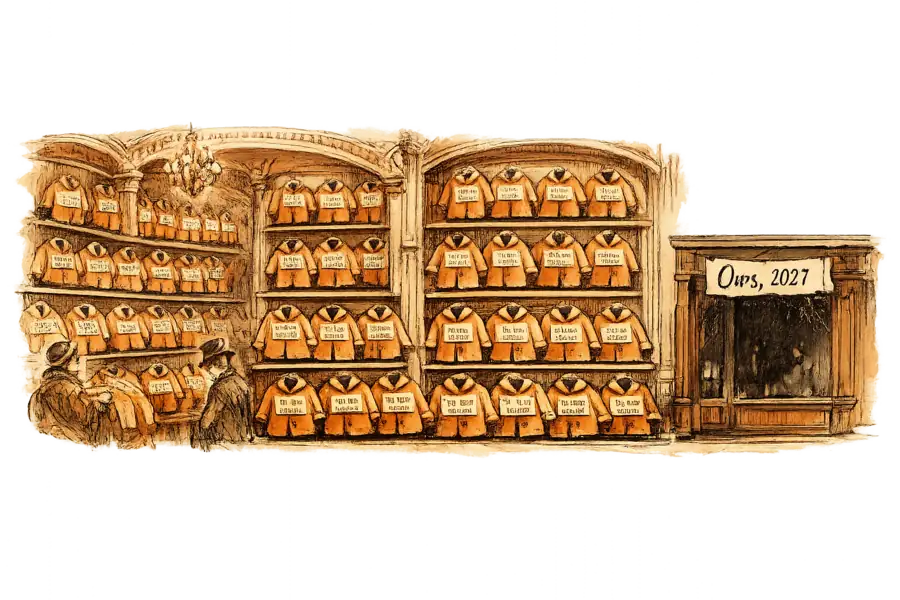
The New Society reaches 600 points of sale and owns none of them. The childrenswear label built its wholesale business first, placed by agents and distributors onto the shelves of Le Bon Marché and MyTheresa. Only now does it open anything of its own: a concession at El Corte Inglés this September, a first shop in 2027. The order is the argument.
Consider the operation behind those 600 doors. Roughly 20 people run the whole company. Two dozen agents place the collections across Europe, and distributors carry them into Asia and Canada. The line grew into womenswear and a fast-growing teen range on the same wholesale base. None of that required a marketing department larger than the company.
For more than a decade the doctrine ran the other way. A brand sold direct first and treated wholesale as the retreat it would make later, from weakness, if growth stalled. Direct-to-consumer was sold as the end of the middleman. It removed one and hired another: the ad auction, which reprices every quarter and answers to no one. The bill was paid with venture money, on the theory that a customer, once bought, stays bought.
The prize was owning the customer: her data, and a relationship no retailer could intercept. The cost of acquiring her outran what she returned. Allbirds, which sold almost everything through its own site and shops, reported aided brand awareness of 11 percent in the U.S. as of early 2022 and moved into wholesale to reach customers more cheaply. The roster of brands able to scale while staying direct keeps thinning, and the thinning is a verdict.
Call it foresight if you wish. The founder, Estefanía Grandío, came up through Oysho and Hugo Boss, where wholesale and the department-store concession are not a strategy but a habit. In childrenswear especially, where parents shop across labels for children who outgrow a size by spring, the multi-brand shelf never fell from favour. That is not prescience — it is the reward for never having been fashionable.
Wholesale is the channel that pays you; the direct one is the channel you pay, and keep paying.
This comes at a price. Wholesale hands the margin and the end customer to the buyer, and reduces a brand to a line of numbers on a department-store order. A cancelled order takes a season with it, and the discount rack is someone else’s decision. That is the ceiling The New Society is now testing: a concession of its own, and the thin slice of direct trade that wholesale cannot provide. She did not avoid the direct model; she earned her way to it.
The New Society built its distribution and is adding its own shops; Allbirds built its shops and is adding distribution. They pass in the doorway going opposite ways, and the door takes no side.