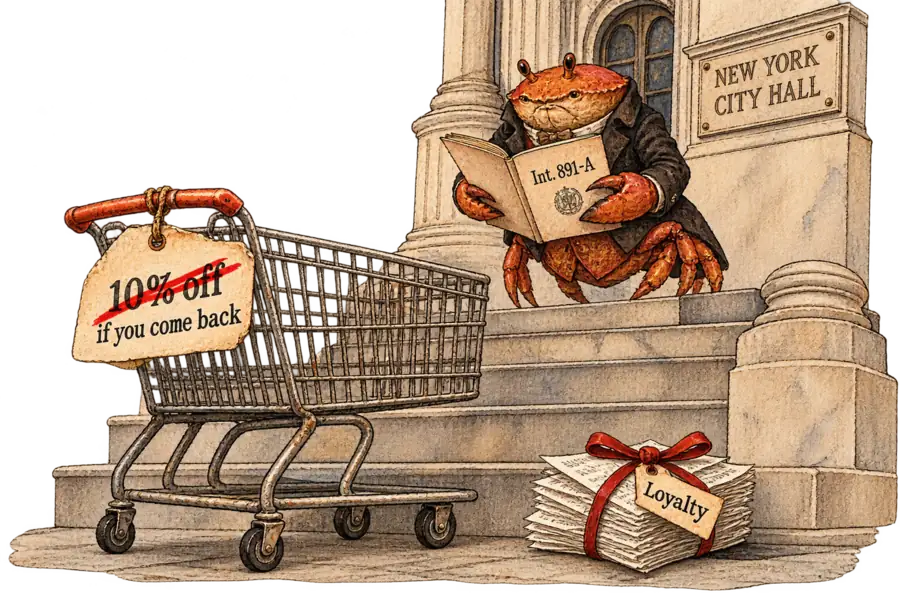
New York's Council Concedes Its Pricing Bill May End the Abandoned-Cart Discount
New York City's Int. 891-A, passed 44 to 5 and awaiting the mayor, would let personalised discounts rest on purchases or on what shoppers tell a shop about themselves, not on what they are seen to want. The Council's own committee report acknowledges that abandoned-cart discounts may no longer be permitted.
Sir John Crabstone
On 12 November New York’s City Council voted 44 to 5 for Int. 891-A. The bill bans pricing set “completely or in part by an algorithm that uses personal data to offer different prices to different customers for the same goods or services”. Its exemptions let a discount rest on what a shopper has bought, or on what they have told the shop about themselves.
The bill awaits Mayor Zohran Mamdani and would take effect a year after it becomes law. A price personalised to what a shopper was merely seen to want fits none of the exemptions. Nothing in the bill stops a retailer marketing a bona fide discount to re-engage a customer, unless that customer has opted out.
The Council’s release says the bill “allows for bona fide discounts and rewards that are legitimate and transparent”, loyalty programmes among them. Fines are capped at $1,000 for each violation, and the bill counts a separate violation for each consumer or transaction. If each recipient counted, one non-compliant code emailed to ten thousand New Yorkers would carry a ceiling of $10m.
Small sellers get a softer start: a covered business, with fewer than 15 locations, mostly in the city, receives notice and 30 days to cure a first violation.
Retail Dive’s Weekly Closeout headlined “NYC bans surveillance pricing” and credited the Council’s line to “New York’s law”. That line comes from a press release describing a bill. The Closeout’s link for the National Retail Federation’s opposition leads to a 2 July 2025 release announcing a suit against the state’s disclosure act, not the City bill.
The bill’s terms are narrower than “transparent” suggests. A loyalty discount must be disclosed to all members and offered “uniformly” to anyone who meets its conditions. Tiers may use purchase history only if it is “not paired, combined, or cross-referenced with any other personal data” beyond enrolment.
A receipt may set the discount, provided nothing else does. The committee report adds that “uniformly” does not mean every individual receives the exact same discount at the exact same time, and gives birthday discounts as an example. It also lists life-milestone and subscription-cancellation discounts among those still permitted.
Personal data means anything that “could reasonably be linked” with “a specific consumer or device”. Location is exempt only when a shopper “affirmatively and knowingly” shares it, and then only for trip duration and mileage costs in delivery logistics or for local market conditions. On a plain reading, a price that varies with the make of a shopper’s phone fits none of the exemptions.
The vendor behind Very’s discount engine, which we examined in October, promises incentives “only when a shopper is hesitating”. Very sells in Britain, but New York’s list of permitted data has no entry for hesitation.
Businesses asked the Council to ban only price increases and keep every discount. The Council declined; its report warns that a retailer could then “only offer discounts to those with a lower willingness to pay”.
Target drew that line in October, saying Circle uses shopping history “not to raise your price”; the FTC’s follow-up question, as we reported, was whether prices vary. New York asks the same.
The same report says the State Legislature passed the One Fair Price Act (S.8623B/A.9349B) in June, and it awaits the Governor’s signature. Section f of the bill enforces the City law only where it is consistent with state and federal law.
On one discount, the report says more than the release. It acknowledges that “discounts offered for items abandoned in a consumer’s cart” may no longer be permitted, and defends the result: “consumers cannot rely on discounts they do not know are available to them.” An abandoned-cart code rewards the shopper who left and charges full price to the one who stayed.
In June the Retail Council of New York State named three of the discounts the original bill would prohibit. The amendments restored the purchase-history discount, and the report addresses the cart. It does not say what becomes of the third, “a wish list or registry”; the shopper volunteers that data, and the bill is silent on it.
A wish list is an abandoned cart that has signed its name.