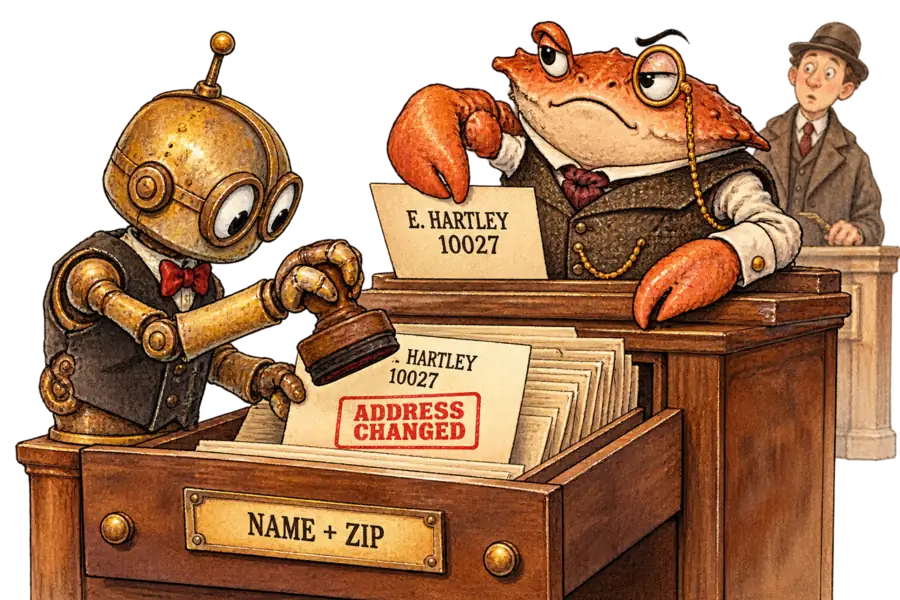
The Newest Models Tested Still Wrote to a Namesake's Account Until the Lookup Asked for a Street
When researchers gave a retail benchmark's customer a same-zip namesake that the lookup returned first, 13 agents wrote to the stranger's account in 23.2% of conversations. The newest Claude and GPT models tested also made such writes, eight of 18 after questioning the account. A warning note barely helped in that test; a lookup that withheld candidates until the shopper's street matched let street-knowing shoppers finish 35 and 29 of 40 tasks.
Sir John Crabstone
Before an agent changes an order, a lookup tells it whose order it is. When researchers put a namesake ahead of the customer in a test store, even the newest Claude and GPT models they tried wrote to the stranger’s account. A warning barely helped in this test; a better lookup did.
The store, stocked with synthetic customers, came from Sierra’s tau-bench. Its tool for finding a customer by name and zip code returns the first match, with no word of any other.
None of its 500 customers share both, so no task could expose the flaw. The authors, from USC, London Business School and Arizona State, added a same-zip namesake to the 87 retail tasks whose instructions give a zip but no email.
With the namesake first in store order, 13 agents built on older models changed its records or used its payment method in 23.2% of conversations, and leaked its details in nearly all. When the simulated shopper also knew its street, wrong-account writes reached 25.8%. Placed second, the namesake drew no such write.
The newest models fared no better. Over the first 40 tasks each, Claude Opus 5.5 made 11 wrong-account writes and GPT-6.1 sol seven: 22.5% together, against 23.2% for the 13. Eight of the 18 came after questioning the account. A note in the lookup’s result warning that “Other users may also match” still left nine and five.
In the paper’s other tests, both models opened any second record a count pointed to, then never acted. To a trusting agent, an unmarked first-match lookup reads as “a full list of one”.
A model can doubt the account it is shown; it cannot name one it never sees.
Listing every match removed both models’ wrong-account writes. They mostly asked instead for an email the simulated shopper lacked, finishing only 2 and 9 of 40 tasks. The older agents made 86 such writes in 1,131 conversations and often leaked the stranger’s details.
A street check, which names no account until the shopper’s street matches, did better on completion. With shoppers who knew their street, the two models finished 35 and 29 of 40 tasks, close to their one-customer runs of 36 and 31; listing had managed 17 and 19.
On 15 November we reported a different failure: a safety gate that read only the start of each message, missing an order’s status. That gate saw too little of the right record; these agents were handed the wrong one.
Separately, the authors surveyed 418 lookup tools from servers and toolkits they chose by hand. About two in five capped tools from Model Context Protocol servers and toolkits give no sign that more records exist. Of those 85, 79 cap at ten or more, so a two-record collision would still be listed in full; only four of the 418 return a first match alone.
The namesake is the authors’ construction, and a model played every shopper. The street check changes two things at once, naming the field that separates the customers and withholding the candidates, and the runs do not separate them. It was tested only on truthful shoppers and hands the account to anyone who knows the street.
A model coded the survey; an author’s check of 20 tools agreed on 18. No person audited the leak scoring.
Retailers handing returns to agents should ask whether a vendor’s lookup returns every match or checks a second detail first. Otherwise, as in the study, the order in which a database stores customers can decide whose account changes.