Newoff's AI Buyer Names a Price Before Inspection Checks for Pilling
Newoff's NOA gives sellers an expected purchase price from photos of a garment and its tags, but whether Newoff buys, and for how much, is decided only after collection and inspection. Its own pages make noticeable pilling, stains and stretching grounds for refusal, with refused items returned free, and its launch materials give no figure on how often the final offer falls below the estimate.
Sir John Crabstone
Newoff’s NOA gives sellers a number before the company has touched their clothes. In its launch announcement, carried by Platum, the Korean reseller describes an AI buyer (AI 바이어) that reads photos of a garment and its label and returns the price Newoff expects to pay. Whether Newoff buys, and for how much, is still decided at inspection, where wear shows.
Newoff collects unwanted clothes from the door free of charge, pays cash for what it keeps and resells it in its own app. In Newoff’s account, carried by Seoul Shinmun on 17 November, NOA’s pricing draws on millions of used-fashion price records and the company’s own trading, and storage condition is among the things it weighs. The tool served Newoff’s own buying before customers got it.
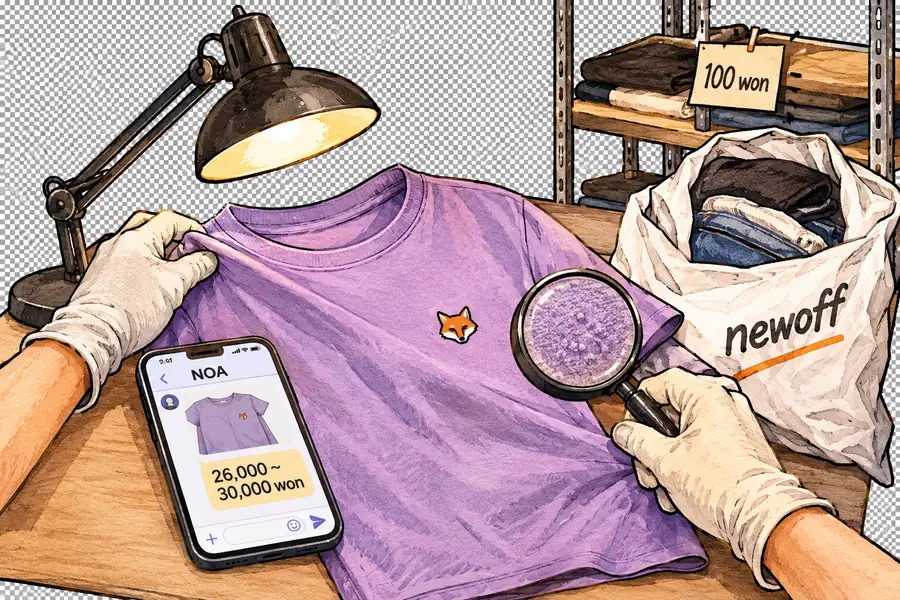
Newoff’s launch image, a promotional mock-up, shows the exchange. Four photos of a lilac Maison Kitsuné T-shirt and its tags go in. Back comes a card giving the style number, year, fabric and size, with a range of ₩26,000 to ₩30,000. Beneath it, the app asks, “Do you like this estimate?” (이 예상 매입가, 마음에 드세요?). The card has no line for condition.

Newoff’s pricing page names condition among six factors that set its price automatically, with brand popularity, design, year, size fit and season. The card does not show whether NOA weighs it. Labels identify a model and a size; they cannot vouch for wear.
The card prices the model; only inspection prices the shirt.
Wear can do worse than trim an offer. Newoff’s eligibility page lists noticeable pilling, stains, fading and stretched necks or sleeves among reasons to refuse an item. Smells of mould, mothballs or tobacco disqualify too, and no photograph carries a smell. A refused item is sent back free or, at the seller’s choice, kept by Newoff for ₩100 an item.
Nor is a seller bound by a disappointing offer. For an item Newoff will buy, the pricing page promises a free return if the price does not please. A generous estimate may therefore cost Newoff a courier’s round trip.
The estimate binds Newoff to nothing, yet it still fixes a number in the seller’s head. Any offer below it may read as a cut, however fair the inspection.
Yoon Hyojun (윤효준), Newoff’s chief executive, said in the launch announcement that direct buying turns on judging each item’s value quickly and accurately (빠르고 정확하게). The photo estimate goes after the first adverb. The second still waits for the courier.
Two other Korean apps handle wear differently. Recl, a used-clothes collector and resale shop, buys by the kilogram and pays a surcharge for garments in good condition; its listing says nothing about deductions. Charan, run by Mine.is, lists no outright purchase. Its sellers consign, for a commission that varies with the price, or sell directly with no commission; either way, they learn a shirt’s worth from whoever buys it.
Platum’s headline promised that photographing unworn clothes brings out the purchase price (안 입는 옷 사진 찍으면 매입가가 나온다). Lower down, the story itself hands that price back to the inspection.
The test of NOA is how often the final offer lands below its range. Newoff’s launch materials give no such figure, and no refusal rate. Every bag opened at inspection adds a line to both.