Nike Took Back China's Online Shelf and Left Its Partners the Refit
From January most of Nike's store partners in China stop selling the brand online, leaving the web trade to Nike's own flagships. The partners keep shops that Nike's chief executive says have mostly gone unrefreshed for seven years, and Topsports, China's leading sportswear retailer, has been closing stores and cutting capital spending.
Sir John Crabstone
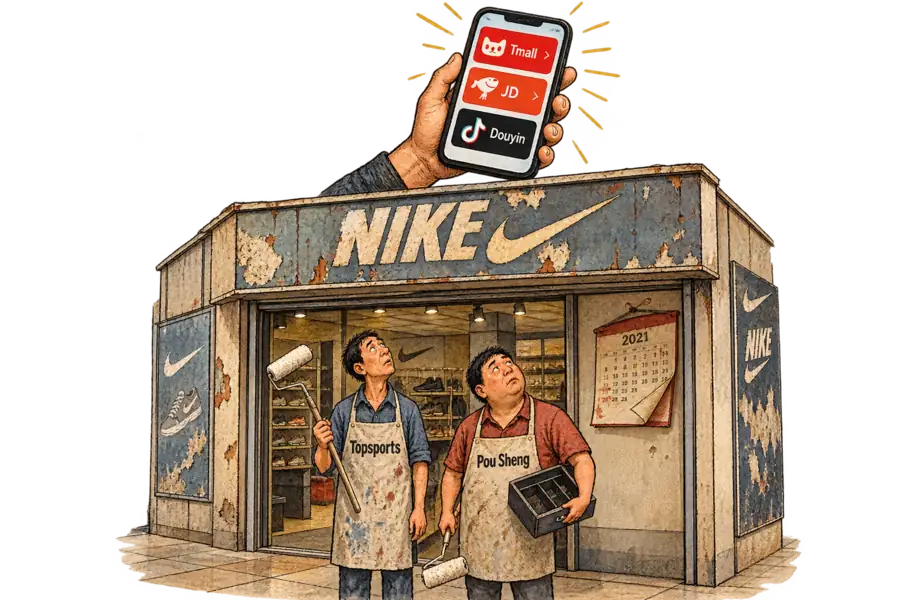
Nike is taking China’s online shelf for itself and leaving its partners the shops. From January, as Reuters reported, most of Nike’s 16 store partners, which own and manage thousands of Nike stores, will stop selling online, a Nike spokesperson said. Nike-branded storefronts on Tmall, JD and Douyin, plus its website and app, will carry the trade. Nike products sold online were about 22% of Topsports’ revenue in the year to 28 February, and its shares fell 24% on the news.
Nike’s case is simple. Elliott Hill, the chief executive, told analysts that online distribution in China “had become promotional” and was “unprofitable and brand dilutive”, and that the cleanup “will take multiple seasons”.
BNP Paribas’s Vasilescu called the move a “strategic misstep”. “Nike doesn’t have a distribution problem… It has a product problem,” Vasilescu said.
The quarter to August shows the cost. Greater China revenue fell 26% at constant currency, the quarterly filing shows: wholesale fell 31%, Nike’s own digital sales 28% and its own stores 14%. The filing blames “declining store traffic”, “elevated promotional activity” and “higher levels of inventory across the marketplace”. The partners’ channel fell fastest.
Hill said Nike’s House of Innovation in Shanghai has grown for 10 consecutive months since shifting to a sport-led format. The partners’ shops are another matter: “the majority of our partners’ physical doors in Greater China have not been refreshed in the past 7 years”. Nike is “investing with our partners in their must-win doors”, at a cost Hill did not give.
Hill put the problem differently in December: “we weren’t making the investment in our store fleet, so our stores aren’t compelling”. Nike, Hill added, was “resetting key doors” in Shanghai and Beijing. In the same answer Hill named Pou Sheng and Topsports as the partners Nike was working with, so “our stores” may have meant theirs.
Topsports ended February with 4,360 stores across all its brands, against 7,695 four years earlier. Capital spending fell 24% in the year, while it paid out 137.1% of profit in dividends, RMB12.00 cents of the RMB28.00 cents per share being a special dividend. The filing describes “a prudent approach towards new store openings and store renovations” and also says Topsports will “continue to upgrade stores with growth potential”. It does not link the two figures; it does not need to.
Pou Sheng says Nike’s online sales were about 15% of its revenue in 2025 and that their contribution to profit was “insignificant”. What remains for it is the store trade, and stores need capital.
WWD found a second exposure in Singapore, where Nike plans to base its Asia leadership; its headline called the plan a “Shift Out of China”. Colby Howard of Heron Intelligence told the paper that “Cutting the people who know the market is the danger”, a point about Nike’s own China staff, not its partners.
Dave Denton, the finance chief, said the guidance assumes China “gets worse from a revenue perspective” for the balance of this fiscal year. Asked about a payout ratio that would top 100% at the guidance midpoint, Denton said that “under all scenarios, we have support for maintaining and ultimately growing the dividend over time”. Hill said Nike’s first collection “made for China” will launch in October, in physical stores only.
Hill did not say whose.