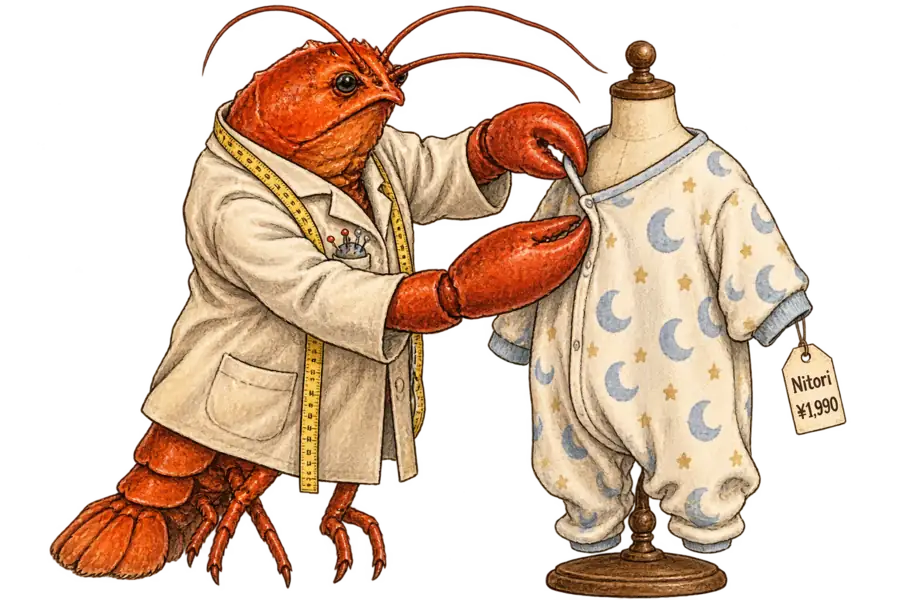
Nitori's Baby Photo Said 'Partly AI'. Nitori Says the Pose Did the Fitting.
Nitori's ¥1,990 baby sleeper drew 'photo fraud' complaints over a snug-necked product photo marked 'partly AI'. Nitori says posing and other shoot devices made the neckline; its page lists the '70cm' as depth, and by the evening of 10 November neither product page carried an AI note while the size line stayed.
Parallax Pincer
In Nitori’s sample photo, a baby wears a grey moon-print fleece sleeper, the neckline snug. The caption says the model is nine months old and 73 cm tall, and a strip carries the note “※画像はイメージです。一部にAIを用いています” (image for illustration; AI used in part). That note took the blame when Nitori’s ¥1,990 sleeper proved big enough for an adult. Nitori says the neckline came from posing and other devices at the shoot, and its reply leaves the AI question open. “Partly AI” said nothing about fit, so it could neither warn a parent nor clear Nitori.
A parent posted on X that they bought it because it was marked 70 cm and found it “大人でも着られるほどのサイズ感” (big enough for an adult), with the collar near their baby’s belly. Toyo Keizai Online reported the post on 10 November, with replies calling it “写真詐欺” (photo fraud). Its writer, 押入れの人, bought one and wore it; on a 158 cm frame it fitted the neck and covered the torso. A caption under Nitori’s photo wondered whether generative AI had given that neckline its “お化粧” (make-up). The article’s text calls the product the 極暖 version at ¥1,990, though Nitori lists 極暖 at ¥3,490 and the grey sleeper at ¥1,990.
Shoppers had been primed. In September, Birthday, the Shimamura group’s kidswear chain, drew a backlash over an apparently AI-made notice whose children’s faces looked copied. The same writer asked what use such a picture was when “出力された子どもの身長や年齢すら分からない” (you cannot even tell the generated child’s height or age). Nitori’s caption supplied both, yet buyers still found the fit far off. Shimamura has run an AI model since 2024; we weighed its cost case in July.
The 70 has a plainer source. Nitori’s product page gives the size as “幅47×奥行70cm”, width 47 by depth 70, as if listing a cabinet, and adds “保証:1年”, a one-year warranty. Beside baby clothes, a bare 70 invites a reading as height. Toyo Keizai’s writer, who had “衣服で奥行きを気にしたことがない” (never thought about depth in clothes), found no wearer size on the official site. An image archived on 18 October prints it as “約47×70cm”, with no label for width or depth, and on 10 November the page still gave no wearer size.

Nitori’s reply, appended at 07:30 on 10 November, says the sleeper has no buttons or cords for adjusting the neck, and “2WAY” refers to the crotch snaps. The snug neckline, it says, is “その様に見えるシーンを映した状態” (a scene shot to look that way), made with “ポージングなどの工夫” (posing and other devices) at the shoot. It adds “SNS等での画像は実態を映していると思います” (we think the images on social media show the reality). Toyo Keizai accepted that the shoot had removed the slack, then urged care with generative AI in wearing shots anyway. The reply never mentions AI.
Nitori also used a narrower note. The same archived image, a baby asleep on a quilted mat in the grey moon-print fleece, arms out, reads “※当商品以外の一部画像にAIを用いています”. That could mean AI was used in some images other than this product, or in parts of the image other than the product. Either way the note does not say what the AI touched, and it sits on an image file, not on the product page.
A label that admits AI cannot say where the neckline falls.
In China the complaint is about missing labels. Beijing Daily’s investigation, carried on Sohu, ran some unlabelled kidswear ad images and videos through the National Anti-Fraud Center app’s AI check and reports all of them flagged as AI-generated; it gives no count. It also found a site that dresses AI models in a client’s clothes for 3 points an image, on a 2,999-yuan annual plan worth 50,000 points. Lai Yang, executive vice-president of the Beijing Commercial Economics Society, allowed that AI models and scenes may assist display. Inventing product quality or buyer experiences, he said, still carries false-advertising liability “即使标注了使用AI” (even when AI use is labelled).
We found no Consumer Affairs Agency rule for sellers on AI product images, and its guidebook to the Premiums and Representations Act (景品表示法) never mentions AI. Its 2018 note on disclaimers (打消し表示) says a headline claim should reflect the product, with footnotes kept for exceptions the headline cannot show. Where the two “矛盾する” (contradict), it warns, shoppers may be misled. The note covers written disclaimers, not photographs; our extension of it is that no footnote could rescue a posed neckline.
Growth room has been built into children’s clothes before. A cream silk child’s dress of 1895 at the Met, smocked at the yoke and cuffs, carries rows of horizontal tucks above the hem that “allowed for letting out as the child grew.” Nitori sells its sleeper as “成長に合わせて長く使える” (long-lasting as the child grows), but its reserve is slack, and by Nitori’s account the photo posed that slack out of sight. Toyo Keizai’s writer worried the slack could wind round a baby’s neck when rolling over, and suggested the sleeper would suit a child of four or five.
The page has changed since. A composite uploaded on 6 November, four days before Toyo Keizai’s report, dresses a 73 cm model in a different version, an ivory “Nウォーム WSP”, under the bubble “オーバーサイズで使える。” (can be worn oversize). The sleeper page’s lead image file was last modified at 14:13 JST on 10 November and shows a flat lay with nobody in it; the dearer extra-warm sibling’s changed about three and a half minutes later. By the evening of 10 November, neither page carried an AI note in its images. The size line still reads “幅47×奥行70cm”.