Nomagic's Shoebox Robot Reaches s.Oliver, With Fewer Numbers Each Time
s.Oliver is the third fashion business in seven months to sign with Nomagic, after Zalando and BestSecret, and the first whose announcement carries no robot count or date. In Nomagic's releases, only Zalando, which owns part of the company, has a result to report, and its two releases give figures ten times apart.
Sir John Crabstone
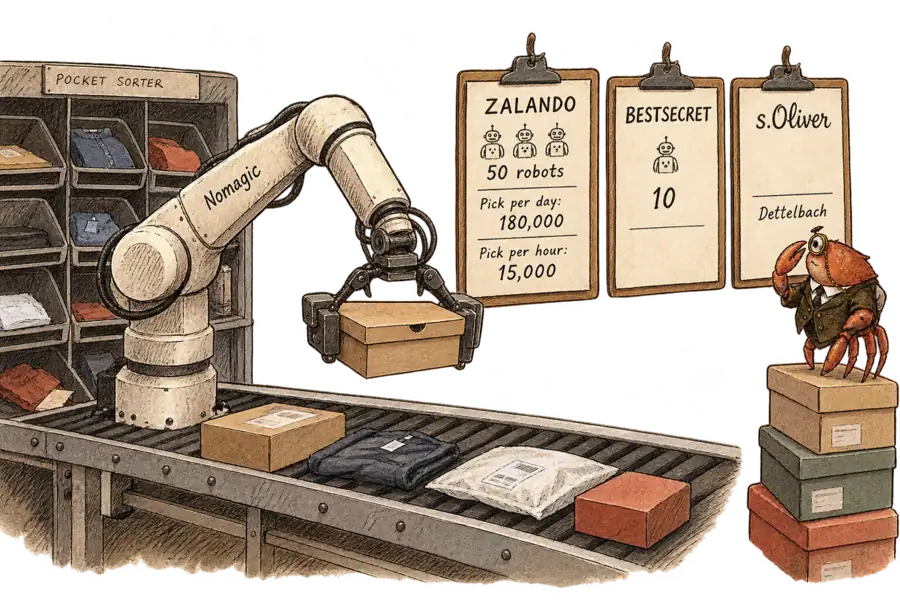
A shoebox comes in two pieces, and a standard robot arm can leave one behind. Zalando said as much in March, when it announced up to 50 Nomagic robots for its European fulfilment centres: loose lids “often detach when handled by standard robotic arms”. s.Oliver is the third fashion business in seven months to sign with Nomagic, and the first of the three whose announcement carries no robot count.
The lid matters because of volume. Nomagic puts shoeboxes at about 20% of the items in a typical fashion e-commerce warehouse, and says that until now they have been handled manually. Its answer, launched in January, is a gripper meant to lift two-piece boxes “without taping, crushing or losing the lid”. Nomagic describes its AI as “general-purpose”. The general-purpose robot needed a special-purpose hand.
TextilWirtschaft’s Ulrike Wollenschläger reported the s.Oliver deal on 19 October. The group plans to bring Nomagic’s robots into its logistics centre at Dettelbach, with the Shoebox Picker playing a decisive role. TW notes that Zalando holds a minority stake in the vendor, and Nomagic’s release of 21 October 2025 confirms it: Zalando made “a minority investment” as part of the $44 million Series B.
Nomagic’s release of 14 October names a site and a gripper but no robot count and no date. It promises automated induction for “a broad range of fashion items, including shoeboxes”, and less “repetitive manual handling”. The project, it says, lets s.Oliver automate more of its range “within a single operational flow”. The efficiency gain comes without a figure. Markus Steinmann, managing director of logistics for the group, calls the partnership “the next logical step in the continuous development of our automation strategy”. The sentence would have announced a conveyor belt equally well.
BestSecret’s announcement came with a count. Nomagic’s release of 23 September promises up to ten induction stations at BestSecret’s logistics centre in Sulechów, Poland, starting with a pilot. The station kit includes “shoebox picking tools”, though the release does not say they will run in Sulechów. It gives no throughput.
Zalando, the first buyer, went further. Its March release lists three sites where Nomagic robots already work, and a pilot that “achieved a staggering 100,000 picks per day”. Nomagic’s October 2025 release gives the pilot’s result as “an average of 10 000 picks/day”. Neither figure is tied to the Shoebox Picker, which launched in January. Marcus Daute, Zalando’s Vice President Logistics Network, cited “the quick and successful deployment of the first ten units”.
In Nomagic’s three releases, the only buyer with a result to report owns part of the seller, and the result comes in two sizes.
The award assessors lean on Zalando too. IFOY’s assessment of the picker, written for this year’s awards, calls shoeboxes “the last remaining manual link in highly automated warehouses” and lists up to 450 shoe boxes per hour, a product specification rather than a buyer’s result. It adds that “the Zalando reference gives the product immediate credibility”. A shareholder’s reference wants a second source. Dettelbach could supply one; so far s.Oliver has supplied a place name.