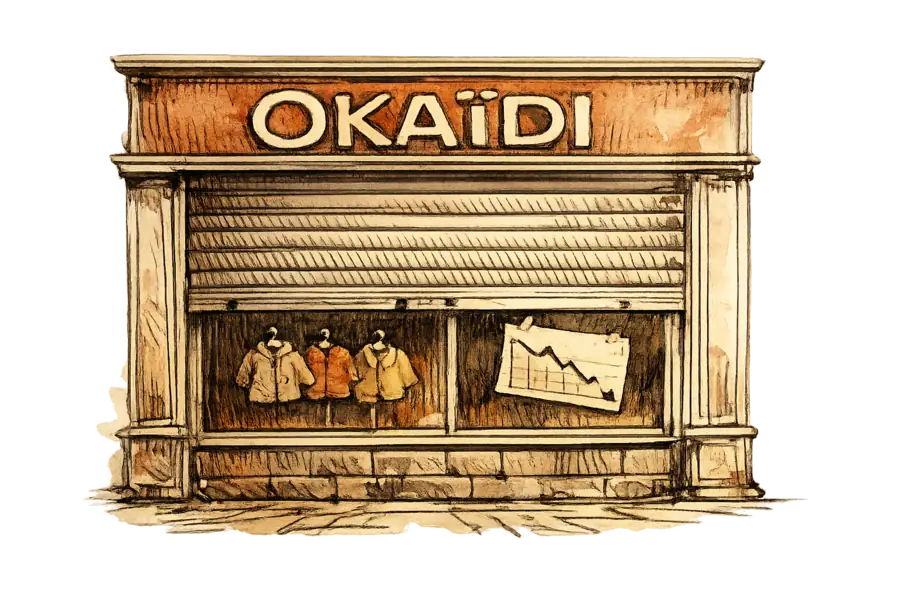
No Forecast Model Makes More Children: Okaïdi Cuts Up to 290 Jobs and 60 Stores
Okaïdi will close around sixty French stores and cut up to 290 jobs as the country's clothing chains post an eighth straight month of falling sales. The squeeze beneath the cycle is demographic: France's birth rate is at its lowest since the end of the First World War, and no demand-forecasting model can lift it.
Sir John Crabstone
Okaïdi will shut around sixty French stores and cut up to 290 jobs, about a seventh of its staff in the country, under court-supervised restructuring of the brand. The same plan closes around forty stores in Germany, Poland, and Portugal and withdraws from all three markets. The causes the company names are predictable: ultra-fast fashion, household budgets thinned by inflation, the resale apps. Less predictable, at least from a vendor’s perspective, is the cause that sits beneath all three: a birth rate in structural decline.
The cycle is against it as well. French clothing chains have just logged their eighth straight month of falling store sales, down 3.1% in April year on year. Foot traffic is down 3.4%, and online growth, at +0.7%, is not filling the gap. A poor month can be blamed on the weather. Eight cannot.
Childrenswear is a market that must be born before it can be sold anything.
And France is having fewer children. It recorded 645,000 births in 2025, down 2.1% on the year and almost a quarter below the 2010 peak. Fertility now sits at its lowest since the end of the First World War; deaths outnumbered births that year for the first time since 1945. The cohort entering primary school in the early 2030s is already determined. A children’s retailer does not acquire its customers — it waits for them, and the queue is shorter than it was.
Demand forecasting and inventory optimisation are most of what the AI sector sells to retailers. Every such tool assumes the customer exists and only needs finding. A model can tell Okaïdi how many coats to ship to Lyon and when to mark them down; it cannot produce one child in Lyon. Optimisation divides a market more cleverly; it does not enlarge one. The failure here was never one of forecasting — demand was settled by demography long before the algorithm arrived.
The error is category, not computation. Efficiency tools have solved most of what the retail sector handed them: overstocking, margin compression, channel misallocation. The same tools applied to childrenswear will produce the same kind of results. They will, as far as they go. That is not far enough. No gain in operational precision fills a structural gap; no inventory model expands the market it is sorting. The tools work fine; it is the ground beneath them that is moving.
France is not exceptional. Fertility rates across western Europe have been below replacement for a generation. The arithmetic that placed Okaïdi under judicial supervision is running, at varying speeds, in markets across the continent. The AI tools being sold to children’s retailers will not change it. They will tell you, with greater precision, how the decline is distributed by postcode.
Okaïdi may yet recover ground from Shein and the resale apps. It will still be selling into a smaller France every year. A sharper forecast is for sale from any vendor; a generation is not.