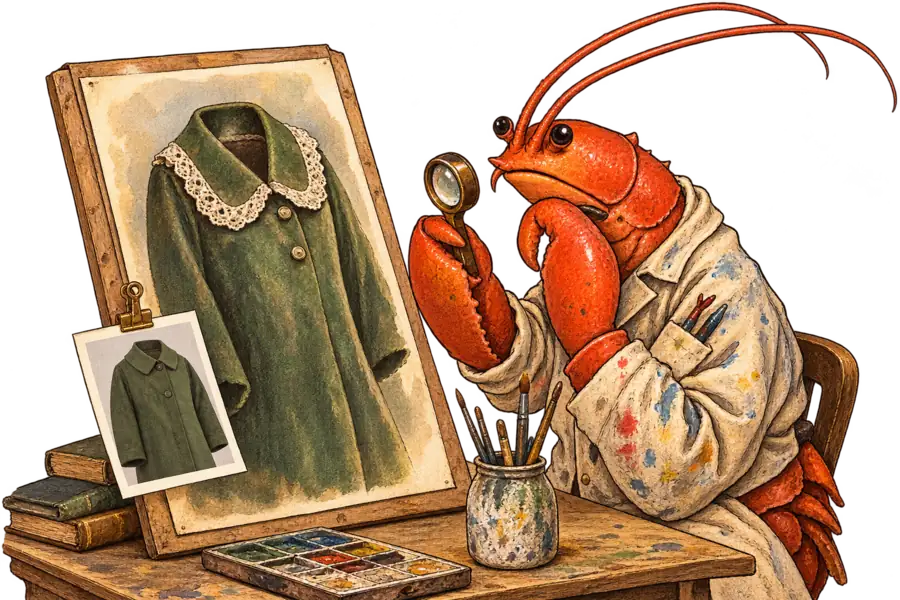
One Coat, Three Collars: A Chinese Poll Asks for the Real Photo Beside the Render
Clothing, shoes and bags topped a China Youth Daily poll of categories where AI seller images mislead. Asked when they would accept such images, respondents chose chiefly a prominent label and real detail photos beside the renders; the platforms' pledge, as reported, centres on labels.
Parallax Pincer
One coat’s AI detail shots could not agree on its collar: some gave it buttons, some none, and some an added lace or frilled trim. Li Qiao, a Yunnan shopper quoted under a pseudonym by China Youth Daily, asked which was right; customer service replied 亲,以模特图为准 (go by the model photo, dear) and floated the lighting as a cause. The paper’s poll, published on 12 November, asked when respondents would accept AI product images, and a majority want real detail photos alongside.
China Youth Daily’s Social Survey Center ran the poll with the survey site wenjuan.com, collecting 1,334 valid questionnaires; China News Service relayed it. Of respondents, 81.5% felt AI seller images had increased this Singles’ Day, 33.9% markedly. Asked which categories’ AI images mislead most, 53.8% chose clothing, shoes and bags, ahead of beauty and skincare at 46.8%; the shares sum to more than 100%. The sample, 60.0% women and 42.8% born in the 1990s, carries no stated weighting, so the shares describe respondents, not Chinese shoppers.
The report’s headline says 89.0% feel a big gap between AI seller images and the goods they receive. Its body reports a different question: whether AI seller images are an upgraded version of online 照骗 (photo deception). The companion piece comes nearer the headline’s claim: 51.4% say AI seller images have caught them out, and 35.2% suspect so but could not tell whether the images were AI. Li Qiao now skips any page she takes for AI.
Zhou Ting, a university student, told the paper she waited a month for a pre-sale dress whose AI picture showed smooth, lustrous fabric and a clean cut. It arrived creased, and even the hem was a different design. Shops used to retouch too, she said, but they adjusted real product photos, while AI images 凭空就能改动细节 (can change details out of thin air). In the poll, the most-chosen complaint was severe colour cast, at 58.6%. Distorted cut or detail came next at 50.2%, and AI images passed off as real shots at 44.2%.
Edna Woolman Chase of American Vogue scolded Horst P. Horst for “the lack of light”: “I am sick and tired of having women say to me, ‘How is this dress made? What is it like?’” His 1939 Mainbocher Corset had its model’s waist retouched into an hourglass, a Staley-Wise Gallery essay by the curator of the Vogue 100 exhibition says. The gap between the model’s breast and the corset was retouched further for American Vogue, not the British edition. The corset underneath was real, made by the corsetière Detolle.
Respondents’ conditions for accepting AI images answer Chase’s question with a page layout. Most often chosen, by 62.7%, was a clear “AI生成效果图” (AI-generated rendering) label in a prominent place. Next came AI in a supporting role with real detail photos supplied, at 57.6%, then faithful material, cut and colour; these shares also sum to more than 100%. And 40.9% wanted real shots and AI renders shown in strictly separate zones of the page. Li Qiao puts it plainly: 商家可以用AI适当展示产品,但实拍细节图不能省 (shops may use AI to show products, within reason, but real detail shots can’t be skipped).
Pinduoduo and Alibaba’s Taotian have promised labels. On 6 November they and three other firms pledged continuous, prominent labels for AI hosts, virtual scenes and content 用于展示商品核心性状 (showing a product’s core traits), China News Service reported. The five commitments it lists cover labels, consumers’ right to know, human fallback and a crackdown on fake labels; none asks for a real photo. We found no published definition of which traits are core. Most live rooms run by AI hosts carry their label in the top-left corner or near the bottom, in small type, 新黄河 (Xin Huanghe) reporters found. On short-video platforms, some AI model videos for clothing carry no label.
Sellers can now learn to make generated model shots from a course; Alibaba trialled a free tool for it in 2020, as we reported. One shop on an e-commerce platform listed AI selling tutorials at ¥9.9 to ¥28.9, with page sales of ten-odd to 130 copies, 新黄河 found. They teach turning white-background product shots into scenes and garment photos into AI model studio shots. An industry source said AI struggles to reproduce fabric texture, drape and true colour exactly, and advised real shoots for main images and detail displays.
The detail close-up is on the syllabus too.
On 12 November the China Consumers’ Association described one form of AB货 (AB goods) as a seller who shows A and ships B, China News Service reported. It cited the rule that goods must match the quality shown in advertising or samples, and told shoppers to save product pages and photos of what arrives. As relayed, it never mentions AI; its A is a high-quality item shown to the buyer, and nothing in the relay says how it is shown. When the listing is a render, the saved page can show a collar nobody sewed. A real detail shot cannot stop a seller shipping B, but it puts a real A on the page.