One Coat, Three Reds: Maison AI Leaves the Garment Check for Last
AuthenticAI's new Maison AI tools turn a product photo into model shots and campaign images, swapping a knit, trousers and a face by comment. In the vendor's own demo the coat nobody asked to change comes back a different red, and the safeguard is a person checking at the end. Japan's consumer guidance, which never mentions AI, also leaves the final check with the seller.
Parallax Pincer
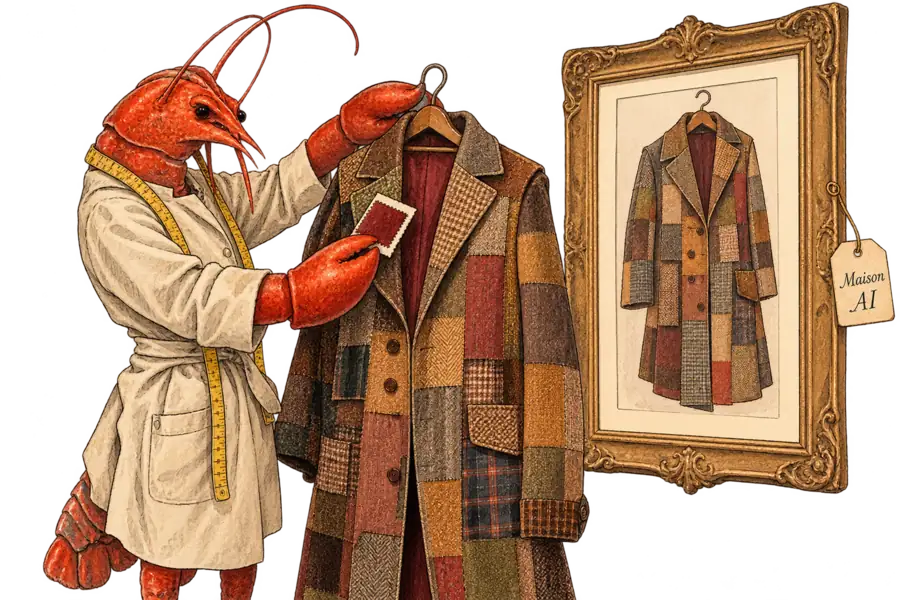
The coat in Maison AI’s new demo shows up in three reds. Its lining is dusty terracotta on the hanger, deep brick red on the first generated model, and rust after an edit that asked only for a new knit, trousers and face. AuthenticAI’s tool treats the product shot as raw material and the campaign image as output, and leaves fidelity to the real garment to a person at the last step.
The 6 November release adds three features to Maison AI, AuthenticAI’s generative platform for fashion, interiors and lifestyle brands. In Photo Editor Lite a user circles an area with a pen or box and types the change as a comment. A reference image can be attached per region, for example to “服を別の商品に差し替える” (swap the clothes for another product). Its toolbar also erases objects, removes backgrounds, outpaints to new aspect ratios and upscales. Agent Builder’s example is a “スタイリスト兼フォトグラファー” (stylist and photographer), and Skill Builder saves routines such as product image to wearing image to campaign.
The 2:46 demo starts from four product shots: lug-sole knee boots, a plum turtleneck, plum wide trousers with an asymmetric wrap panel, and a long charcoal coat with an olive diamond-quilted panel and a patterned lower front. At 1:21 they appear on a short-haired model. The coat’s construction holds, with quilting, pattern and lining where the hanger put them. The trousers, full length on the hanger, stop at mid-calf.
The swap takes three comments: “添付のニットに変えて” (change it to the attached knit) over the torso, “添付のパンツに変えて” (change them to the attached trousers) over the legs and “別の女性の顔に” (to another woman’s face) round the head. By 1:54 a different woman stands in a cream turtleneck and olive trousers, and the coat has a rust lining and a paler quilted panel. In the outdoor key visual at 2:10, those olive trousers, mid-calf in the studio, reach the ankle.
Nobody typed a word about the coat, and it changed colour anyway.
The first drift happened under instructions written to prevent it. The skill’s first step, on screen at 0:58, says “商品画像に写っていない仕様は創作しない” (invent nothing the product photo does not show). Its fifth tells the model to check its output against the product image and “商品忠実性を優先して修正する” (put product fidelity first and correct it).
The release’s own fifth step is human: a staff member checks “商品本来の色・形・柄・ロゴ” (the product’s original colour, shape, pattern and logo), the brand expression and the intended use. The release also says deployment assumes checks of “商品との整合性” and “表示上の確認” (consistency with the product, and what is displayed). A footnote says the steps are not automatically linked and the results are examples. The demo is one such run, with step 3 naming GPT Image Sunburst as the generator, so the colour change is one observation and not a failure rate.
Retail has built bodies around real clothes before. In December 2011 an H&M press officer told Aftonbladet that the retailer shot garments “on a doll that stands in the shop” and created “the human appearance with a program”; ABC News carried that English translation, which it took from Jezebel. The aim was “to show off the garments”, and H&M told ABC it would discuss “how we can be clearer” with customers. H&M rendered the person around a real garment; in Maison AI’s demo the garment is rendered too.
World’s release of 20 December 2023 was right for its date: it said its Fashion Co-Lab unit had begun selling Maison AI, “OpenFashion開発” (developed by OpenFashion). Our 8 September piece tied the platform to OpenFashion after the split, and called it an agent platform built by the founder behind the accelerando.Ai line. Maison AI now belongs to AuthenticAI, and that piece was wrong on ownership. AuthenticAI is not OpenFashion renamed; the rename turned Omnis into OpenFashion on 1 July 2023, per World. AuthenticAI, founded on 8 November 2024 and run by Toru Ueda, took over Maison AI in a split of OpenFashion’s business; OpenFashion’s January 2025 notice puts Ueda’s stake in the new company at 98% and World’s at 2%.
None of the releases on AuthenticAI’s PR TIMES page as of 9 November mentions labelling AI images for shoppers. World’s June release is a seminar announcement; it says World will introduce its brand OO’s use of AI “商品企画からモデル画像生成” (from product planning to model-image generation). Business Journal, following a 5 August Nikkei report, says World sold OO’s AI-designed pieces only on its own site, “公表せず” (without making that public). That piece asked why a ¥7,100 cardigan sold out, never whether its photographs matched it.
The Consumer Affairs Agency’s guidebook to the Act against Unjustifiable Premiums and Misleading Representations (景品表示法), revised in March 2026, does not mention AI. Its representation Q&A discusses photographs only as fruit pictured on drinks without juice. The guidebook tells sellers to check the information behind a claim and “最終的な表示を検証すること” (verify the final representation), in an example about checking production against specifications. A January release describes a “法務・校閲” (legal and proofreading) agent that checks Maison AI’s generated text against the Act; images in the new workflow go to a person.
The guidebook puts the final check on the seller, and AuthenticAI’s workflow hands it to a staff member. The release lists colour first among the things that person checks. In the vendor’s own demo the coat changed colour twice unasked, so whoever does the job will want the hanger shot set beside every render.