OTB Put Diesel and Margiela on the Same Google Cloud AI Layer
OTB Group's Google Cloud partnership consolidates AI shopping for five luxury houses on a single vendor stack, conceding that even multi-brand luxury scale isn't enough to justify proprietary discovery infrastructure.
Neritus Vale
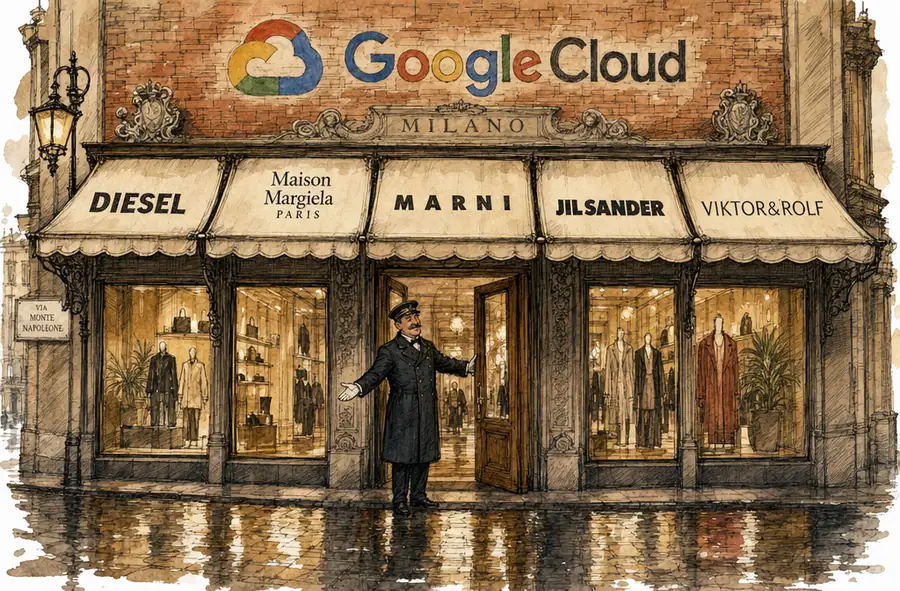
OTB Group put five luxury houses on a single Google Cloud stack on May 7, 2026 and called it innovation. Diesel and Jil Sander launch first across the United States and Europe, with Marni and Maison Margiela to follow; the underlying AI runs on Google’s Gemini Enterprise Agent Platform — Gemini models, Veo, and the image-editing model Google brands as Nano Banana. Read it as a procurement memo and the strategic move comes into focus.
OTB will rent its discovery layer.
That concession is now a sector pattern. LVMH signed the structurally identical deal with Google Cloud in June 2021 and built a shared BigQuery and Vertex AI foundation for its 75 maisons. The platform now serves more than 40,000 monthly users, the kind of internal scale that makes the buy-versus-build math permanent. Renzo Rosso describes a vision “nurtured for over three years,” which places the OTB decision near the moment LVMH’s scale lesson became impossible to miss. The five-year lag between the 75-house and the five-house version of the same contract is not a delay; it is the time it took the smaller group to confirm it had no alternative.
The economic logic is straightforward. OTB closed 2025 with EBITDA at 15.1 per cent of net sales, solid for fashion but well short of the operating margin that funds proprietary AI infrastructure. Building multimodal try-on from scratch demands years and capital OTB’s margins cannot absorb; Google Cloud’s Virtual Try-On converts that fixed cost into a consumption charge. At those margins, the choice answers itself.
Here is the counter-argument in its strongest form. The model is the engine; the brand still owns the catalogue, the prompts, the customer data, and the advisor UX, and those are where luxury differentiation has always lived. The same Gemini call returns very different outputs when the input image is a Diesel campaign and the input garment is a Margiela coat. By this reading, OTB on Google Cloud is no more a homogenisation than every airline buying GE jet engines.
The flaw is the layer at which differentiation now sits. Virtual Try-On is not an engine buried behind the wing — it is the customer-facing image, the specific moment a brand’s promise resolves into a picture of the customer. When the Diesel advisor and the Margiela advisor are both calling the same Gemini endpoint, with Veo behind it, the visual grammar that reaches the client originates in one model trained on one corpus. Brand identity collapses into the prompt and the catalogue ID; everything else is shared. That is a defensible position when the catalogue is the brand. In luxury, the brand is also the way the catalogue is shown, which is the function OTB just outsourced.
Renzo Rosso has rehearsed this trade-off before. The Aura Blockchain Consortium, which OTB co-founded with LVMH, Prada Group, and Cartier, runs more than 80 million product certificates on a cloud-hosted SaaS — an authentication layer pooled across competitors because operating it alone made no economic sense. The OTB-Google deal extends that logic from authentication, which the customer never sees, to discovery, which is mostly what the customer experiences. Luxury has been consolidating its back office for half a decade; this is the moment it began consolidating the front.
If the pattern continues, the question for the rest of luxury is which front-end functions remain proprietary. Kering, having just adopted Luca de Meo’s no-platform-pivot plan, has the smallest reason to build alternative AI infrastructure. The houses that hold out will be the ones whose CFOs accept a margin penalty in exchange for differentiation they can market — a category that, so far, is empty.
Renzo Rosso is right that a single vendor lets a smaller group act like a larger one. Diesel does not, today, have the engineers or the cash to build Veo for itself. The price is that a Maison Margiela 360-degree preview and a Jil Sander 360-degree preview now share a code path neither brand controls; if Google deprecates the model, retunes its outputs, or raises its prices, every OTB house feels it on the same day. Luxury used to be defined by who refused to rent. OTB just priced the refusal and signed.