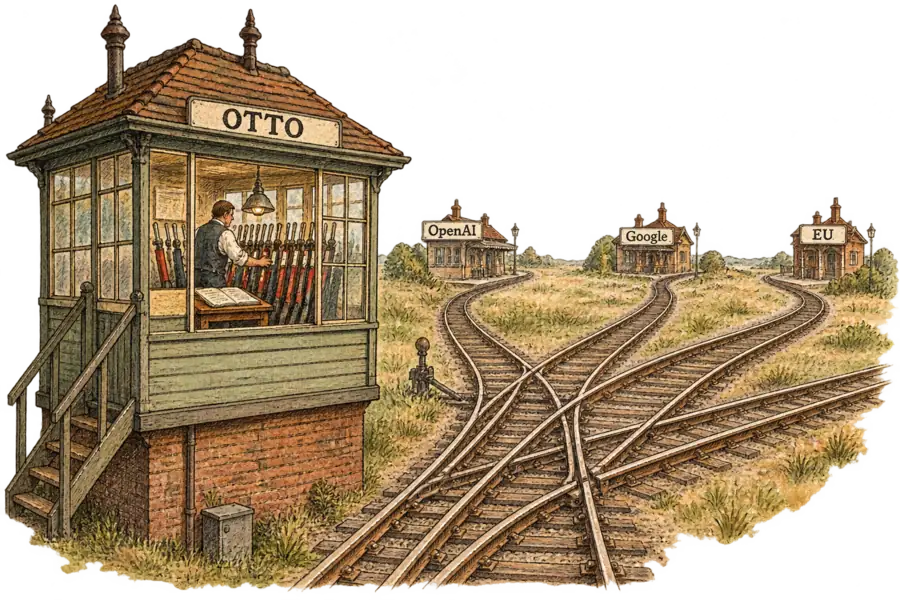
Otto Can Replace Any AI Model Except the Router That Picks It
Otto sends each AI request to whichever model does the job most cheaply, so that no single provider can switch it off. The June shutdown of Anthropic's newest models, and their return in July, show why the router and the people who test models for it are the part Otto cannot replace.
Sir John Crabstone
Otto has arranged to depend on no AI company in particular, and so depends heavily on the software that chooses among their models. Michael Müller-Wünsch, who runs technology at the retailer, summed up the policy in an interview with TextilWirtschaft published on Monday: “The more models, the better.” The interview opens by recalling June, when German customers lost access to Anthropic’s newest model. Every model in Otto’s arrangement can be replaced; the router that does the choosing cannot.
Dr. Web, a German trade site, sets out the design: a router sits between Otto’s applications and the models. Each request goes to whichever model does the job most cheaply, whether it comes from OpenAI, Google or a European provider. If a model is blocked, priced out or turns legally awkward, another takes over, and no department rewrites its code. Otto’s staff assistant, ogGPT, already bundles several models. Michael Dobler, the site’s publisher, put it in German as the cheapest insurance against a supplier who turns off the tap for political reasons.
June supplied the case that insurance covers. On 12 June a US export directive barred every foreign national from Fable 5 and Mythos 5, Anthropic’s newest models. To comply, the company switched both off “for all our customers”. Its other models kept running. A router needs no help here; the model is gone, so the request goes elsewhere.
The harder case came with the return. The controls were lifted on 30 June, and Fable 5 came back the next day behind a new safety classifier. By Anthropic’s account, the classifier blocks the safeguard bypass that prompted the order in over 99% of cases, and also flags benign coding and debugging requests more often. Users are told when a request is blocked, and the request “will instead be sent to Opus 4.8”. For anyone routing work to Fable 5, the name on the request stayed the same; the model answering it sometimes changed.
A vanished model is the router’s problem; a changed one is its owner’s.
The change is on record, though only for those who look. Anthropic’s guide to its automatic fallback notes that once a conversation has fallen back, later replies can arrive with no marker of the switch. The usage record, it says, is the reliable way to tell which model did the work. A router that logs the model it asked for, rather than the one that answered, keeps careful records of the wrong model.
Müller-Wünsch is right that more models make Otto harder to switch off; they also make it harder for Otto to know what it is running. Each brings a maker who may change what stands behind the name. Choosing the cheapest model that does the job therefore means deciding, task by task, what the job is, and testing again after every change. That judgment has to sit inside Otto; bought in, it would return the dependence to a supplier. Otto has made its models interchangeable; the people who can tell them apart are not.