Otto Hands Sereact's Robots the Judging and Its Staff the Final Quality Decisions
Sereact's release has up to 25 robots assessing Otto Group returns in Poland, with Sereact operating them and staff moving toward final quality decisions. Zalando's release three weeks earlier had the robots grasp, identify and sort; Otto's adds a judging step and a count in two units, but still no throughput or error rate.
Sir John Crabstone
Otto Group’s returns staff are to move toward “final quality decisions” once Sereact’s robots arrive, says Sereact’s release of 28 October. The release counts up to 25 dual-arm robots that will grasp, identify, assess and sort the returns, with Sereact operating them under a robotics-as-a-service model. Neither company has published a throughput or an error rate.
No decision is final unless another came first.
TextilWirtschaft’s Carola Sobbe reported the pilot on 29 October, citing the developer: ten robots at first, at Otto’s Hermes logistics centre in Poland, with 25 planned as a next step.
Two-armed robots are not new. Zalando announced them first. A 7 October release from Sereact, Zalando and CEVA said Sereact’s dual-arm robots “grasp, identify, and sort” fashion returns at CEVA sites in Greven and Świebodzin. That deal was robotics-as-a-service too, delivered for Zalando, which had joined Sereact’s Series B in July.
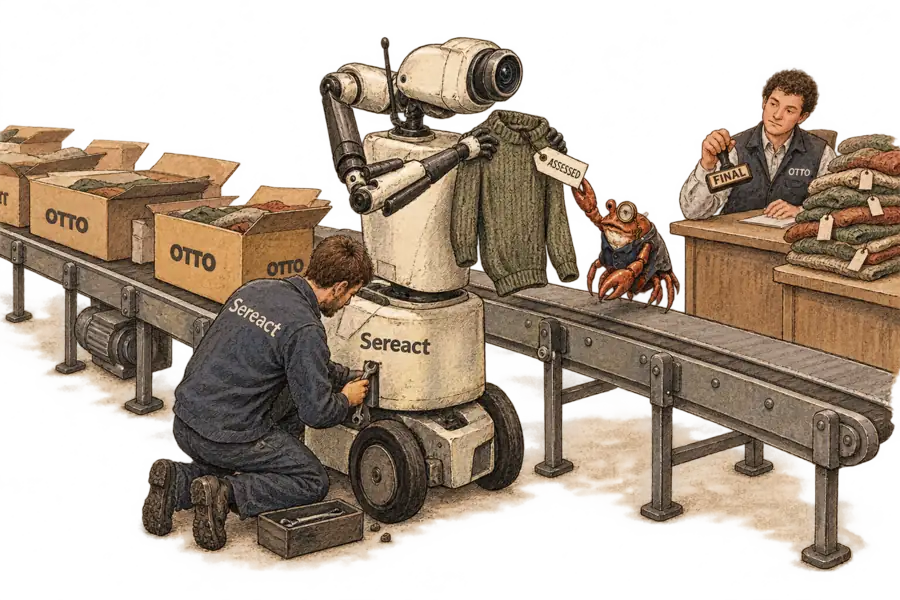
The Otto release adds a verb to the Zalando list. Otto’s returns will be “grasped, identified, assessed, and sorted”, and Sereact’s Cortex model will decide how to “assess its condition, and route it accordingly”. Naming a jumper is classification; judging one is a decision.
Staff give up “repetitive grasping and lifting” and take on “supervision, exception handling, and final quality decisions”. The release does not say what happens when the robot’s assessment and a person’s disagree.
On 12 October we relayed Dr. Web’s note that Zalando’s partners named neither a robot count nor an hourly output. Otto’s announcement supplies the first, untidily, and still not the second.
The release’s bullet counts 25 dual-arm robots. Its body starts with ten “dual-arm systems”, adds “15 more robotic arms” and arrives at “a total of 25”. Ten two-armed robots and 15 arms make 25 only if an arm is a robot.
NVIDIA’s Cosmos models re-render simulated picks “across garment states, packaging, materials and lighting”. Whether lipstick on a collar counts as a garment state, the release does not say.
The results get two conditions. Phase two depends “on initial results”, and a broader rollout is evaluated only “if the second phase is successful”. Otto’s Martin Umland expects to find out “how far Physical AI can take us”. The release does not promise to publish the answer.
Sereact’s product page, which already lists damage inspection, shows why the missing error rate matters. Items “inspected inconsistently” go out to the next customer and come back again, at “double the last-mile cost”. Sereact puts a multiplier on the error; it has not published the rate.
The page also says every Sereact station “deployed anywhere feeds learnings back to the fleet”, while “nothing changes on your floor without validation”. That fleet includes robots sorting returns for Zalando, a Sereact investor. Neither page nor release says whether Otto’s returns will help train the robots that sort another retailer’s, or who owns the data.
“Every return the systems handle makes the model better at the next one,” says Ralf Gulde, Sereact’s chief executive, in the release. Whose next one, Gulde does not say.