Parfumerie's Unsponsored Fragrance Guide Still Has Paymasters
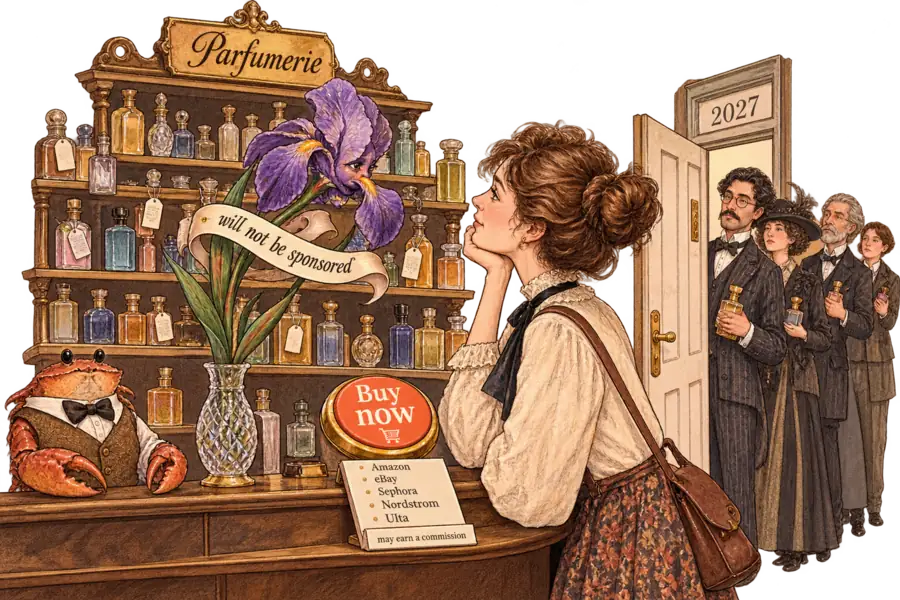
Parfumerie's AI fragrance guide, Iris, launched in the UK promising unsponsored recommendations, yet the company earns retailer commission and plans brand partnerships for 2027. It discloses the commission beneath the retailer list; a paid sentence from Iris would need to declare itself.
Sir John Crabstone
Parfumerie’s AI fragrance guide, Iris, opened to UK shoppers today with what WWD calls a “key distinction”: its recommendations “will not be sponsored”. The pledge excludes sponsorship, not the affiliate commission the business runs on. Shoppers can buy more than 300 brands through retailers such as Selfridges and Sephora, and Parfumerie earns commission when they do. Direct brand partnerships, planned for 2027, would add another paymaster.
Commission needs no sponsored slot to shape a guide. WWD calls the 300 brands the “initial” shoppable assortment, while Parfumerie’s library lists “over 1,500 brands”. The pages we read do not say what Iris does when a shopper’s taste lands on a bottle no partner sells.
Parfumerie’s answer, in the same WWD piece, is that recommendations are driven by each person’s taste and can help emerging houses be discovered alongside established names. That is a claim about outcomes, and the product pages give no figures on which brands Iris recommends.
On the Tom Ford page, the buy button lists retailers cheapest first: Look Fantastic at £33.60, then Sephora at £42. Beneath that list sits a note: “Parfumerie may earn a commission if you buy through these links.” The foot of the page carries a different line: “Iris uses AI and may make mistakes. Check product details.” Parfumerie admits fallibility in one place and declares its interest only at the point of purchase.
Its terms, updated in May, never mention commission. They say instead that Parfumerie does “not endorse the products or services offered on Third-Party Websites”, a phrase that plausibly covers the shops its buttons open. Boilerplate, perhaps, but boilerplate is the part a shopper agrees to.
Iris sends shoppers to retailers “with current pricing and stock information”, WWD reports. The product pages are humbler: “Check details, prices and availability with retailers.”
That advice earns its keep. On the Baccarat Rouge 540 page, the eau de parfum’s full sizes include a 70ml at £80 and a 70ml at £265. The cheaper bottle, in its own photograph, is the matching hair perfume.

In October we argued about Glance, another AI shopping agent, that a label can mark a paid result but not a paid lesson. The lesson is what 2027 may put up for sale.
Parfumerie’s co-founders pitch two audiences, in our reading: shoppers and brands. Shannon Edwards calls the company “an intelligent discovery layer and a brand-building environment”. Natalie Varma told WWD the technology is grounded in brand tone and factual product information; separately, she said category structure and taste intelligence let Parfumerie “narrate the experience” for each shopper. Our reading is that a brand paying from 2027 would be funding a guide already grounded in its tone.
The pitch has started early. Parfumerie’s contact page invites brands to reach “an engaged fragrance audience through editorial, data intelligence, and commerce integration”. It does not say whether editorial is paid or whether it means Iris’s answers, but the first item on that list has a rule in Britain.
Schedule 20 of the Digital Markets, Competition and Consumers Act bans paid promotion through editorial content “without making that clear in the content”. Whether a chatbot’s answer counts as editorial content in the media is a fair question.
A footnote can declare a commission; a paid sentence has to declare itself.
The two product pages we read, Tom Ford and Baccarat Rouge 540, carry the same assurance: Parfumerie “is independent and not affiliated with” the brand concerned. If the partnerships arrive, those pages may have to lose that sentence. Shoppers who notice where it has gone will know more than the chat tells them.