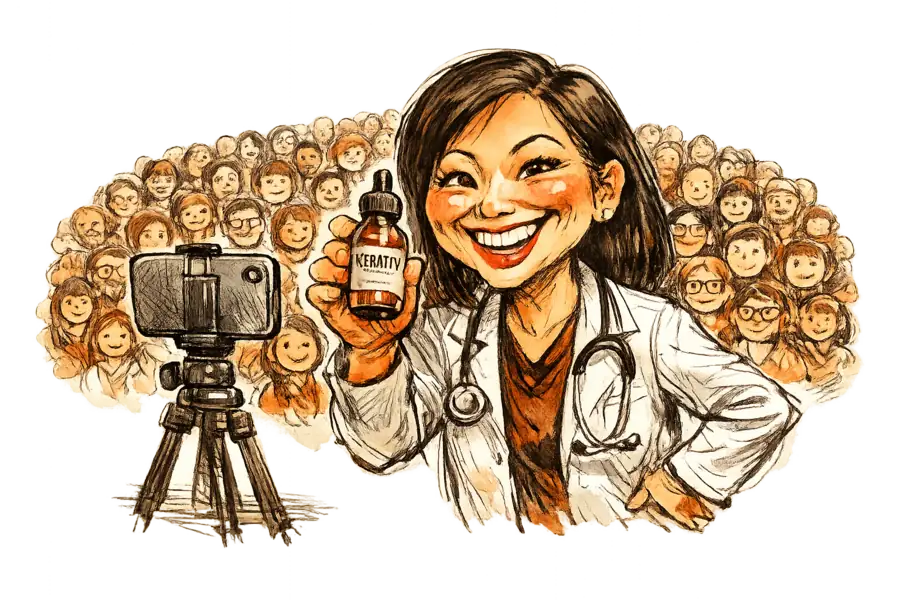
Dr. Park's Serum Took a Consultant. Her Audience Took a Decade.
Dr. Joyce Park spent more than a decade building a skincare audience. Her hair-care brand Kerativ runs the now-standard play: build the following first and choose the category second; the credential, not the serum, is the asset no rival can copy.
Sir John Crabstone
Dr. Joyce Park has spent more than a decade making skincare videos. On April 28 she put her name on hair care, launching Kerativ, a $44 shampoo and a $65 scalp serum sold direct to the consumer. The product is the newest thing about the venture; the audience that will buy it is the oldest, and the only part no competitor can reproduce.
The dermatologist-brand wave has been building for years. Dr. Dennis Gross, Dr. Muneeb Shah, Dr. Shereene Idriss have each shown that a clinical credential converts in prestige beauty in ways no marketing budget can replicate; that prior trust shortens the credibility cycle from years to a single launch announcement. The model is codified enough now to have its own consultant class. The credential is differentiating; the chemist is shared.
Park is selling Kerativ as a science story, and the science is not invented. The brand’s six-month clinical trial, at its 12-week interim mark, recorded a statistically significant increase in hair volume and density, as Glossy reports. The serum was formulated by Allen Sha, whose firm has also worked with Dr. Idriss, Eadem and Sofie Pavitt Face; the active stack runs 3% Redensyl alongside 1% Kopexil and Adapinoid. The chemistry is real, and it is rentable. That is not a product advantage; it is a distribution advantage wearing a lab coat.
The audience is a different matter. Her Tea With MD accounts hold 1.2 million followers between them: 507,000 on Instagram, 776,000 on TikTok, gathered one explainer at a time since before “influencer” was a job, as Glossy reports. They did not follow a brand; they followed a board-certified, Stanford-trained dermatologist who spent years explaining why the product on their shelf was not doing what the label promised. That kind of trust does not transfer by acquisition; it compounds only through time.
The category was chosen, not stumbled into. By 2023, Park was seeing roughly ten telogen-effluvium patients a day; she ran a structured survey of her audience before committing to hair, and the clinical signal and the research pointed the same direction. The hair-wellness lane she entered is not empty — scalp treatments, damage-repair brands, and ingredient-led shampoos with clinical positioning already occupy it. What is unusual is the sequencing: the market research was complete before the company existed, and the respondents were already following her.
Her launch routes through those followers first: Park plans to educate her own audience across her platforms, then extend reach through expert creators — chemists, trichologists, hairdressers — via ShopMy. She raised no outside money.
Most brands build a product and then go looking for an audience; Park built the audience and chose the product last.
Twelve days ago this page watched a beauty label buy its audience for the price of a bachelorette trip. Park’s took ten years and cannot be expensed. The dermatologists eyeing the same move will find the formula available, the consultant bookable, and the audience gone.
That gap is the entire business.