Pennsylvania's AI Ad Label Turns on the Goods. New York's Turns on the Model.
Pennsylvania's new law asks for an AI label only when synthetic content gives a false impression of the goods or services advertised, so it and New York's synthetic-performer law can flag different parts of one campaign image. Its sponsor also struck 'knowingly, recklessly or willfully' from the bill before it passed.
Sir John Crabstone
New York’s AI label, in force since June, attaches to an invented model. Pennsylvania’s new law looks past her to what is being sold. Josh Shapiro signed the Artificial Intelligence Deceptive Advertising Act on 22 October. Its label is owed only where synthetic content creates “a false consumer perception about the nature, origin or authenticity of the goods or services being advertised”.
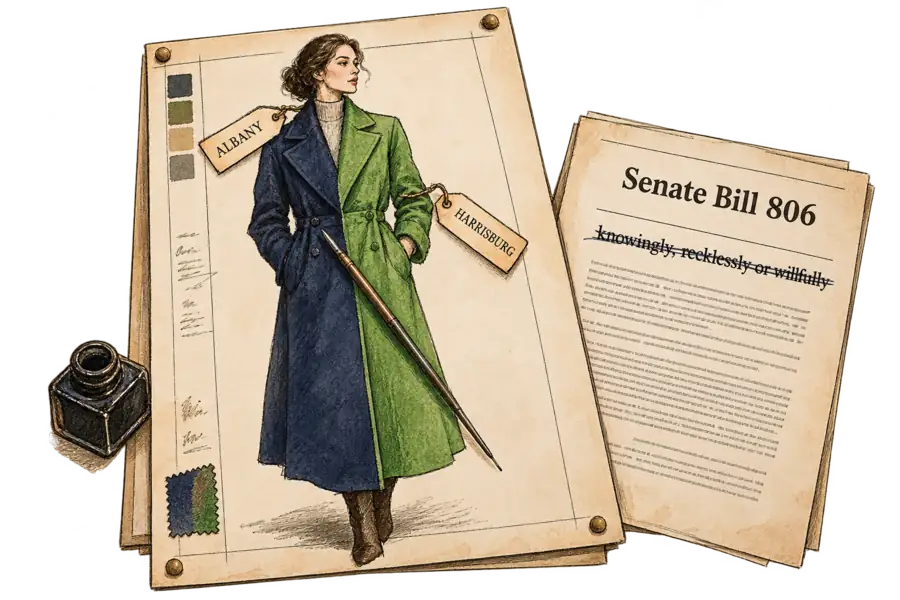
The two labels can fall on different parts of one photograph. An invented woman in a faithfully rendered coat needs New York’s label and, arguably, not Pennsylvania’s. Recolour a real model’s coat with AI, in a green the shop does not stock, and Albany wants no label. Harrisburg reaches that image only if the edit is “significant” and colour counts toward the coat’s “nature” or “authenticity”, terms the act leaves undefined.
Albany asks whether the woman is real; Harrisburg asks whether the coat is as shown.
The Verge told readers that any ad “significantly modified or generated” by AI needs a label, text included, “regardless of where an ad was created”. It filed the deception clause under loopholes. That clause is the trigger. The act exempts anything “limited to text” and is silent on where an ad was made.
That reading resembles the bill Nick Pisciottano introduced in June 2025, which would have labelled “any content generated by artificial intelligence”, “written text” included.
In May a Senate committee rewrote it as a separate act about deception. Enforcement was confined to the Attorney General and district attorneys, with fines of up to $3,000.
On 10 June Pisciottano struck “knowingly, recklessly or willfully” from his own bill, and the Senate passed it 48-2 that day. The act as signed states no mental-state requirement.
New York went the other way: its duty starts only when the advertiser knows the performer is synthetic. The brand that never asks its vendor has a defence in Albany; Harrisburg’s text states none.
AI Policy Desk’s checklist still quotes “knowingly, recklessly or willfully” as the signed text, and adds that “an honest mistake is not the target, but ‘recklessly’ covers not checking”. In the bill both chambers passed, those words carry a line through them.
Pennsylvania’s older consumer-protection law forbids claiming goods or services have “characteristics” they lack. The new act says “nature, origin or authenticity”, and leaves other recourse intact, so the older law stays open. Only a case will settle whether a smoothed texture or re-draped hem counts.
The act takes effect 60 days after signing, around 21 December. A House amendment to make it 120 failed by 100 votes to 103.
The label must say that the advertisement “contains content that was modified or generated using artificial intelligence”. Where it is required, a false impression about the goods is already in play, and the words do not say which part of the picture carries it. A sky-only edit would not trigger it. The shopper learns that a machine touched the picture and must guess whether it touched the coat.