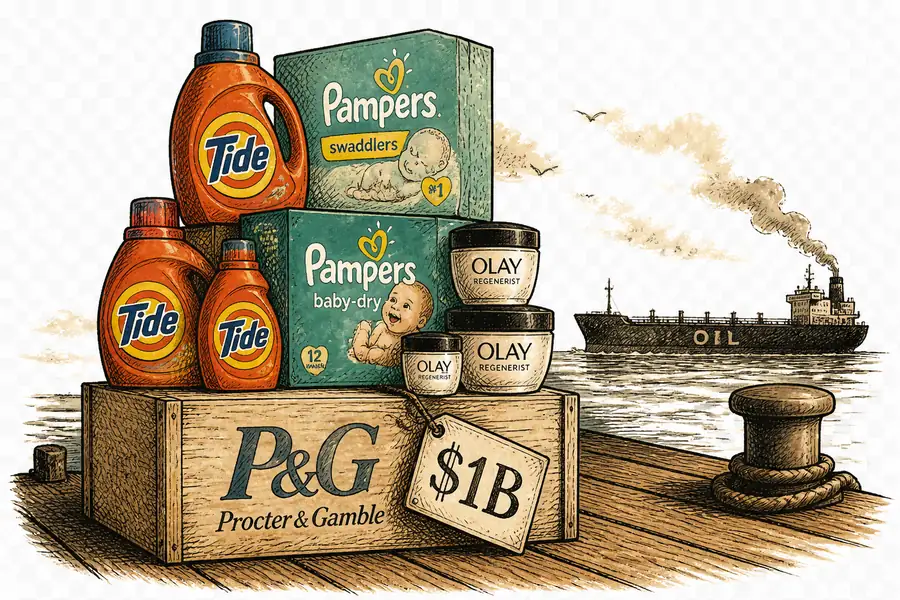
P&G's $1B Conflict Bill Outsizes The Topline It Beat
P&G reported 7% revenue growth, beating the $20.5 billion consensus, and disclosed a $1 billion annualized Middle East conflict cost in the same release. The disclosure now travels with routine guidance, not the footnotes.
Sir John Crabstone
P&G beat the quarter and disclosed the war in the same hour. Net sales grew 7% to $21.2 billion, ahead of a $20.5 billion consensus, while CFO Andre Schulten told the Q3 call to expect roughly $1 billion of after-tax cost in fiscal 2027 should Brent stay near $100 a barrel (versus a $150 million after-tax cost already baked into this year’s guidance). The conflict bill is larger than the consensus beat. Guidance was maintained.
That used to be a footnote. Now it is a slide.
Personal care has long preferred to treat its inputs as a procurement concern. Schulten reminded the call that “the majority of our feedstock is petro-based” — which is the polite way of saying P&G is a petrochemical processor that ships fragrance. The Middle East premium is not a transit charge; it is the bill of materials. Inventory accounting has hidden it for months; arithmetic will not.
The maintained range is the most revealing line on the deck. The bulk of the cost lands in fiscal 2027, and the company has deferred 2027 numbers until July. Schulten conceded the obvious: “Will it be sufficient to offset the full $1 billion after-tax? Likely not.” A maintained range is therefore not confidence. It is the part of the calendar where the cost has not yet arrived.
L’Oréal had disclosed €90 to €100 million from the same disturbance the day before. P&G’s figure is roughly ten times larger. Two of the world’s largest personal-care companies, in successive twenty-four hour windows, wrote the war into routine guidance. The companies are different; the disclosure logic is identical. L’Oréal was an event. P&G made it a regime.
That is not a footnote — it is an operating cost.
The beauty shelf has always quietly assumed cheap petrochemicals. Every Pampers, every Tide bottle, every Olay jar embeds a Brent assumption that retailers never see and consumers never read. When the assumption shifts from the mid-sixties to a hundred, the cost lives in inventory for a few months and then arrives at the gross margin. Schulten said the company would offset what it could through innovation and selective pricing; he did not say it would be enough.
Markets read the print as a beat; the reading skipped the disclosure. P&G’s headline, 7% growth with volume back and beauty up, is the kind of result that obscures the line it is paired with. The $1 billion after-tax exceeds the consensus beat in absolute dollars. It is therefore not a rounding adjustment; it is a change in the cost stack.
What used to be exceptional is now operating. CPG companies will negotiate the figure down with offsets, hedges and pricing; they will not unbook it. Retailers buying these categories will receive the offset first as a price ask, then as a floor. Schulten’s $1 billion is not a forecast about Iran or Israel. It is a forecast about the price of a category whose inputs travel by tanker.
The headline was the beat. The bill of materials was the company.