Phota's New Angles Keep the Face and Lose the Groom's Glasses
Phota's iPhone app offers style presets that change a picture's framing after it is taken, and a demo of Adobe's Project Sight Span lets the user place the camera. Either way, what the new view shows of clothes and accessories is computed. Phota's own definition of identity treats glasses and hair colour as 'transient', and its terms and privacy policy never mention the invisible watermark TechCrunch reported.
Parallax Pincer
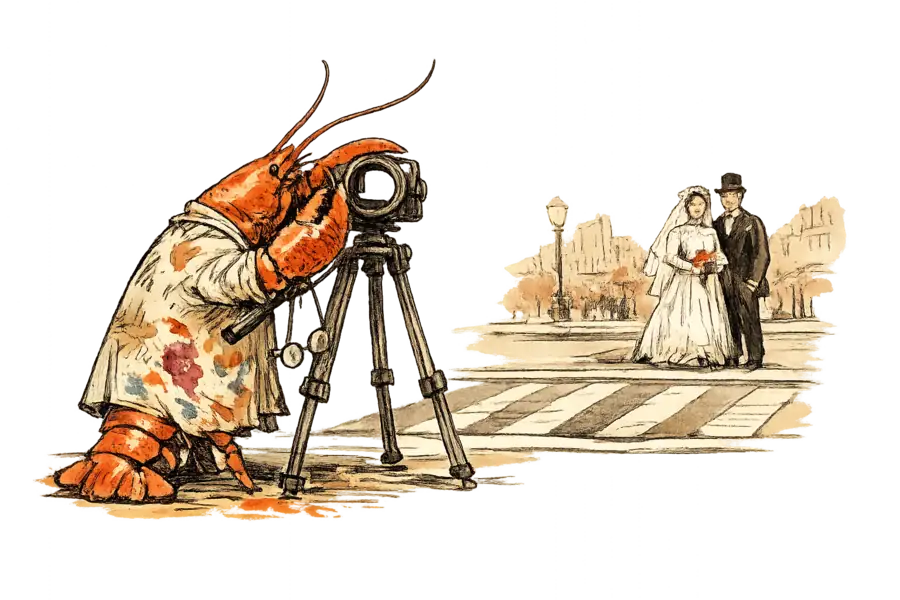
On Phota’s App Store page, one street snapshot of a bride in high-necked lace and a groom in a black suit becomes four new pictures. The groom’s thin glasses survive in only one, as round wire frames, and in two the bride’s pulled-back hair falls loose past the shoulders. Phota’s style presets alter the framing, and Adobe’s Project Sight Span lets the user place the camera after the shutter. Either way, what a new view shows of clothes and accessories is computed. The pictures at stake are the ones fashion reads as unstaged evidence of fit: review photos, street style and creators’ try-on snaps.

Phota is an iOS app from Cecilia Zhang and Zach Xia, who met at Adobe working on Project Indigo, Lightroom and Photoshop, TechCrunch reports. It polishes camera-roll snapshots unasked; users pick styles from subtle, lens-preserving edits to “alternative angles, and entirely different perspectives”, and can turn “a selfie into a regular shot”. The founders say users took more photos because they knew Phota could enhance them later. Its App Store listing asks, “Wish someone had taken a photo of you two instead of another selfie?” In the unlabelled selfie pair Phota supplied, her arm is around him and his zip hoodie is brown in the left panel; in the right, his arm is around her and the hoodie is black.

Xia told TechCrunch of an “obsession with authenticity”, and Zhang said Phota’s personalisation technology “learns about people’s identity” and can “preserve them in any transformation”. Phota’s blog posts, from autumn 2025, set out what that means. A post on context says, “A generated photo doesn’t have to be factual to feel real.” The identity post says a system must hold bone structure and the way a face moves, while “hair color, makeup, beard, glasses” are “transient features”, free “to change naturally or with user control”. Clothes do not make the list, and hair means colour, not style.
In a fashion photograph, the transient features are the evidence.
The identity layer is Phota’s own; its privacy policy says Google Gemini and OpenAI’s GPT models help “generate AI Output”. The identity post says a single image “isn’t enough” and that reliable results need “a few dozen images”. The policy lets Phota train a model of any person or pet that “recurs across multiple photos” in a user’s library, but not of “a person captured once in a crowd or group photo”. So the friend in every try-on snap can get a model, and so can a street-style stranger shot more than once in one user’s library, though the policy says trained models are not shared between accounts. Models stay until the user removes that person or deletes the account, and a non-user who suspects one exists can ask support to remove it, which Phota will do “where appropriate”.
TechCrunch also reported that edited images carry “invisible watermarks that identify them as altered by AI when shared on social platforms”. Phota’s terms and privacy policy never mention a watermark, so neither says what kind it is or which platforms read it. The only mark reported is one the viewer cannot see.
Fashion’s candid pictures were staged long before software. On 10 May 1908, the house of Margaine-Lacroix sent three mannequins into the Longchamp enclosure in clinging gowns split to the knee, the curator Susie Ralph recounts on Kensington and Chelsea Libraries’ blog. Photographs ran in the press the following week, and an unnamed “authority” declared that women “have had to change their figures”. The occasion was staged, but the cloth and the bodies stood in front of the lens. Phota’s new angles start from a real moment and compute the drape.
Adobe’s Sight Span Labs page says its demo preserves “the tattoo on his arm and the textures of the buildings in the background” when the viewpoint changes. A single image “leaves much of a scene unseen”, the page explains, so the system “has to infer geometry and appearance”. The Verge says tattoos and facial features “remain surprisingly recognizable and true to the original”, yet finds the result “far less deserving of being called a photo afterward”.
Adobe gives no ship date; the page offers only to notify visitors “if this Sneak becomes available as an experiment”. It already lists uses, among them “Product repositioning”, in which one studio photo could yield “a hero shot, a three-quarter view, or a top-down shot, without a reshoot”. Phota Labs’ API composes licensed talent onto products. The company’s ads page sets “Every new scene, season, or channel is another shoot day” against “One licensed identity plus product imagery yields full campaign sets on demand”.
Once the angle is chosen in post, a photographer’s framing becomes a first draft. A model’s usage terms, negotiated for a shoot, now meet a photograph that keeps producing new pictures. Reuters reported last month that contracts it reviewed already asked models for AI rights, as we covered. A review photo was worth something because a camera stood somewhere and a body stood in front of it. With these tools, the camera may have stood nowhere.