The 300% Talking Toy May Be Heard Before It Is Kept
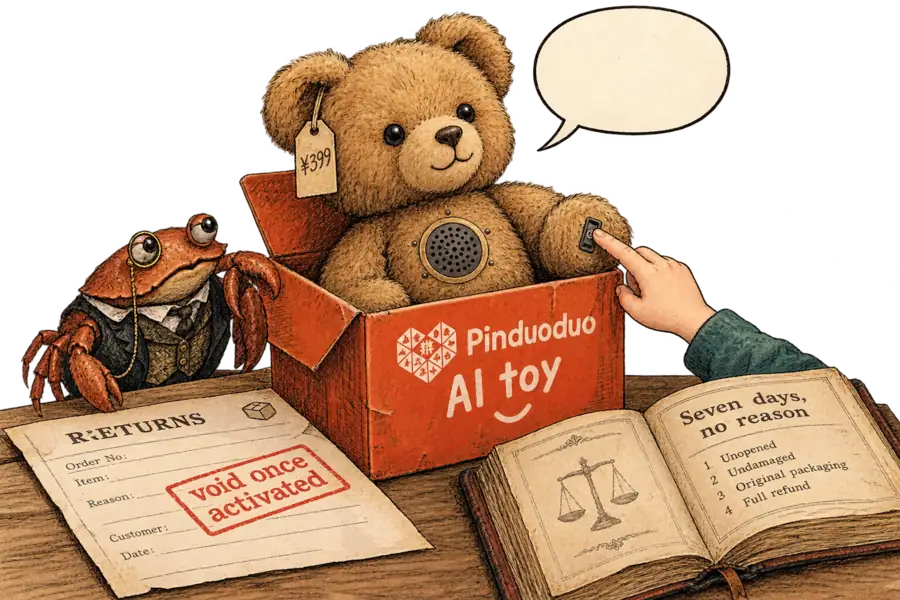
Pinduoduo tells merchants that AI can support a 300% premium on toys, while some sellers on China's big platforms refuse returns once a toy is activated. China's return rules allow a buyer to test a toy, and let a seller exclude activated goods only through a confirmation step at checkout.
Sir John Crabstone
Pinduoduo is courting merchants for a new AI-toy category with extra Double 11 traffic and an assurance that “AI functions can support a 300% premium”, a figure set against 9.9-yuan free-shipping goods. Tech Planet’s Lin Jing quoted the line from the platform’s merchant pitch in a report 36Kr republished; the English wording is 36Kr’s. Some sellers stop taking returns once such a toy is connected and activated. The buyer cannot test the toy without activating it, and activating it voids the return.
The report prices talking cats and bears from as low as 399 yuan up to 3,000, against an average of 99 for a blind box. It finds the policy on Taobao, JD and Pinduoduo, and concedes that sales suffer. Its return figures are soft. A rate “above 50%” is credited to unnamed “industry reports”; a 60% rate after one livestream is trade talk relayed by a manufacturer. The buyers’ complaints are firmer: activation drags, and one 599-yuan Walulu went back because its owner could not keep it talking.
Last year a 36Kr headline called the seven-day rule the biggest foe of AI toys. The piece, from Intelligence Emergence, quoted people in the industry putting returns of AI plush toys at 30% to 40%. One practitioner said toys at 300 to 400 yuan came back more often than white-label ones under 100, because the price raised expectations. An investor called the rule an amplifier that emboldens buyers to try new categories and costly goods, while hurting makers whose product falls short. The foe, on that account, is also the salesman.
China’s rules anticipated the quarrel. The 2017 interim measures on seven-day returns hold that “reasonable debugging” to confirm quality and function leaves goods intact. For electronics, activation data counts as a trace of use once the buyer goes beyond such checking. Toys sit on the same list as clothing, where only removed labels, soiling and damage count. Goods that lose much value once activated may be excluded, but only through a prominent confirmation step at checkout, and without one the seller must accept the return.
The State Council’s 2024 implementing regulations of the consumer-protection law sit above those measures and keep their logic. Sellers may not widen the non-returnable list on their own authority. Exclusions need a prominent label and the buyer’s confirmation at purchase, never a default. Goods reasonably tested without harm to quality, function or appearance must be taken back, though buyers must act in good faith and may not use the rule to harm sellers’ lawful rights. Activation goes unmentioned.
Absent that confirmation, and if a regulator files a talking plush with toys rather than electronics, the buyer holds the better of both texts. A connected toy with accounts and subscriptions could be argued onto the electronics line, and neither text says which governs. A Tianjin court judged a comparable notice in 2023, for a phone. The seller’s notice barring no-reason returns of activated devices sat at the foot of a long product page that buyers could pay without reaching, and the buyer received no prompt before paying. The court ordered a refund.
The toy is priced for its conversation, and the conversation starts only at activation.
The market may settle the mismatch first. The category opened at about 399 yuan a toy, Tech Planet’s closing section notes. The same section says toys around 99 yuan have sold well over the past year, a cheaper tier than the talking cats above. At that price a buyer might afford not to listen first.