Pinduoduo Polices AI Content Years Before the West Has a Rule
Pinduoduo now forces its sellers to label AI-generated video, and Chinese regulators are already pulling the listings that sell software to strip the mark off. No Western marketplace compels anything close; the EU's own version arrives in 2026 looking a great deal like the regime China built first.
Sir John Crabstone
Since 16 December, a seller who posts an AI-made video on Pinduoduo must label it “content generated by AI,” or watch the post come down and the store slip in the rankings. No Western marketplace compels the same. China’s bargain giant is writing AI-content rules into its seller terms while the West still debates whether the question is its own.
The rule did not spring from Pinduoduo’s conscience. It descends from Beijing, where labelling measures jointly issued by the Cyberspace Administration and three partner ministries took force on 1 September, demanding an explicit label any shopper can read and an implicit label embedded in the file’s metadata — and encouraging, though not requiring, a digital watermark. Strip the required labels, and it is the seller, not the platform, who has broken the law.
The stakes are not abstract. On these same platforms, buyers now fabricate defects with AI to claim refunds on goods that arrived intact; a reporter testing it succeeded three times in four, once with a fake chipped blade on a seven-yuan pair of scissors. AI content costs the marketplace money, so the marketplace polices it.
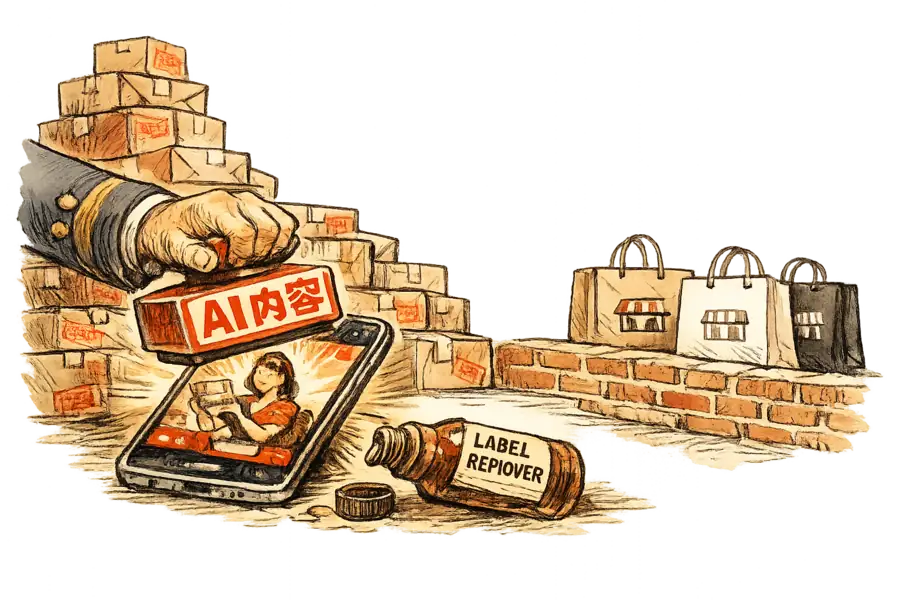
Enforcement came in February. Regulators pulled more than 543,000 items and penalised 13,421 accounts across platforms that included Pinduoduo, and among the targets were sellers hawking software to strip the AI mark from a file. A market in label-removal had formed before the West built the label.
The Western reflex is to call this censorship and look away. But the West’s own rules police deception, not provenance: Etsy asks sellers to disclose AI use in their listing copy, and Etsy’s own enforcement moves only once a shopper has been fooled. The obligation is on the seller’s conscience, not in the file. China marks the content at the source and punishes in the rankings; the West waits for a complaint.
The West’s one scheduled answer is European. The AI Act’s marking rules land on 2 August 2026, nearly a year behind Beijing, and they bind the toolmakers more directly than the marketplaces that list the goods. When they land, they will look a great deal like the regime the West spent a year calling authoritarian.
A label is a small thing; the power to compel it, and to punish its erasure, is not.
China’s marketplaces and the West’s draw on the same factories and the same image tools. A seller who learns to label AI content for Pinduoduo does not forget that habit when the listing goes live on Amazon. The West will write its AI-content policy in time. It will find the template already set, in China, by the same platforms now landing parcels in every Western postal code.