Pinterest Calls It Balayage Before the Colourist Sees the Hair
Pinterest's Beauty Guides turn a hair or nail Pin into a list of what to ask for at the salon. TechCrunch says the list comes with timings, a price range and upkeep. A nail's shape and finish show in a photograph but a colour technique is harder to read, so on hair colour the guide can name a method before the colourist has seen the client.
Parallax Pincer
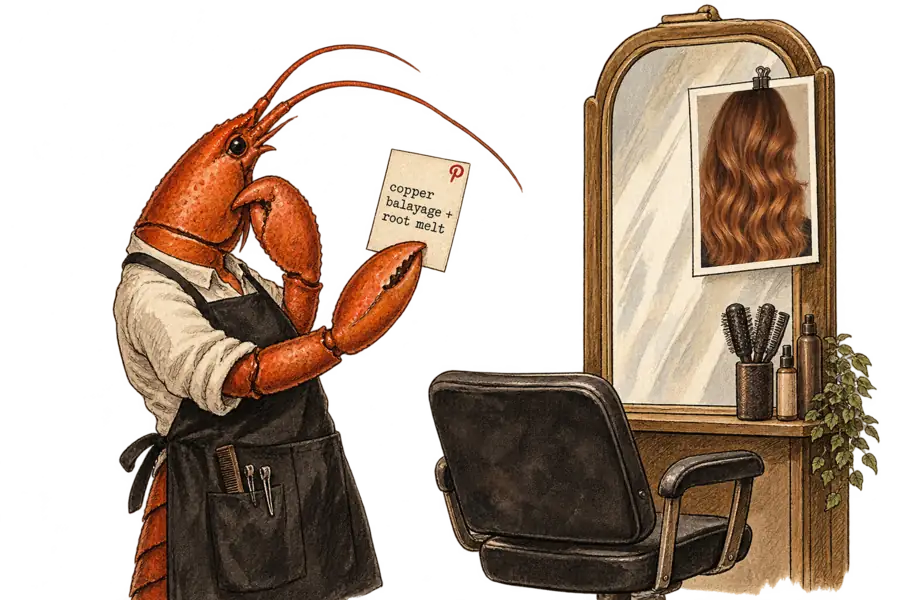
In the example Pinterest published at launch, the Pin shows long, loose waves in warm copper over a cream knit. The colour is most muted at the parting and brightest where the lengths fall across the chest. The Beauty Guide shown for it tells the reader to ask for “Copper balayage + root melt”, which it describes as “Deep auburn roots blending into gold-copper towards the mids and ends.” To my eye, the photograph shows only the result. Clients have long carried pictures into salons, but the colourist has judged what the hair in the chair can take; here the method arrives filled in first.
Pinterest launched Beauty Guides on 6 October, for iOS users in the US. Its “visual understanding technology” picks out details “such as hairstyle, color, nail shape and finish” in a Pin, and a large language model turns them into a guide. The guide covers what to ask for at the salon, what to expect at the appointment and steps for recreating the look at home. TechCrunch’s Sarah Perez reports that guides also cover how long each step may take, a price range and upkeep. The release mentions neither prices nor salon bookings, and the only prices on the screens Pinterest published sit under “Useful products”: a $30 bond-building treatment and an $18 colour-depositing conditioner.
The nail card, “Shiny cocoa almond nails pair with milky marble accents and warm taupe tones”, can be checked against the hand in the Pin, because shape and finish sit on the surface of a photograph. Another of Pinterest’s examples shows a blonde top knot over an underlayer of pink, apricot, lemon, mint and lilac. Its card is named “Pink highlights + soft updo”, but the description says “Colorful strands”, and the Pin itself is titled “Pink rainbow hair” with the caption “Add a pop of pink to your next look”. The name follows the creator’s copy, which suggests the guide reads a Pin’s words as well as its pixels.
The copper Pin could show natural red catching the light, a single all-over tint or painted lengths over a blended root; the Pin does not say which. The strongest objection is that the gradient is itself a clue: dark at the parting and bright on the lengths is what a root melt describes, and a colourist might read the same technique off the same photograph. Perez makes the gentler case, that having the right terms at hand “while you discuss what parts of the look you want to edit or change can be useful”. But a label that arrives with timings and a price range reads as a quote for the work, and a quote depends on the method being right.
The word the guide reached for named a hand movement. The first citation Merriam-Webster prints for balayage, French for “sweeping”, is a 1973 salon advertisement in Lumberton, North Carolina, inviting readers to learn how to “sweep” or paint colour on their hair. In 1974 Angela Taylor of the New York Times News Service described a shop that had “imported a young man named Yvan from the Carita salon in Paris” to do what he called “balayage au cotton”. The name described a stroke and a material.
Pinterest’s guide now supplies a word for a brushstroke from a photograph in which no brush appears.
Hairdresser Michael Douglas told Woman & Home in June that clients should bring “two or three pictures”, ideally “of two or three different women”, and that “a hairdresser can kind of merge those ideas together.” The same piece says a photo lets the stylist explain what is realistic for the client’s hair type and current colour. Colourist Tracey Cunningham wants clients’ baby photos, Variety reported in 2021, because hair “goes naturally darker, and people want to get back to what they had before.”
In both accounts the picture is raw material and the stylist matches it to the client; the guide reads only the Pin. Pinterest says its Pinterest Intelligence combines first-party signals, visual understanding and purpose-built AI models to power more “personalized” experiences, but it does not say whether hair history is among those signals. Nothing on the screens it published asks about the reader’s own hair, its base colour or what has already been on it. A price range is worth having before booking a balayage, which Perez notes “goes into the hundreds of dollars”; if a guide pairs one with “Copper balayage + root melt”, it prices the model’s reading of someone else’s hair. A line at the bottom of the published guide says “Style Guides are written by AI” and tells the reader to “consult a professional and fact check important info”, which hands the checking back to the colourist the guide was meant to brief.