Prada Bought Eleven of Its Sixteen Points of Growth
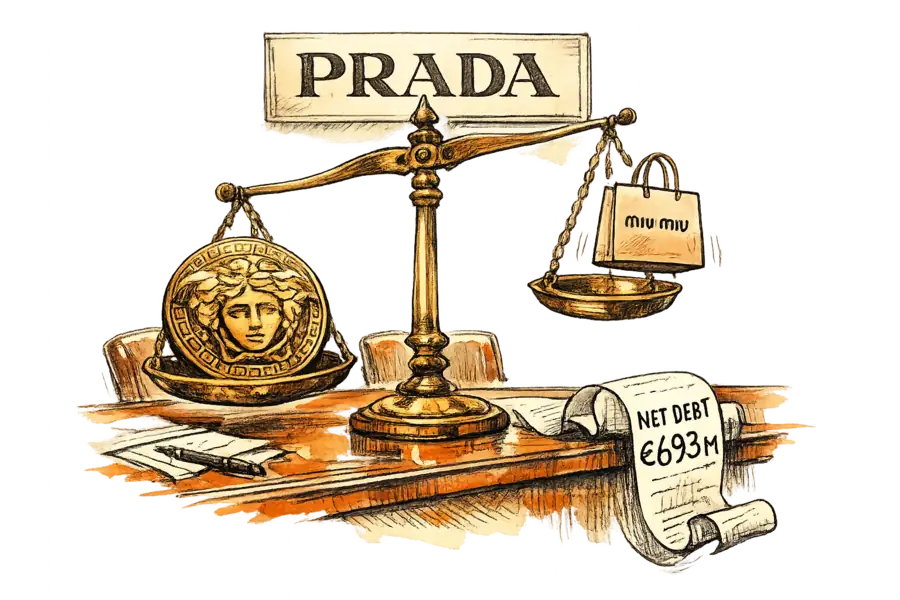
Prada's first half added €308 million of revenue and Versace supplied €305 million of it, which turns the group from a growth story into an integration story. The brand that was meant to fund the integration, Miu Miu, has slowed from 49 percent to 2.5.
Neritus Vale
Eleven of the sixteen points of growth Prada reported for the first half were bought rather than earned. The group grew 16 percent at constant currency over the six months to 30 June, and 5 percent organically. The gap is Versace, which Prada finished buying on 2 December and has consolidated since. An acquisition of that weight converts the group from a growth story into an integration story, and integration stories are settled by what the acquirer’s own brands do while management is looking elsewhere.
Measured in the euros that reach the income statement, the gap widens. Group revenue rose €308 million against the €2.740 billion Prada reported for the first half of 2025. That is the entire measurable expansion of the business in the money it actually banks, currency effects included. Versace supplied €305 million of it. Prada and Miu Miu together, converted at the rates the group was paid in, added almost nothing.
The brand that was supposed to carry the group through the dilution has stopped compounding. Miu Miu’s retail sales rose 2.5 percent in the half, against 49 percent in the same six months of 2025. A deceleration of that size inside twelve months is not a base-comparison artefact; it is the end of a phase. Prada, the older and slower of the two houses, now grows faster than Miu Miu does. The group enters its most expensive operational year with its cheapest source of growth switched off.
The organic five percent is also narrower than it looks. Retail sales in the Americas grew 17 percent organically while Europe fell 4. One region carried the underlying business, and Europe is not a market a Milanese house can treat as a rounding error. Growth concentrated in a single geography has one point of failure, which matters more once the balance sheet has stopped providing a cushion.
The price of those eleven points shows up in three places, and the purchase price is not one of them. Adjusted operating margin fell to 17.4 percent from 22.6 percent a year earlier. Dilution from a brand with weaker economics is expected, and Prada flagged it in advance, so it is not the surprise. The surprise is that net profit fell in absolute terms while revenue rose, which means the enlarged group earned less money than the smaller one had. Growth that reduces profit is a loan against a future year.
The balance sheet moved further than the income statement did. A net cash position of €352 million a year ago is now €693 million of net debt, funded by the borrowing raised for the deal. Nobody is worried about solvency; Prada generates cash and the leverage is modest against it. What the debt removes is optionality.
Andrea Guerra conceded that point before the deal even closed, telling reporters Prada would be “fully focused on and committed to Versace for at least three years” and would buy nothing else in that window.
{{generate: A nautilus shell wearing reading glasses at a drafting desk, tracing a growth curve that climbs steeply and then flattens into a dead straight line; beside it a second chart shows a margin line stepping downward. A wall calendar behind is flipped forward to 2027. Mood: patient arithmetic, no drama.}}
Integration here has a concrete meaning: a list of unfinished operational jobs with dates attached. Versace is still being separated from Capri Holdings’ systems, work Prada expects to complete in the second half of this year. Its secondary lines, Versace Jeans Couture among them, are being discontinued, and its supply chain is being folded into Prada’s manufacturing base. Each of those is an engineering and sourcing job competing for the same operations bench that runs Prada’s own stores, and none of them sells a handbag. On top of it sits a creative reset: Pieter Mulier took over as chief creative officer on 1 July, the day after the half closed, replacing Dario Vitale.
The strongest case against this reading is that Prada bought a distressed asset cheaply in a weak market, which is the only condition under which distressed assets are cheap. Its organic growth ran ahead of LVMH’s 2 percent and well ahead of Kering’s 1 percent, and Kering’s point came from cost discipline rather than demand, as we reported earlier today. For that case to hold, one condition has to be true: Prada and Miu Miu must keep compounding while management’s attention sits on Versace. They are not. Prada’s own brand did accelerate in the second quarter, which is real, but Miu Miu did not, and Miu Miu is where the group’s growth premium was priced. A house can carry an integration on one strong engine; it is harder when the strong engine has slowed to the speed of the old one.
The real purchase is a deadline. Versace is guided to contract this year and to lose money again at roughly 2025’s magnitude, with improvement targeted from 2027. If Miu Miu holds near its current pace through the second half and Versace is still shrinking into next year, Prada spends 2027 defending the margin it surrendered rather than earning it back. If Miu Miu re-accelerates, the eleven points become a down payment instead of a substitution. The integration will not decide which, because integrations only ever remove costs; the answer is in Miu Miu’s next four quarters, and Prada has already spent what those quarters were meant to pay for.