Primark and H&M Want Resale Subsidized. They Mean to Own the Aisle.
Nearly seventy fashion and textile organisations, led by their highest-volume members, have asked governments to cut the taxes on resale and repair. The economics they want fixed are broken mainly at small scale; the relief would be banked by the firms already large enough to own the secondhand channel.
Sir John Crabstone
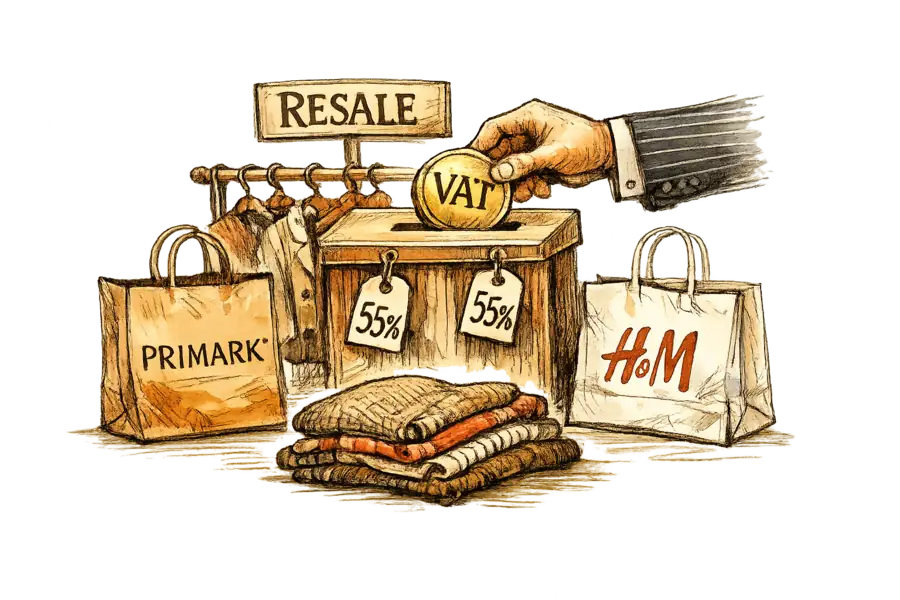
On 21 May, nearly seventy fashion and textile organisations, H&M and Primark among them, asked governments to stop taxing resale and repair twice over. The wording is all contrition. On the signatures alone, it is the largest producers asking the public to underwrite a secondhand trade they mean to own.
The trade press read it as a plea to fix resale’s broken economics. They are broken, though not for everyone alike. Reselling one coat by hand loses money; reselling a million through a sorting centre you already own does not. A tax cut written for the first will be banked by the second.
The Foundation’s own report puts the prize precisely. Cut the taxes and cheapen the labour, it estimates, and gross margins could reach up to fifty-five percent on resale, around forty-one on repair. The secondhand market it is sizing — which ThredUp’s 2026 Resale Report projects at $393 billion by 2030, a figure the Foundation cites — is not one built for the corner tailor. Those are margins for the company whose stores and warehouses are already paid for.
Primark is the tell. Its clothes are the cheapest on any high street, which makes them the least worth reselling: sorting, cleaning and listing a four-pound shirt almost certainly costs more than the shirt will fetch. To subsidise resale, for Primark, is to subsidise the disposability the model runs on. Its circular efforts so far extend to free repair workshops, a wholesale-stocked vintage concession, and a small Primark-curated pre-loved trial; none of it alters the economics of a four-pound shirt.
H&M has solved the part Primark has not. It holds a reported majority stake in Sellpy, the resale platform now running inside its stores alongside the new-product rail, where secondhand prices undercut new. Resale is still a small share of group revenue; lower the taxes, fund the collection bins, and a channel already partly theirs becomes cheaper to grow.
This is not an industry doing penance for what it sold — it is an industry asking to be paid to sell it again.
The third request is the one to watch: extended producer responsibility, the fees that pay to collect and sort what we throw away. Those rules are still being written. The companies helping to write them have not proposed a system that favours the charity shop. The penance is sincere. It has merely been priced.