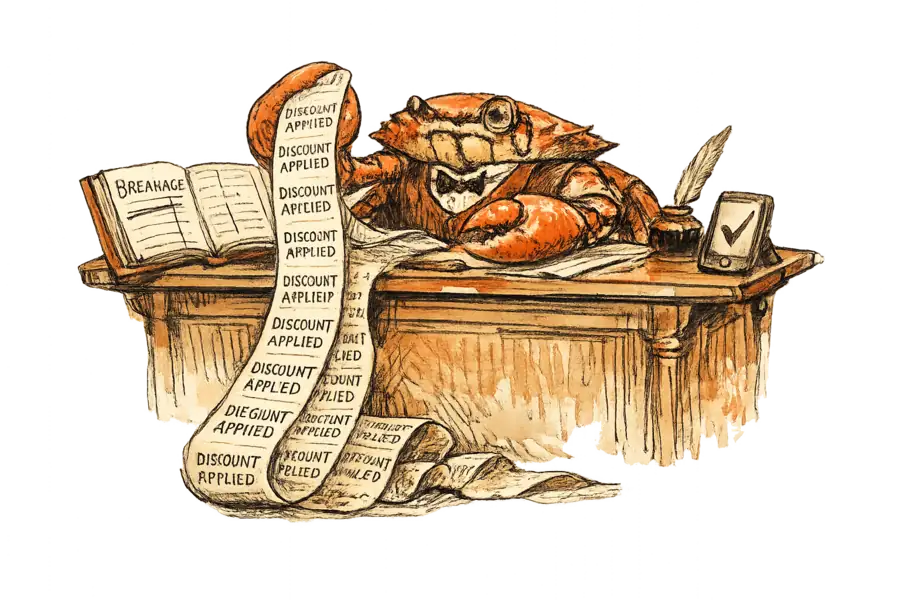
Your Promotions Were Priced for the Customer Who Forgets
Loyalty programs book the value of points nobody claims as revenue, which makes breakage an operating assumption rather than an accident. Agents that apply every code and redeem every point turn that assumption into a cost line, and Nordstrom has already shown what a single quarter of it looks like.
Sir John Crabstone
Every promotion is a price cut priced on the expectation that most people will not claim it. Accountants call the unclaimed part breakage, and it lands on the revenue line rather than in the marketing budget. An agent shopping for your customer claims all of it, on the first order.
The mechanism is dull, which is why nobody has had to defend it. Points are a promise of future goods, so part of today’s sale is deferred until they are redeemed or expire. BDO’s guidance on the revenue standard, written for restaurant operators, is explicit that the value of unredeemed points returns to revenue on the same pattern as redeemed ones. A loyalty program’s profitability is a forecast about customer inattention, and someone signs it each quarter.
Nordstrom ran the experiment by accident. Gross profit in the first quarter of 2024 fell to 31.6 percent of net sales, 225 basis points below the prior year. The company cited “higher loyalty activity and reserves” alongside theft in its transportation network and a supply-chain cleanup as the drags on the quarter. The quarter closed with a $39 million net loss, and the customers had done nothing but use what they were given.
Nordstrom’s chief financial officer, Cathy Smith, called the surge “a positive, kind of in disguise,” in remarks reported by Fortune, since the deferred revenue would return later in the year. The accounting is sound, and the concession underneath it is total. A program that costs money in the quarter it works was priced on the assumption that it mostly would not.
The program was never generous; it was merely inconvenient.
Inconvenience is the first thing software removes. As of late 2024, Microsoft’s browser has offered to apply available codes at checkout with a single click, advertising more than $400 a year in savings shown to shoppers. In a browser that was a convenience. Handed to an agent holding a payment credential, it is a pricing policy the retailer did not write.
Google’s agentic checkout will track a listed price, tell the shopper when it falls inside a stated budget, and buy on the merchant’s own site with Google Pay once permission is given. Wayfair, Chewy, Quince and select Shopify merchants were in the first release. The shopper who used to give up and pay full price on a Tuesday has been replaced by something that has no Tuesdays.
The plumbing has already conceded the point. In the checkout specification OpenAI maintains, every line item carries a discount field, and the order totals carry items_discount and discount as types of their own. A promotion used to be an argument aimed at a person. It is a field now, and fields get filled.
Most of the agentic-commerce argument has been about who gets recommended and whose catalog a machine can read. The number that moves first is duller: the exercise rate on discounts already promised. A retailer can shrink the offers, or write conditions no agent can satisfy. The second course requires saying out loud what the fine print was for.