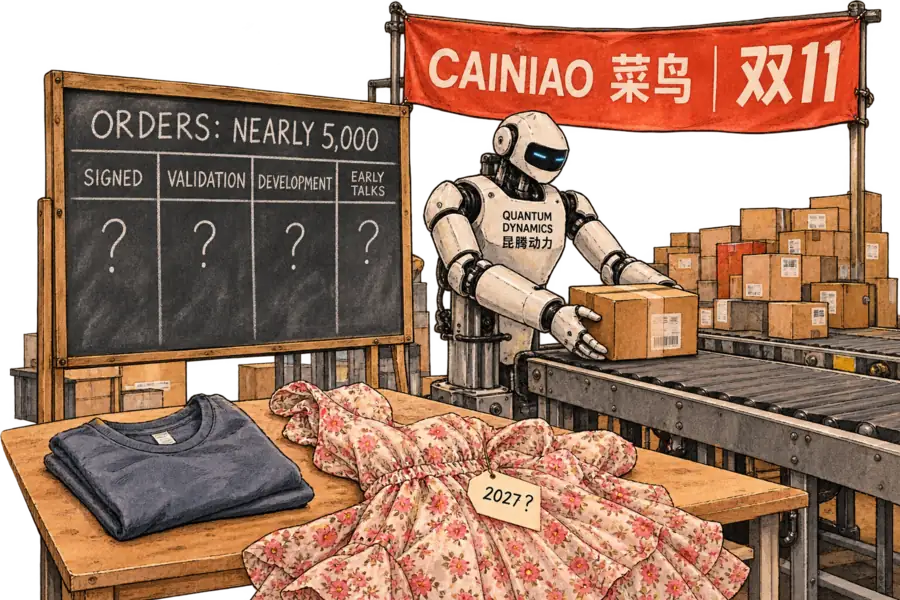
Nearly 5,000 Robot Orders at Quantum Dynamics Run From Contracts to Early Talks
Quantum Dynamics, the warehouse-robot start-up of Cainiao's former CTO, says its robots worked Double 11 and that it holds batch orders for nearly 5,000. Its investor's write-up places those orders anywhere from signed contracts to early talks, and neither source defines the 99% success rate or counts interventions.
Sir John Crabstone
Robots from Quantum Dynamics (昆腾动力), the Hangzhou start-up of Cainiao’s former technology chief, Li Qiang, worked Double 11 at Cainiao, Pandaily reported on 13 November. The company also claims batch orders for nearly 5,000 robots. Pandaily itself says that figure is not a delivered fleet, and no published account splits the signed contracts from the early talks.
Pandaily’s two sources are the company and one of its investors. The first is a company statement QbitAI (量子位) ran on 12 November; its footer says Quantum Dynamics supplied it (本文由昆腾动力提供).
The second, a post by Yunqi Partners (云启资本), mirrored on elsewhere.news, reprints an interview with Li from the WeChat outlet 新智驾. Yunqi co-invested in the start-up’s seed round of more than ¥100m (超亿元种子轮融资); Pandaily does not mention the stake.
Yunqi’s own summary is candid about the orders. They cover weighing, feeding, labelling, picking and packing, at the signing, validation, development or early-talks stage (分别处于签单、验证、研发或接洽阶段). No split is given.
An order still in early talks is a conversation with a number attached.
What is running is modest. For now, Li says, a warehouse may hold only a few embodied robots.
Li’s 2027 goal, given to the investment site 投中网 in July, was more than 1,000 robots working every day. The order book is nearly five times that.
The statement’s showcase customer is a leading domestic cross-border platform (国内一头部跨境电商平台). Talks began in July, robots entered a warehouse in September, and batch contracts began to be signed in October.
Li gives the same months for the first warehouse trial, at Alibaba Group’s international logistics department. Neither text calls them one customer; the calendars match. The first paying customer, which runs warehousing for high-end beauty and luxury goods, paid around September for a product not yet fully ready, and had not yet had robots in its warehouse.
The statement’s dual-arm robot feeds over 1,200 parcels an hour onto sorting lines at a 99% success rate (成功率99%). Success is not defined. If it means first attempts, about a dozen parcels an hour fail.
Yunqi’s preface repeats the 1,200 and 99%, but Li’s own answers do not. He says the vision-language model handles most recoveries and remote human help is used relatively little (目前实际使用得比较少). On site, humans fill in whatever the robot leaves, and very heavy or odd-shaped parcels stay with them.
Li’s yardstick is a person at about 600 parcels an hour on weighing; the robot reaches that only in some periods. Later tasks run at about half, near 300 an hour. The highest success rate he cites is about 95% (95%左右), after a first task that began in the 60s. That figure and the 99% come from different tasks and times.
Double 11 piles parcels up fast, the statement says, and the robots kept running (持续运行). It does not say how well.
Clothes are harder than parcels. Li has shelved a project to unpack, inspect and refold a client’s clothes, though he has not abandoned it. Men’s T-shirts and shirts were manageable; dresses and irregular womenswear (款式比较复杂、不规则的时尚女装) were far harder.
In returns work scoped with the logistics firm Kejie (科捷), the statement describes a need in which staff check returned shoes and clothes (商品检查由人工完成) while robots shelve them overnight. It says the first pilot is signed and being implemented, and it claims repeat purchases. In that plan the person keeps the judgement; the robot gets the shelf.
Jack’s sewing robot, as we reported, also offered signatures as evidence of demand. Quantum Dynamics’ orders have no published delivery date, and Li expects to revisit womenswear in 2027 or 2028, once the robot’s planning and handling both improve.