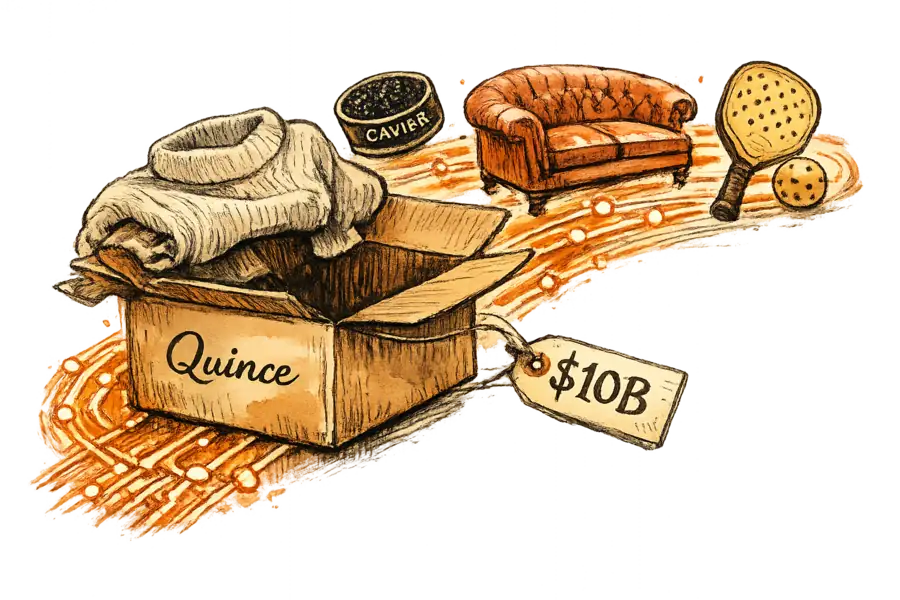
Quince Is Worth $10 Billion. The Brand Was Optional.
Quince's $500M round at a $10.1 billion valuation is being read as a cashmere brand growing up. It is better read as the price of a sourcing-and-listing machine built to carry any category without a brand at its center.
Neritus Vale
Quince raised $500 million in March at a $10.1 billion valuation, and most of the coverage filed it under a familiar headline: the cashmere company grew up. That headline mistakes the asset. ICONIQ and its co-investors were not buying a sweater. They were buying a sourcing-and-listing system designed to hold a sprawling catalog together with no brand at its center. The cashmere never changed; what changed is how much the machine underneath could carry, and what it could carry turned out to have no obvious edge.
The system is a manufacturer-to-consumer model that treats forecasting, not branding, as its core skill. Quince owns most of its technology stack and controls its manufacturing through direct factory relationships, which lets it forecast demand weekly down to individual sizes and test small batches before committing to volume. Top-line revenue passed $1 billion last year, the company says. That figure matters less than its slope: triple-digit growth, sustained every fiscal year, is what a working forecasting loop looks like from the outside. ICONIQ’s own note calls AI something that “amplifies every part of the system,” sharpening demand signals and compressing the time from design to shelf. Strip away the cashmere and what remains is a guessing engine wearing a storefront.
The deliberate thinness of the Quince brand is the part the coverage reads as style and should read as architecture. A strong brand is a boundary: it tells the customer what the company is for, which is the same as telling them what it is not for. Patagonia cannot credibly sell caviar; the name means something too specific. Quince’s name was built to mean almost nothing beyond “the thing you wanted, made cheaply and shipped straight to you,” and a name stripped of categorical meaning has almost nowhere it cannot go. That emptiness is not a marketing failure. It is the precondition for a catalog that can add a category without contradicting itself.
The catalog’s reach is the evidence that the design works. Quince now sells a seven-foot curved-arm sofa in performance velvet from $1,450, alongside rugs it sources through importers and tableware it drop-ships from East Fork and Jean Dubost. It also sells a tin of caviar, vitamins, Dopp kits, and pickleball paddles. On its own site the company benchmarks its home goods against RH, Serena & Lily, and West Elm rather than against apparel labels; the closest structural analogue is Costco, a trusted buyer that will stock anything its sourcing can reach and its members will believe in. None of this is brand extension in the usual sense, because there is no brand essence being stretched. There is only a sourcing function pointed at a new shelf.
Quince’s real product is the credibility of a factory that ships straight to your door, and that credibility belongs to no category in particular.
The strongest case against this reading is that the glue is trust, not software. Trust is brittle exactly where Quince is now headed. By this argument the catalog is held together by one learned belief, that Quince delivers surprising quality at an implausible price, and that belief was cheap to earn on a $50 sweater a customer could return for a year. It is far more expensive to honor in furniture, where a disappointed buyer gets seven days to send a sofa back, against the year Quince grants on soft goods. If the promise breaks in even one high-consideration category, the halo that lets a sweater seller move furniture inverts, and the catalog reverts to a pile of unrelated listings no model can bind. That seven-day window is Quince conceding, in its own return policy, that it knows the risk.
The model’s cost advantage has a second exposure. Quince built its prices partly on the de minimis tariff exemption, which let it ship small international packages through customs without duties; that exemption has since been suspended. Factory relationships, without the regulatory tailwind, must now carry the price gap alone.
That objection is real, and the early evidence runs against it. ICONIQ reports that a significant share of revenue already comes from repeat customers buying across categories, which means the quality belief is transferring from one shelf to the next rather than staying trapped in cashmere. The brand-light design is what makes the transfer cheap: because the name carries no category-specific meaning, trust earned on a sweater generalizes into a belief about sourcing that travels to any shelf. A logo-heavy brand cannot do this, because its meaning is also its fence. The honest limit on the thesis is narrower than the objection claims. Trust clearly transfers; the open question is only whether quality holds in the categories where it cannot be faked, and that is a question about factories, which is the one thing this system was built to control.
If the sourcing system keeps closing the loop between customer and factory faster than its rivals, the lesson of Quince’s $10 billion is not about Quince at all. It is that the brand, long treated as the one asset a retailer could not outsource, may be the most optional thing it owns. For most of a century the brand was the store of trust that justified the markup; Quince’s wager is that a fast enough supply chain produces that trust directly, in quality and price, and hands the markup back to the buyer. The forecast is conditional, and the condition is exact: it holds only as long as the factories deliver in the categories no model can rescue. If they do, every brand-heavy rival inherits a question it has never had to answer, namely what its brand is worth once customers can buy the quality without it. That question is no longer about cashmere — it is a price every retailer will now have to name.