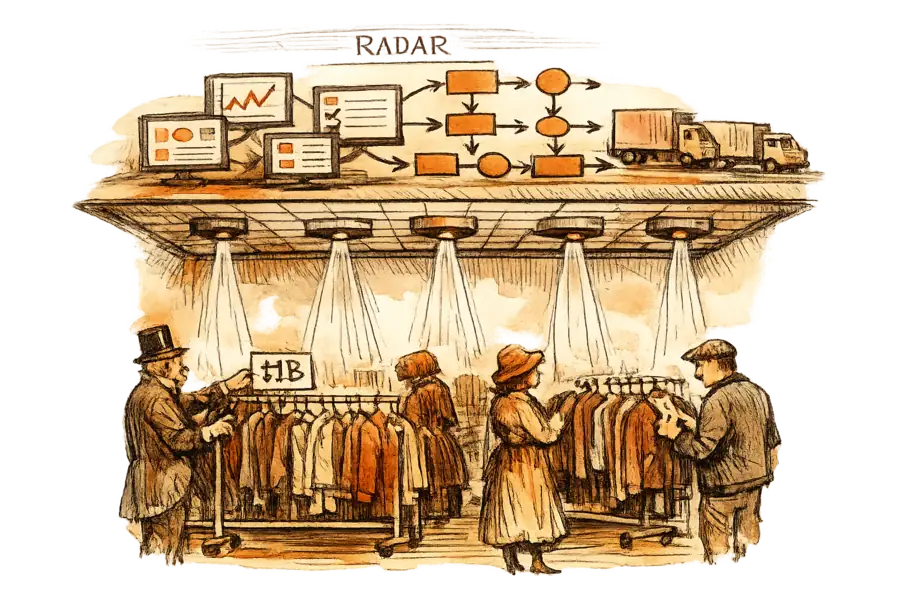
RADAR Priced the Layer Above the Shelf at $1 Billion
RADAR's $170 million Series B at a $1 billion valuation is capital betting that retail's durable AI margin sits in the decision layer above merchandising, not in the point tools that count stock. The wager only pays if retailers let the store's continuous record drive their decisions rather than merely display them.
Neritus Vale
RADAR raised $170 million this month at a valuation of $1 billion, and almost none of that price is for the hardware on the ceiling. The round is a wager that retail’s AI margin will settle in the layer that turns what a store knows into what a store does, above the point tools that count stock or scan shelves. Capital is moving toward platforms that call themselves retail intelligence, and the bet beneath the label is that this decision layer, sitting above merchandising, is the part rivals cannot cheaply copy.
RADAR sells overhead RFID: ceiling-mounted sensors that read every tagged item and refresh a full inventory snapshot every eight seconds, at a claimed 99% accuracy. The feed follows each garment across the sales floor, stockroom and fitting room, and the software turns those raw location signals into replenishment alerts, fulfillment routing and loss-prevention flags. Accuracy is the wedge, not the point. The point is the claim to hold the only continuous, item-level record of everything that moves inside a store.
The physics here is not new; the story around it is. RADAR has been building overhead RFID since 2013 and did not raise a $30 million Series A until 2023, a decade after the company started. The hardware barely changed between that round and this one. What changed is the category RADAR is allowed to claim, from inventory accuracy, a line item, to retail intelligence, a layer. The company now promises what it calls “one of the world’s largest datasets on in-store customer and product interactions,” and its lead investor calls the physical store a “blind spot in an otherwise data-driven economy.” A billion-dollar valuation is paying for that second description, not the first.
The bet on a decision layer is a bet about where switching costs build up. A point tool answers one question, how many of a SKU sit on the floor, and a retailer can replace it with a cheaper reader without changing how it works. A platform that routes replenishment, fulfillment and markdowns off its own data becomes the thing those decisions depend on, and pulling it out means going blind again. RADAR is narrow in the stack, owning both the sensor and the software, but wide across store functions, which is what the word intelligence is meant to signal. The same word is spreading across the field: Simbe reads shelves with camera-equipped robots instead of RFID, yet sells the identical noun, branding its product a Store Intelligence platform. When two companies built on opposite sensors reach for the same word, the word marks where capital thinks the margin sits.
Above merchandising is a claim about margin, not org charts. Merchandising software (planning, allocation, pricing) sells into a crowded budget and competes on features incumbents can match within a release cycle. The layer that sits over those tools, deciding which one fires and on what evidence, is harder to dislodge because it owns the inputs the others run on, and its margins do not erode the way a hardware maker’s do. RADAR’s new finance chief came from the autonomous-vehicle company Nuro, after an early stint on Uber’s finance team, a hire that reads as a capital-intensive race to own a layer, not a tidy software business. That is the logic now pulling nine-figure checks toward intelligence and away from the single-purpose tools beneath it.
Whoever owns the continuous record of what moves inside the store owns the decisions made from it, and that ownership, not the sensor, is the whole theory of the round.
The strongest case against the round is that RADAR is a point tool wearing a platform’s valuation. It is deployed in more than 1,400 stores, fleet-wide at American Eagle and at Old Navy, which proves the hardware works and proves nothing about the decision layer. A retailer can buy overhead RFID to do one valuable thing, cut stockouts, and leave every consequential decision where it already lives, in the planning systems it runs or the judgment of its buyers. On that reading the decision layer is a slide, not a product, and the data dies in a dashboard someone checks before doing what they meant to do anyway. The use-of-funds bill gives the worry weight: it leads with more deployments and next-generation sensor hardware, the capital-hungry economics of a fleet operator, and lists autonomous checkout as something still to be built. Thirteen years on, a company selling an intelligence layer is still mostly installing hardware.
The answer is that the two products differ in kind, not degree, and that difference is either the moat or the mirage. A reader that reports a number can be swapped for a cheaper reader that reports the same number. What RADAR holds instead is a continuous spatial record of every item’s movement, the substrate decisions are made from. A retailer that has routed fulfillment through it for two years cannot pull it out without going dark. The switching cost lives in the data, not the accuracy. The moat only forms, though, if a retailer lets that data drive its choices instead of merely describing them, and that is the retailer’s call, not RADAR’s.
The verdict on the round will not show up in the valuation; it will show up in what American Eagle’s buyers do with what the ceiling sees. If their orders change because RADAR’s record contradicts their plan, capital has found the one layer in retail that point tools cannot reach, and the next nine-figure rounds will follow whoever captures the most of what happens inside the store. If the orders do not change, a billion dollars has bought the most accurate inventory count in retail and agreed to call it intelligence. The sensors were always going to work. The open question is whether anyone lets them decide.