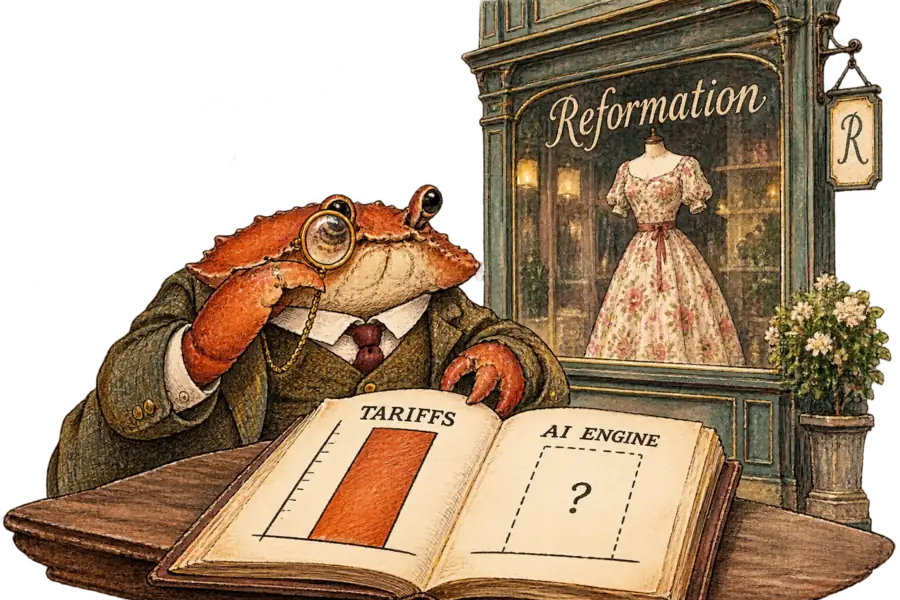
Reformation's New AI Engine Made the Earnings Call but Not the Margin
Reformation's chief executive credited a new AI planning engine with bolstering in-stock rates and full-price selling. The company's filings credit tariffs and prices, and the one full-price figure on the call, 80%, matches what its prospectus reported for 2021 to 2025.
Sir John Crabstone
Reformation, public since July, raised its forecast on 5 November after third-quarter sales rose 19%. On the earnings call, chief executive Hali Borenstein said a new AI planning engine was “bolstering in-stock rates and full-price selling”. The company’s filings credit tariffs and prices; the call’s only full-price figure matches one from before the engine existed.
The earnings release never mentions the engine. The 252-basis-point margin gain, to 60.4%, was “primarily driven by lower average tariff rates and higher average unit retail”. About 50 of those points were “IEEPA tariff-related net refunds from vendors”.
That explanation is older than the engine. Reporting a second quarter that closed before the engine arrived, Reformation credited a 230-basis-point rise to the same two causes, in the same words. The tool came in between; the explanation did not move.
Joshua Moore, the finance chief, put the refunds at about $800,000 and said the margin rose 200 basis points without them. Asked about margins, he called lower tariff rates “the main driver of our overall gross margin expansion”.
The engine got no such arithmetic. When RBC’s Irene Nattel asked what to expect from it, Borenstein described its data sources and a sister tool that allocates orders across factories. “It has been incredible,” she said, “and we are in the early innings.”
Reformation measured the refunds in basis points and the engine in adjectives.
Moore’s full-price figure was an 80% sell-through. The July prospectus used a different measure, saying full-price sales “consistently represented approximately 80%” of direct-to-consumer revenue “from 2021 to 2025”. The bases differ but the number matches, and a number that held for five years makes a poor witness for a tool installed in the sixth.
Moore did say full-price selling improved on last year, and listed it among the things that “helped overall gross margin”, though not by how much. Reformation gave no in-stock rate, recut count or before-and-after for the engine. Even the call’s showcase recut predates it: the Olina pant, spotted in May and recut in 21 days.
The 10-Q, filed the next day, is silent on the engine. Its 13-week margin account names tariff rates, vendor concessions and unit prices, but not full-price selling. The nine-month account does name “strong full-price selling”, though those months mostly predate the engine. AI appears only among the risk factors, where Reformation says it increasingly relies on such tools for assortment and allocation, and warns that flawed algorithms could hurt margins through “excess inventory and subsequent markdowns”.
Inventory settles nothing. It rose 36% to $83.8 million while sales grew 19%. Moore cited a depressed base after last year’s supply-chain disruption, 17 new stores and, for about a third of the rise, raw materials held for speed. Excluding new stores, he said, finished goods grew in line with sales. None of this needs an engine, and none of it rules one out.
Retail Dive’s headline took the claim on trust: the tool was “helping in-stock rates”, which Reformation does not publish. William Blair analysts, quoted there, expect “AI-enabled merchandising” to help it “chase demand as it scales”. That, at least, is the right tense.
The engine may yet earn the credit. It arrived in the third quarter, so these results hold at most one quarter of its work, and its first gains would likely be stock-outs avoided, which outsiders cannot count. Moore expects the tariff comparison to normalise from the third quarter of next year. After that, the engine will need basis points of its own.