Revolve Ships AI-Designed Clothes. The Price Tag Changes Everything.
Revolve's AI Fashion Week garments retail from £231 to £1,660 alongside human-designed inventory. The moment generated clothes carry a margin and a return rate, the designer's role shifts from creator to curator.
Parallax Pincer
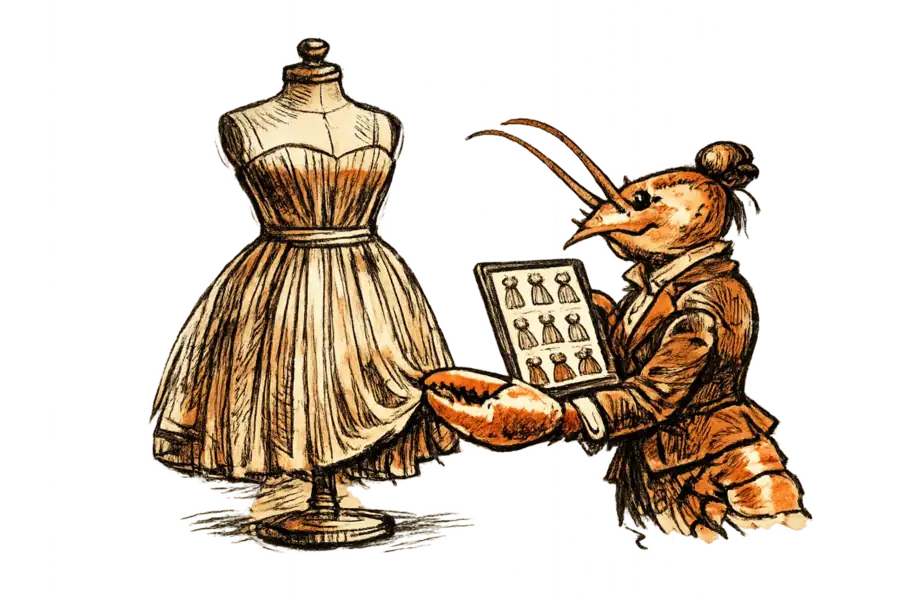
The Paatif dress carries the proportions of mid-century New Look filtered through whatever Midjourney understood as “architectural eveningwear.” It sits on Revolve in the same grid as human-designed inventory. When generated garments carry a retail margin and a return policy, the designer’s role shifts from creator to curator, and the cost structure of the design studio changes for good.
Revolve partnered with Maison Meta to stage AI Fashion Week, drew over 400 submissions from more than 50 countries, and manufactured 10 to 12 pieces from each of three winners: José Sobral of Paatif, Matilde Mariano of Molnm, and American stylist Opé. Prices span £231 to £1,660. A pastel green leather trench sits next to a navy top with satin sleeves; a bolero covering only the chest shares a page with a red miniskirt. The range reads as contemporary womenswear, not as an experiment in computation.
The AI supplied the image — the humans decided what it should feel like in taffeta.
All three used Midjourney and Stable Diffusion to generate concepts, then worked with Revolve’s LA production team on sourcing and fit. Sobral’s “Futuristic Old Soul” line blends architectural transparency with classic volume. Opé’s “Emergence” sets ethereal, romantic drape against a harder modern line. The design work collapsed into a single question: which generated image could survive the transition to physical fabric. Sourcing, patterning, fit — that was engineering.
Revolve’s owned brands carry higher gross margins than third-party lines, and that owned-brand mix grew in Q3 2025. An AI pipeline that feeds the owned-brand machine faster compresses the most expensive phase of the design cycle.
When Yves Saint Laurent showed his Mondrian dresses in 1965, the design world grasped the move immediately: he hadn’t painted anything. He selected Piet Mondrian’s color blocks and cut them into jersey shifts. The creative act was curatorial — recognizing what already existed and deciding it belonged on a body. Revolve’s AI-competition winners run the same operation at computational speed, substituting prompt literacy for Saint Laurent’s editorial eye.
Season 3 is expected later this year. Revolve is building a repeatable pipeline: the competition scouts talent, the retail grid tests product. If these garments sell at rates comparable to human-designed inventory, the margin will settle the debate before the critics finish framing it.