Rosso Says OTB Clients Can Try the Fit. Google's Try-On API Has No Field for Size.
Renzo Rosso says OTB's Google-built try-on lets customers try the fit and lifts average spend among those who use it. Google's Cloud try-on API takes a person photo and a product photo but no size or measurement, Google's own shopping help page disclaims fit, and the users are customers their advisors selected.
Parallax Pincer
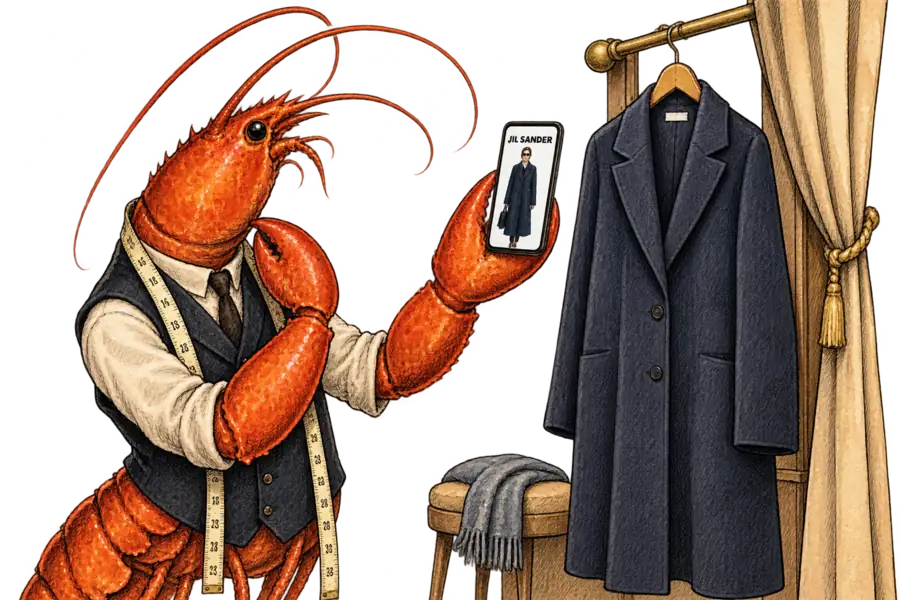
In the picture, a young man wears a navy Jil Sander coat with a concealed placket, a patch pocket on the chest and dropped shoulders, its hem straight at mid-thigh. Renzo Rosso, chairman of OTB, which owns Jil Sander, Diesel and Maison Margiela, says the tool behind such images lets customers try the fit, and that those who use it spend more. Google’s Virtual Try-On API, which the tool runs on, has no field for the coat’s size or the man’s, and nothing in its documentation tells the AI model where the hem should land. OTB’s own layer on top of it is not documented, and the customers who spend more are ones their advisors had already picked.

Press images FashionUnited ran in May include a screenshot of a session: a Jil Sander “styling edit” in a phone browser at vto.jilsander.com, curated by a named member of staff at the brand’s Rinascente shop in Milan. Diesel’s version runs at vto.diesel.com. The opening photo shows a man in a pale blue V-neck, grey pleated trousers and loafers, and it looks like a studio model shot rather than a client’s own picture. A separate image from the same set, which appears to be the result, keeps the man and changes everything he wears, down to cream trousers and woven black shoes. The rendering is careful: the placket runs straight, the pocket sits square, and the cloth breaks softly under the arm.


Rosso spoke on stage at Google’s Think Style Unfold event in Milan on 14 October. In FashionUnited’s English translation, he said: “Thanks to the Virtual Try-On, we can digitally dress the customer, allowing them to try the fit of the garments.” He added that the system is “starting to deliver good results, including an increase in the average spend among customers who have used this tool”. FashionUnited’s Press Club write-up is headlined “Google’s virtual try-on boosts OTB’s average spend”, but it gives no figure, no time frame and no comparison group. The Italian page names the metric as the scontrino medio, the average receipt, and uses the English word for what customers try: “il fit dei capi”.
Google’s API reference lists what a try-on request can carry: a person image, a product image with an optional mask and text description, and a prompt. Its nine parameters set things like image count, seed, safety filters and the watermark. No field in either list holds a size, a height or a measurement. A size could travel only as free text, and the reference does not say the model reads one. OTB’s build runs on Google’s Gemini Enterprise Agent Platform and is tailored to each brand, according to the May release, so it may pass size along in ways the reference cannot show.
Google is blunter when it talks to shoppers. The help page for its consumer try-on in Search calls the result “a helpful vibe check”, says the image “does not determine or guarantee the actual fit of the garment”, and tells users to pick a size from charts and reviews “regardless of the size shown in the visualization”. The same page lets users “select the clothing size you typically wear” when building an avatar, to “improve body shape accuracy”. That consumer product is separate from the Cloud API OTB uses. Yet OTB and Google Cloud’s May release said the service lets customers “visualize exactly how specific items will look and fit on them with a high degree of realism”.
OTB owns the house that once made size the whole design.
In autumn/winter 2000-01, Maison Martin Margiela blew up archetypal garments, the trench among them, to “an Italian size 78 or 80”, MoMu in Antwerp records. Every element, “the zips, buttons, pockets”, was “extended, all in proportion”, and the pieces “do not fit the wearer’s body and do not come in predefined commercial sizes”. A garment scaled up in every element looks much like the stock size in a cropped photograph, because the photograph carries no scale. If that is the image the tool takes, it could hand the client an ordinary trench and lose the oversized silhouette that was the point; that is inference, since the session screen shows the navy coat both on a model and flat, and OTB has not said which image the tool uses. The May release put Margiela’s rollout in “the coming months”, and the October write-up does not say whether it has arrived.
The spend claim has its selection built in. OTB designed the service, on a Google stack it shares across its brands, as “a premium clienteling tool” for advisors to share previews “with selected customers”. Those customers then, as Milano Finanza described the flow, supplied their own photo. My guess is that customers picked this way would outspend the average customer with no try-on at all. Rosso adds that the tool lets OTB “go beyond the single garment and offer a more complete styling experience”, and a complete look presumably rings up more pieces than a coat alone.
The May release says the pictures are there “to encourage in-store appointments to experience the products firsthand”. That is a sensible job for a convincing image, and it leaves the fit where it has always been tried, in a fitting room. The Jil Sander session screen keeps a running count, 17/25 Credits, and the tape measure stays in the shop.