Send Alexa Someone Else's Outfit and It Answers in Lookalikes
Amazon now lets invited US shoppers text Alexa for Shopping a photo of an outfit and get back similar products from its own catalogue. The picture is often someone else's work, and nothing Amazon has published gives its maker or its wearer a part in the sale.
Parallax Pincer
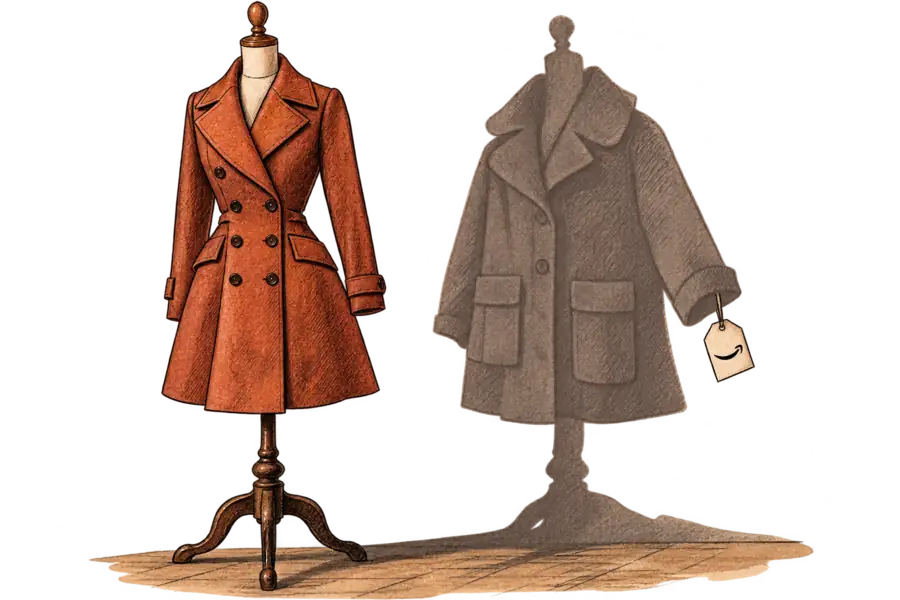
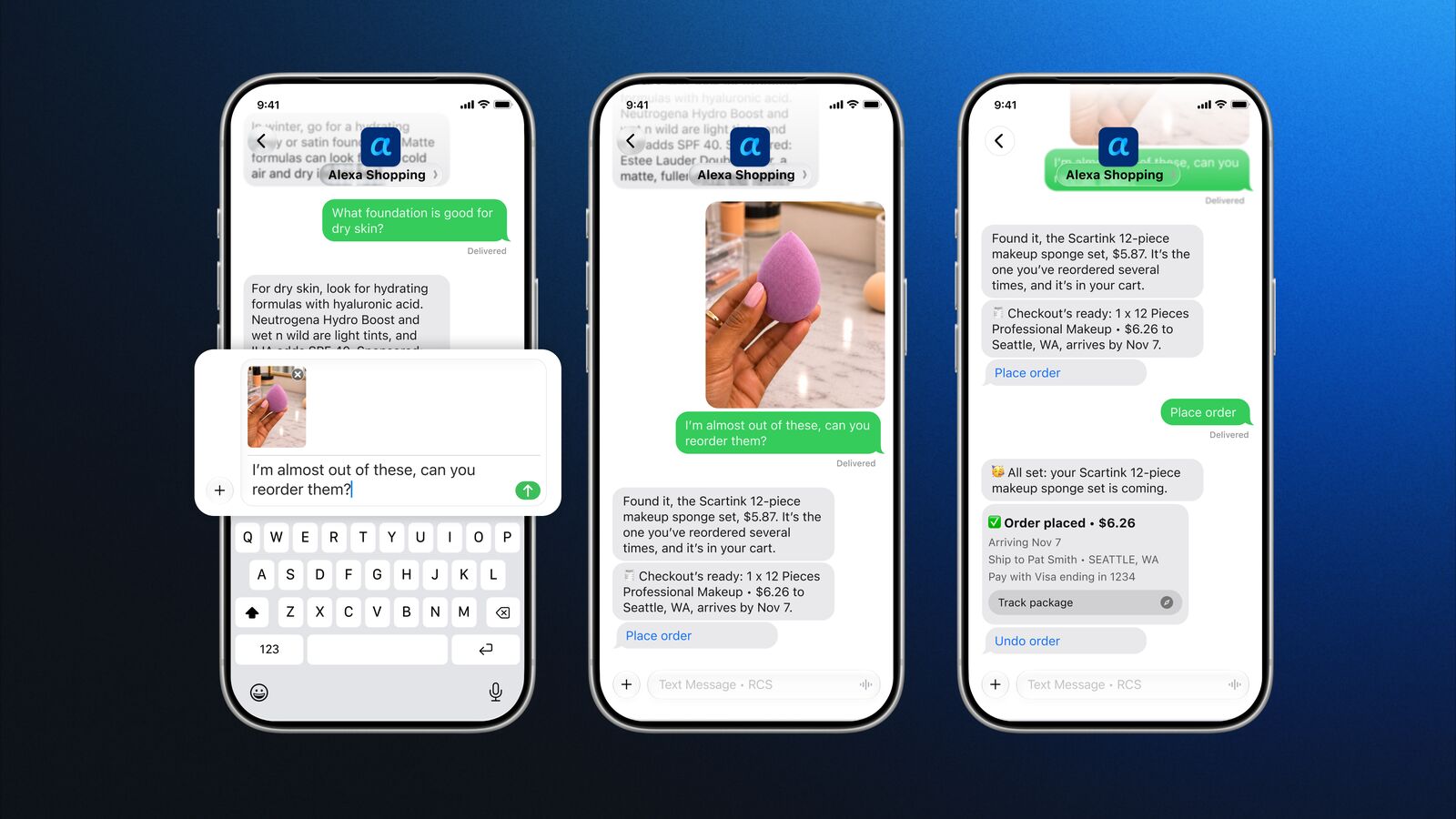
In Amazon’s demos, the only photo a shopper sends shows a makeup sponge: a purple teardrop with a velvet nap, pinched between pink-manicured fingers. A photo of “the outfit you spotted while scrolling”, which the announcement suggests sending, appears in none of them. That picture is often someone else’s work, and Alexa for Shopping turns it into “similar looks” from Amazon’s catalogue. Nothing Amazon has published gives the photographer or the wearer any part in that sale. Amazon also blocks rival shopping agents from its store.
Texting opened on 6 November to “a small group of U.S. customers by invitation only”, and “millions more customers” are promised in the coming weeks. The agent is not new: Amazon says more than 400 million customers used Alexa for Shopping in the last 12 months. Invitees “accept the terms, link your phone number, and start shopping.” The agent can “complete the purchase on your behalf” with the shopper’s approval, and it learns “personal preferences, shopping habits, and tastes”. The contact appears as “Alexa Shopping”, although The Verge reported it as “Amazon Alexa”.
The announcement’s photo tip covers anything spotted “while scrolling or out in the world”, promising that Alexa “finds similar products on Amazon.” TechCrunch’s Ivan Mehta described users sharing “a picture of an item or someone wearing an outfit”. The same report noted that Amazon “blocked Meta’s Muse from querying its site in September”, a block we covered at the time. Whenever the scrolling happens off Amazon, another platform supplies the picture and Amazon supplies the answer.
Amazon has not said whether a reply will name the brand in a photo of someone else’s outfit. The Verge’s opening paragraph has Alexa searching for “matching results in Amazon listings”; further down, the same piece says “similar products”. Amazon’s own sign-up page offers a photo search “to find similar items”. The demo’s sponge comes back named, but it is “the one you’ve reordered several times”, so the shopper’s order history supplies the name. Texting is “invite-only right now, and only available in the US”.
Amazon has not said how the texting matcher works. StyleSnap weighed “brand, price range, and customer reviews” in 2019, so a lookalike search need not be purely visual. Still, a photograph carries colour, outline and print; it can only hint at fibre, weight and the way double-faced wool falls from a shoulder. Those are much of what separates a coat from its copy. Our 6 November piece reported a benchmark in which photos weakened research agents’ following of shopper preferences, and 35.2% of 125 sampled failures picked the item closer to the photo. No retailer assistant, Alexa included, was tested.
Amazon has built this search before, and that version offered some of the people behind the pictures a cut. StyleSnap, announced in 2019, took “a photograph or screenshot of a fashion look” and returned “similar items on Amazon that match the look in the photo.” Its announcement opened with Instagram as a place shoppers find looks (“a cute tie-dye top you saw on Instagram”) and said influencers in Amazon’s programme were “eligible to receive commissions for purchases they inspire.” Instagram belongs to Meta, whose shopping agent Amazon blocked in September. The texting announcement lists no feed and no commission.
Amazon’s rules for those pictures sit in general pages that never mention the texting service. Its help page for Alexa for Shopping points to the Privacy Notice, whose voice, image and camera section says Amazon uses “images, videos, and other personal information” to respond to requests and to “improve our services.” The Alexa FAQ that the help page also cites covers images that Alexa+ users share by email, the Alexa app, Alexa.com or Kindle. Those are “stored in our cloud”, and Alexa “may still retain” descriptions of them after deletion. The terms customers accept sit behind a sign-in.
Of the general pages above, only one reaches the people in and behind the pictures. The Privacy Notice sets out what Amazon collects “About Customers” and says nothing about anyone else in their photos. Amazon’s acceptable-use policy forbids infringing anyone’s copyright or “privacy, or other right”. It also bars distributing “content that includes the name, likeness, or personal information of any person” without the “necessary rights”. The duty falls on the shopper, and the stranger on the pavement never hears of it.
Amazon wants rival agents to say who they are, and asks no photograph where it came from.
The published picture was the copyist’s pattern long before the phone. In 1956 Balenciaga made journalists wait a month after his buyers. The FIDM Museum explains why: “Unscrupulous manufacturers and retailers could simply copy the published descriptions and illustrations without purchasing the approved originals.” Some retailers credited the couturier: stores advertised “line-for-line copies of famous Paris originals”, and some sold “American editions of Paris originals” under the designer’s name. Balenciaga could make the press wait, and nobody in a screenshot can.