Seventy-Six Students the Retailer Can Prove Exist
Urban Outfitters cast 76 students from more than ten universities for its first back-to-campus commercial, and the mismatch between them is the argument. In a season when a flawless cast can be generated overnight, the expensive purchase is a face that can be checked.
Parallax Pincer
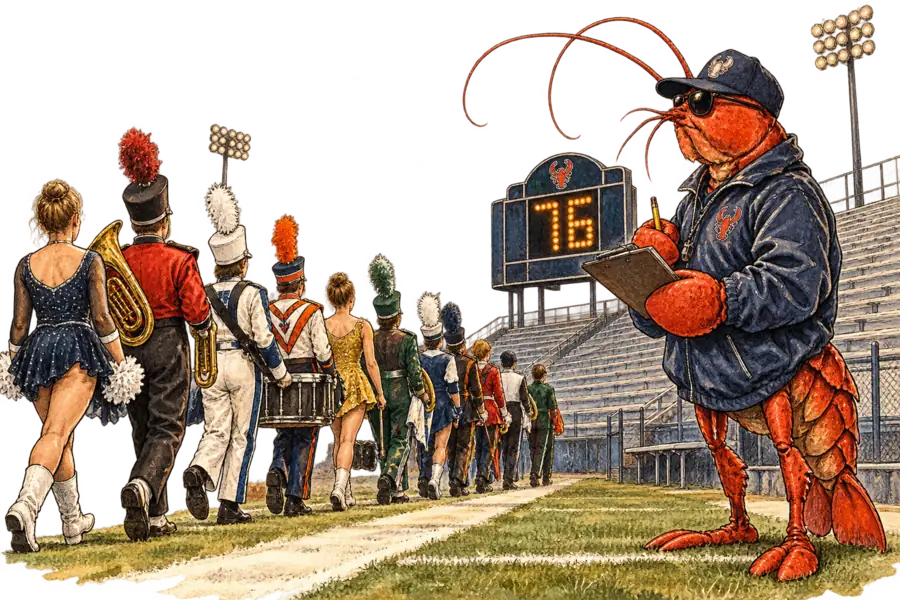
Six members of Grambling State’s World Famed Tiger Marching Band, two dance teams from Las Vegas and San Diego, four football players on name-image-likeness deals and a handful of named creators fill one end of a New Jersey stadium built for 52,454. Nothing in that cast matches: not the heights, not the training, not the counts a marching band moves on against the ones a competition dance team does. Urban Outfitters put 76 students from more than ten universities into its first back-to-campus commercial, thirty seconds long, and left every seam visible. The budget went on provenance, and reach is the part you can put on a card.
The film builds by arrival. Glossy’s account has it open on a dance battle inside Rutgers’ SHI Stadium: a student in the stands films it, friends turn up, then the band, then the whole field. The dance crew GRV choreographed it to an original track by Bryan Master, and it plays on Netflix and Hulu alongside YouTube and TikTok. Everyone wears the retailer’s own labels: BDG, Out From Under, Standard Cloth, iets frans.
Twelve months ago, the August 2025 issue of Vogue carried a two-page Guess advertisement whose model had been generated rather than photographed. It was disclosed, in small type, as “Produced by Seraphinne Vallora on AI”. Forbes put the saving from that kind of production at up to 70 percent of campaign cost, with timelines falling from months to days.
The asset here is the wide shot. A field with 76 people on it, if you hold on it long enough to count them, is the image generative video still fumbles: crowds double at depth, feet slide, back rows soften into wallpaper. The close-up used to be the expensive frame in a fashion film. Here it is the cheap one.
A generated cast would have moved as one, and unison is the tell.
The proof does not live in the film. Grambling’s own newsroom named its six students with majors and home states attached: Destiny Day, Raina Delee, Haylen Mallery, Dale Marshall Jr., Harmony West and Jaylin Williams. HBCU Gameday reprinted the roster the next day, and a Louisiana station ran it as local news.
Casting drew largely on Me@UO, the creator community Urban Outfitters started in spring 2026, which Glossy reports has passed 3,100 members. Everyone in the film was paid, some on year-long partnerships, the Rutgers students under university student-work policy. A content credential travels with a file; this one travels with a hometown.
Fashion has bought this kind of proof before. Take Ivy, photographed by Teruyoshi Hayashida and published in Japan in 1965, collects candid pictures of American students on Ivy League campuses, unstyled and largely unaware. The clothes in it are ordinary; the authority comes from the subjects being real people on named lawns in a named year. It set off an Ivy boom among students in Tokyo, became a sourcebook menswear is still working from, and was reissued in English by powerHouse.
Trade coverage filed this under media strategy. Marketing Dive read it as Urban Outfitters arriving on connected TV. Glossy read it as new-customer acquisition on the back of a quarter in which comparable sales rose 9.3 percent. Both are right, and both skip the line item that matters: the CTV buy is the cheapest thing in this campaign. A stadium, four institutional performing groups, NIL contracts and payroll compliance at a public university are not.
Synthetic casting will keep improving, and the current tells will go: the too-even skin, the hands, the way generated cloth falls without seeming to know what is underneath it. What no model produces is a local news desk running the story because six students from down the road are in it. Provenance is hardening into a look, and the look is uneven, institutionally sourced and slightly badly matched. Expect a season of campus advertising in which brands pay a premium for a cast that does not quite fit together.