Washington Closed the Loophole. The Front Moved South.
Shein and Temu took 3.6% of South Africa's clothing market in four years, a share international retailers needed thirteen to build. As Washington and Brussels close the de minimis loopholes that fed ultra-fast fashion, the same fight opens across sub-Saharan Africa, where customs enforcement is far weaker.
Sir John Crabstone
Two Chinese shopping apps now take 3.6 percent of what South Africa spends on clothing, textiles, footwear and leather, research for the Localisation Support Fund found. International retailers needed thirteen years to build that share; Shein and Temu took four. Their surge is the opening front of ultra-fast fashion’s move into sub-Saharan Africa, where the de minimis fights of Washington and Brussels replay against far weaker defences.
South Africa’s retailers tell it as a jobs story, and the research obliges them. The platforms booked R7.3 billion in 2024, more than a third of the category’s online spend. The same study set that against R960 million in lost local production and roughly eight thousand jobs never created, most of them in shops rather than factories. The fund’s chief calls it unfair competition that needs to be closed out. He is right about the damage, and wrong about its address.
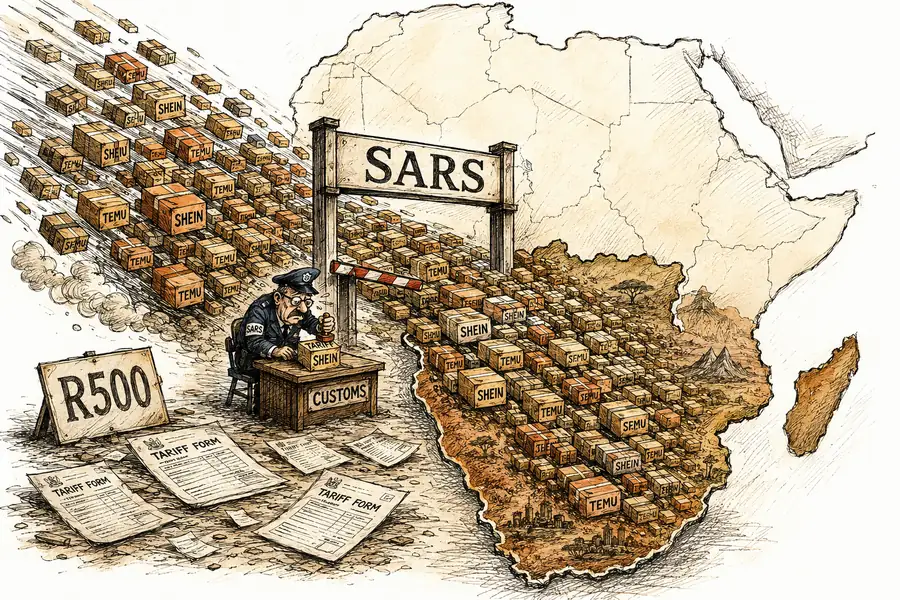
The address begins at the border. South Africa let parcels worth under R500 enter at a flat 20 percent duty and no VAT. The platforms were accused of splitting large orders into small ones to stay beneath the line. SARS scrapped the concession in 2024, adding VAT in September and lifting the flat rate toward the standard 45 percent clothing duty in November. The rule changed; the parcels kept arriving.
Washington went first, and went harder. In May 2025 it ended the de minimis exemption on parcels from China — citing the fentanyl crisis, not trade competition — the rule that had let the same two firms ship into America duty-free by the billion. In its place came a duty of thirty percent of value, or a flat charge on every item. The exemption was a line in trade law and a business model in practice. Ending it raised their American costs in a day.
Brussels is most of the way through the same work. The European Union has agreed to levy customs duty on small parcels, with the €150 duty-free threshold due to end in July 2026. Each wealthy market that closes raises the value of the one left open. South Africa was their first sub-Saharan foothold, and the least able to enforce against the volume.
The platforms are already past South Africa. Shein has sold there since 2020, Temu since 2024. Temu reached Nigeria by the end of 2024, and it is now contesting the whole continent with Jumia. Neither operates a local entity for a regulator to summon. SARS runs one of the region’s more capable customs operations, and it is straining. When it collects, the incentive shifts; volume follows the path of least resistance to markets where enforcement is thinner still.
A tariff is only as real as the customs officer who collects it.
Shein and Temu did not find a loophole in South Africa. They found a continent of them.