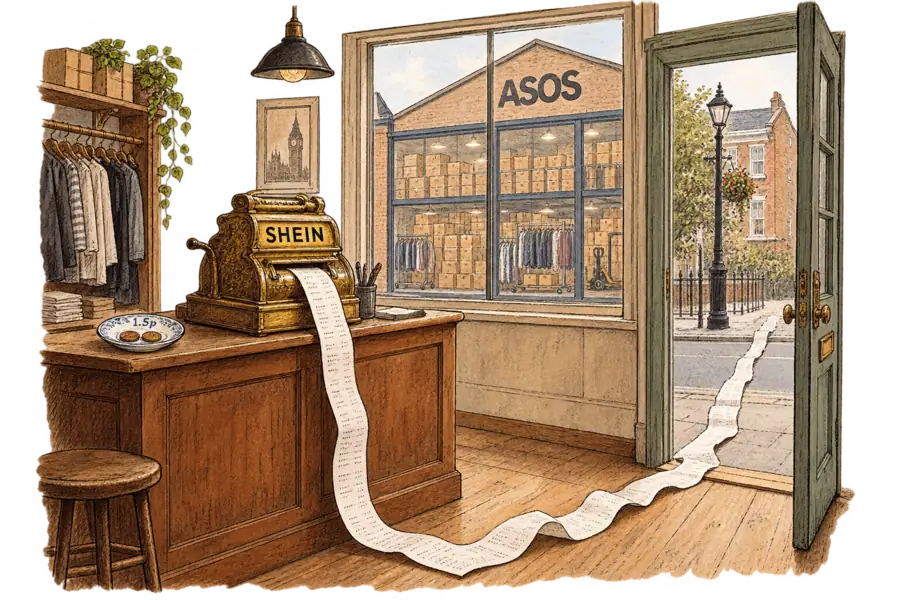
Shein's UK Company Outsold Asos. Its Margin Held While the Group's Swung.
Shein Distribution UK sold £2.56bn of goods in 2025, more than twice Asos's UK revenue, but its operating margin sat at about 1.5% in each of the last three years while the Shein group's fell from 4.3% to 2.5% and climbed back to 4.1%. The filing sizes Shein's British checkout; it cannot show what Shein earns in Britain.
Neritus Vale
Shein’s British sales company sold £2.56bn of goods in 2025, and its accounts show a margin that barely moves. Shein Distribution UK has earned about 1.5p of operating profit on each pound of sales for three years running, while the Shein group’s own margin fell and then recovered around it. The filing measures how much Britain buys through Shein’s checkout. It cannot show what Shein earns from those shoppers, though the coverage so far has read it as if it could.
The press read the filing as a scorecard. FashionUnited led on rising profit, City AM on revenue “despite IPO woes”, and Drapers headlined that Shein had overtaken Asos, setting the UK company’s turnover against Asos’s worldwide revenue. Drapers flagged that mismatch itself. Asos’s results for the year to August 2025 put its UK revenue at £1.21bn, so Shein’s British company is more than twice the size of Asos’s British business. The years differ, with Shein’s ending in December and Asos’s in August, and Shein’s figure is retail sales while Asos’s is total revenue including other services. Neither difference is large enough to change the comparison.
On profit, the comparison falls apart, because the two companies do different jobs. Asos kept 47.1p of gross profit from each pound of revenue, the margin of a retailer that buys its own stock, holds it and marks down what fails to sell. Shein’s UK company kept 3.4p. Both book distribution costs below the gross line, so no reclassification closes a gap that wide.
Legally, the UK company is the retailer: it sells to each customer directly through its own online store and books the whole sale when the parcel is delivered. Its directors’ report gives its activity as “provision of marketing and sales”, and its 113 staff were “primarily providing marketing expertise for the UK market”. The year’s listed milestones were festival partnerships with Live Nation and Wireless, an Oxford Street pop-up and a Christmas gifting activation. Its two leased offices, in east London and Manchester, total 2,542 square metres. The directors’ report names no warehouse among the sites inside its emissions-reporting boundary.
The British company also holds very little of the stock it sells. Asos ended its financial year with about 112 days of stock, our calculation from the inventory and cost of sales in its results, which is why those results dwell on markdowns and write-downs. Shein Distribution UK ended 2025 with about a week’s worth on the same arithmetic, using the inventory and cost notes in its accounts. It does hold title to that stock and carries the returns, with a £26.4m returned-goods asset and a £27.8m refund liability. But a week of stock leaves little room for the markdowns that dominate Asos’s results, which suggests the risk on unsold fashion sits elsewhere in the group.
In 2025 the UK company booked a lower inventory cost per pound of sales, and its gross margin barely moved. By our calculation from note 6, the inventory cost expensed fell from 88p to 77p in each pound of sales. For a retailer that would be a windfall, but the accounts show a lower cost line, not a lower price paid, and a reclassification between lines would look the same. Other costs, which the accounts do not itemise, nearly tripled to £495m on the same arithmetic and absorbed the difference almost exactly.
Below the gross line, the UK company’s margin has barely moved in three years. Operating profit came to about 1.5% of sales in 2023, 2024 and 2025, taking the 2023 figure from the comparative restated in the 2024 accounts. That stillness survived real upheaval. On the restated basis, the company’s own distribution and administrative costs nearly quadrupled in 2024, by our calculation, and gross profit rose just far enough to cover them. The pattern is consistent with a margin set by pricing between companies in one group, though the accounts do not say so.
Shein’s prospectus describes how that group is organised, though not this company’s pricing. Roadget Business, the Singapore company that owns the UK distributor, “primarily is responsible for procurement, online operations, marketing, software development and investment holding”. The prospectus lists the UK company’s business as “online sales, marketing and procurement”. Separately, it says outside advisers review transfer pricing between Roadget and its major subsidiaries in China, Singapore, the United States, Ireland and the United Arab Emirates against the OECD’s arm’s-length principles; the UK is not on that list. The UK company’s tax charge came to 24.9% of its pre-tax profit, in line with the 25% British rate.
The accounts do show that money moves within the group. They record £13.9m of intercompany income and a net £72m intra-group asset, the figure the strategic report cites. They take the FRS 101 exemption from detailed related-party disclosure and refer readers to the group’s consolidated accounts, in which, as in any consolidation, sales between Shein companies cancel out. What they do not disclose is the terms: the prices at which goods and services pass between the UK company and the rest of the group.
The strongest objection is that the British margin may simply be the truth. Shein runs on thin margins everywhere, and the prospectus gives its own reasons for the group’s 2024 squeeze: growth in fulfilment and administrative costs, a shift towards home and living, the cost of entering new markets and heavier discounting. Several of those fall on new markets and product lines, not on a mature British business, so the group’s fall need not have reached the UK company. For that reading to hold, though, the UK margin would have to move whenever its own costs moved.
It did not. The UK company’s costs rose sharply in 2024, and its gross profit rose to match them, which is not how a margin behaves when it merely reports what the business happened to earn. In 2024 the group’s operating margin fell from 4.3% to 2.5% and ended 2025 at 4.1%. Through that swing the UK company’s margin moved by about three hundredths of a point on the restated comparative, or seven hundredths against the original 2023 filing.
Whatever Shein gained or lost on British orders in those years, almost none of it showed up in the company that took them.
The filing also describes a year the group has since left behind. Shein’s prospectus defines Europe as the EU plus the United Kingdom. In the second quarter of 2026 its European revenue fell 13.9%, as we reported on 1 October. The group blamed a larger marketplace share and lower volumes, after it raised prices and cut advertising ahead of the end of the EU’s €150 duty exemption. Britain’s equivalent change takes effect in October 2028, City AM reports. Neither the interim report nor the UK filing says how British sales fared that quarter.
The British structure is shifting as well. Shein’s current UK terms, dated 1 July 2026, carry the line “Our business model has changed!” They name a sister company, Infinite Towers Services, as operator of shein.co.uk, with Shein companies and outside merchants selling through it. Infinite Towers’ 2025 accounts show £11.9m of revenue, most of it subscription fees, and no employees. Its commission income had already more than tripled in 2025, to £2.6m, so the marketplace was running before the July terms. If outside merchants take a growing share of British orders, the distributor’s turnover will fall even if British shoppers spend no less, and any league table built on it will be measuring paperwork.
Whether Shein makes money in Britain is a question no public document answers. Between them, the UK filing and the group’s accounts never put British sales and a British margin in the same place. If the arrangement holds, the UK company’s 2026 accounts, due by September 2027, will show about 1.5p in the pound again, whatever Europe’s slump cost the group. Shein has built a British business that is measured in public and judged in private.