SHEIN Says It Can Forecast a New Seller's Stock, Not Hold It
SHEIN's year-end plan for new semi-managed sellers says the platform can name which products are worth stocking in local warehouses, and how deep. Sellers buy that stock themselves, and SHEIN's own recruitment notes point them towards oversized Christmas trees and outfits with complicated sizing, against a forecast peak of 17 November.
Sir John Crabstone
SHEIN says it can tell new sellers which products to put in a local warehouse, and how many. The offer sits in a year-end plan for “semi-managed” newcomers, described by 36Kr 出海 on 26 October. SHEIN supplies the forecast; on the evidence of its prospectus, where merchants “manufacture or source their products from their own suppliers”, the seller pays for every unit SHEIN recommends.
Semi-managed sellers keep stock abroad and, for last-mile delivery, can ship each order on SHEIN’s own labels, with freight subsidised in the US, Europe and Britain. Newcomers may start in a SHEIN-certified third-party warehouse and switch to their own once sales work. The key line says that, working from demand forecasts, SHEIN “can directly provide which SKUs are worth committing to local warehouses, and the recommended stocking depth” (哪些 SKU 值得压本地仓、建议备货深度多少).
The account carries no byline and quotes only one seller, a SHEIN case study. It says the advice will “greatly reduce sellers’ inventory risk” (极大降低卖家库存风险). That seller, offered as “a typical case” of support for newcomers, was already trading on SHEIN last Black Friday.
Ebrun’s morning brief repeated the plan’s five slogans the next day, “stock light” (轻备货) and “bet on the right goods” (押对货) among them. It read the plan as SHEIN shoring up its own peak-season supply and range of categories.
SHEIN’s recruitment site tells the seller’s story at length, often in the same sentences. Wang Xiao, who has sold on SHEIN since 2024, makes nursery and baby-party decorations. Untested designs start at five to ten units per style-colour. SHEIN’s buyers pass on selection direction, launch timing and compliance information, and the write-up never mentions a local warehouse.
The method is SHEIN’s, scaled down. Its prospectus describes launching new products in batches of about 100 to 200 items and reordering winners, with “minimal upfront commitment, inventory risk, and resource waste”. Wang’s 100 to 200 is a different quantity: the weekly sales at which he raises production markedly, not an opening batch.
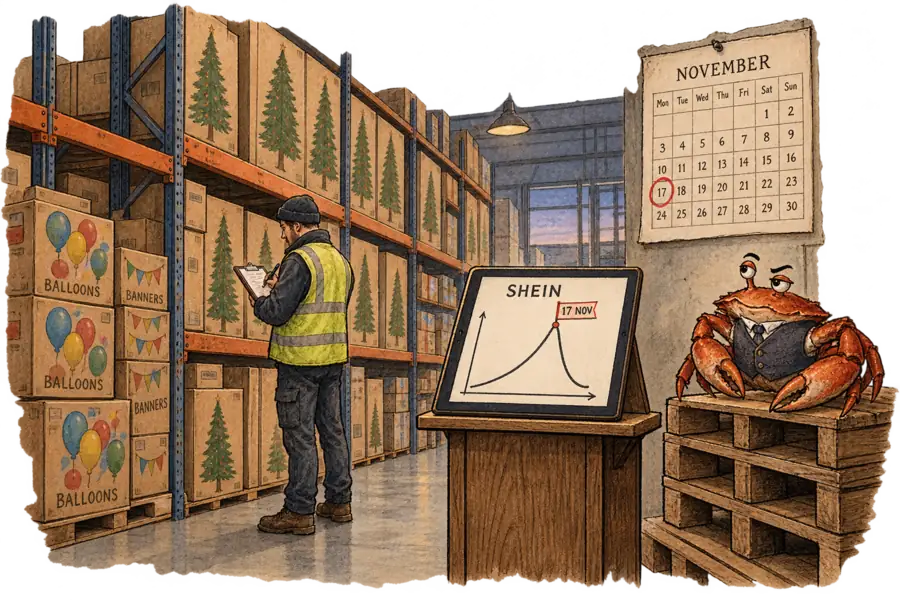
SHEIN’s recruitment notes show which goods it wants held locally. Its call for Christmas sellers points semi-managed (local) sellers towards oversized trees and outfit sets with complicated sizing, among other lines. The note forecasts that demand for Christmas and party goods peaks on 17 November, holds for about a week, then falls fast.
A forecast can make a loss less likely; it cannot make it SHEIN’s.
The plan’s publicity is silent on stock that misses the peak. The prospectus, summarising the marketplace agreement, gives the general rule: “Sellers are responsible for all their own expenses in connection with the Agreement.” No clause addresses unsold stock; that it stays with the seller is our reading of this rule.
In July, Marketplace Pulse framed the marketplace as SHEIN’s hedge on localisation and found that “the goods kept shipping from China”. Its figure, taken from SHEIN’s prospectus, is that products stored in the central Chinese warehouses made up over 90% of 2025 net revenue. That is a revenue share, and marketplace sales enter revenue only as commission and service fees, so it mostly describes SHEIN’s own sales. If local stock does arrive through semi-management, it will arrive on sellers’ pallets.
Our reading of SHEIN’s UK accounts found its British sales company holding about a week of stock, suggesting the risk on unsold fashion sat elsewhere in the group. Semi-management would give “elsewhere” an address outside the group.
In September’s interim report, SHEIN’s chairman wrote that increasing local inventory coverage in Europe is a key priority and that, as forecasting improves, “we can hold more inventory closer to consumers with greater confidence”. He meant SHEIN’s own inventory, and the same passage says localising it “will drive a modest increase in fulfilment costs” for the group. The plan for new sellers leaves open whether “we” will ever cover theirs.