Shopping Agents Find Stock Wherever the Count Is Wrong
Haus of Brilliance's founder jokes that its marketplace stock counts rely on 'duct tape', and Walmart's own guide says a seller's stock update can take up to four hours to show. An agent reading a stale listing can order a piece that is not there, and Walmart counts the cancellation against the seller.
Sir John Crabstone
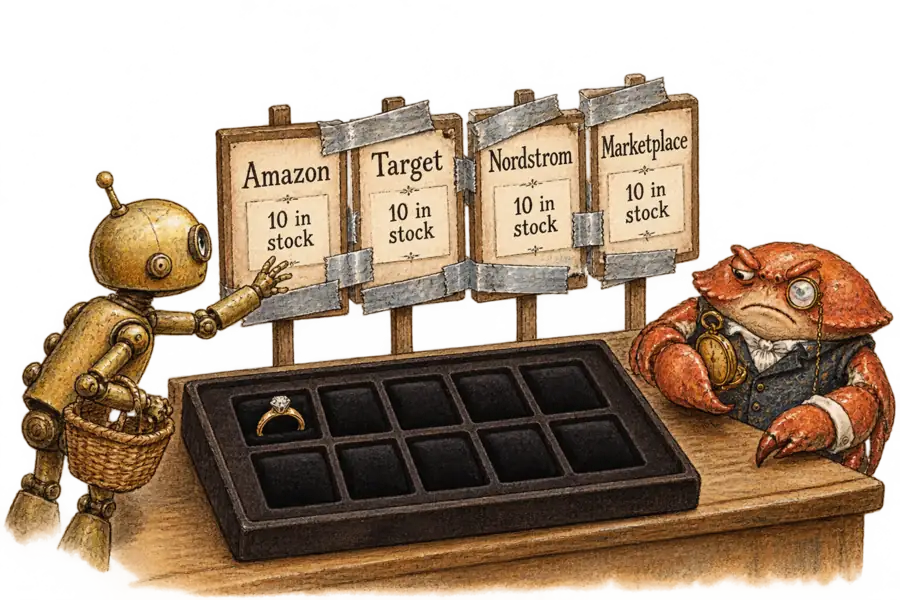
Every marketplace a brand joins is another stock count to keep true, and an agent shopping them must take each at its word. Monil Kothari, founder of the jewellery brand Haus of Brilliance, told Modern Retail of the failure his systems are built to prevent: “We might have 10 units of a piece on Black Friday,” he said; “nine might sell, and if your inventory doesn’t update and reflect that it’s now one, it shows another 10 units available.”
Kothari joked that much of the business relies on “duct tape”: an off-the-shelf ERP joined to its channels by third parties and in-house API connections. “Our systems move very fast,” he said. The listings they feed may not.
Modern Retail frames the holiday danger as “running out of stock at crucial moments”. Kothari’s example is the opposite failure, and the dearer one. A stockout loses a sale; a phantom unit sells, and must then be unsold.
The unselling has a price. Under Walmart’s performance standards, a seller’s cancellation rate must stay at 2% or below, and “Out-of-stock” is among the causes the seller answers for. A seller that misses the standard and fails to recover can lose its account.
The inventory guide says keeping stock current “ensures that your item never goes out of stock”. A count ensures nothing; it reports. Asked why a zeroed item still shows as in stock, the guide says “it could take up to four hours for the update to reflect on Walmart.com.”
A companion checklist sets no schedule, asking for updates “in line with your acknowledgement of orders and rate of sale”. It names the predicament: “Sometimes, issues arise if you share the same inventory across multiple marketplaces and don’t make updates accordingly.” Walmart subtracts its own open orders from the display “to prevent overselling”, so the risk lies in sales made elsewhere.
Target says less in public. Its requirements for Target Plus set no refresh rate for stock. They require integration through an “approved Channel Partner” and an agreement not to “use competitor fulfillment services”. The page does not define the phrase; presumably it excludes Amazon’s and Walmart’s fulfilment networks, leaving a Target seller to ship from its own or a third party’s warehouse.
Agents may already shop Walmart’s site through a web browser, the company says, “following steps designed for people”, and presumably see the same count a shopper does. Walmart is building a gateway to make them faster; it says agents see “the same prices that a human would see on Walmart.com.” Whether they will see a fresher count, the announcement does not say.
If agents shop at the pace Walmart intends, then once the last piece sells, the only stock left to find will be where the count is wrong.
Walmart’s returns process applies, its agent terms say, “if an agent doesn’t act as intended”. An agent that does exactly as intended, on a count that has not caught up, makes no mistake. The brand’s cancellation rate records one anyway.