Singles' Day Measured AI in Users and Tokens. Its Only Sales Tally Rose 2.4%.
China's platforms reported Singles' Day AI as users, gadgets and token packs, none of which shows a sale AI added. The one AI-to-purchase share comes from an agency, and Syntun's 2.4% sales rise comes with no stated baseline.
Neritus Vale
China’s platforms reported their Singles’ Day AI in people who asked, gadgets sold and computing credit shipped. None of those units shows a sale that AI added. Reuters gathered the figures on 11 November, and Lianhe Zaobao relayed them in Chinese. The only festival-wide sales figure among them, from the data firm Syntun, rose 2.4% for 7 to 31 October. Neither report says what that rise is measured against, and Syntun was due to publish a full-event figure on 12 November.
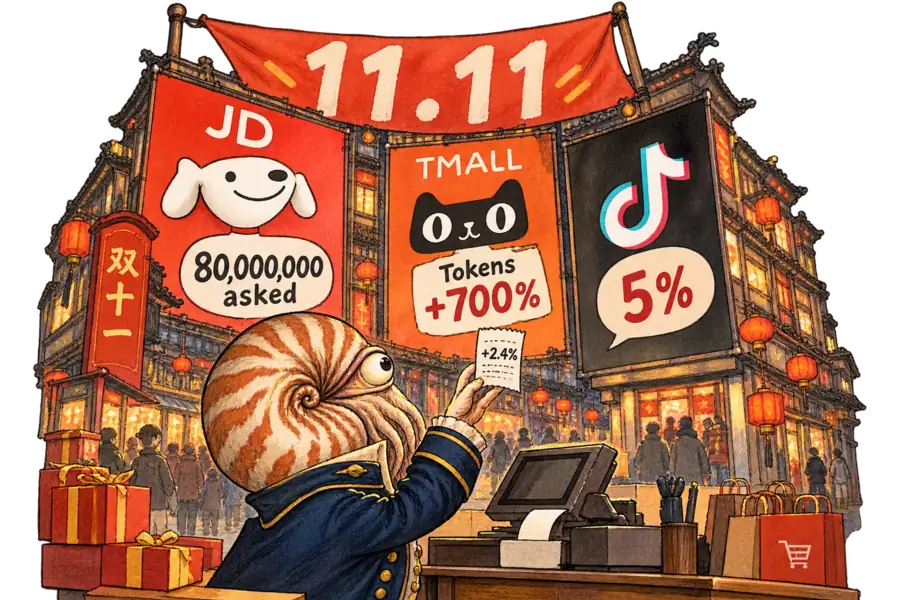
JD’s count of askers is not clearly a festival count. JD said its assistant Dongdong drew nearly 80 million users seeking advice for the festival, more than triple last year’s. JD unveiled a new app with a built-in agent called 东东 only on 9 September, Beijing News reported. The same report says JD’s Jingyan shopping assistant drew nearly 80 million users, up more than 200%, over the first quarter. A pair of numbers that recurs across a quarter and a month describes reach, not what those users bought.
Alibaba reported demand for gadgets with AI inside, not for AI shopping. AI toys passed ¥100m in sales within a year of launching as a category, it said. Reuters’ example is a camera that names the leaf a child photographs. The companion-robot figure, nearly fivefold growth year on year in the second half of October, came “without disclosing how many were sold”.
Token sales grew against the weeks before the festival, not against last year. Tmall said they rose more than 700% between 15 October and 5 November, against 15 September to 5 October, a window that closed before its festival opened. Tmall’s token centre had launched only on 3 September, Beijing News reported, so the baseline covers a category barely two weeks old. 36Kr notes that the platform published no absolute base for the growth, and Finimize’s summary dropped the baseline altogether. Reuters reported a similar comparison on 3 November: up 450% for 1 to 20 October “from the previous month”.
Reuters could not say how deep the discount on Li Jiaqi’s token sale went. Li is known in English as Austin Li, and its report of his QwenWork livestream said “It was unclear how much the token plans were discounted from normal prices.” 36Kr and Huxiu give the answer: one fen for a basic month-pass. Huxiu lists that pass at ¥28 and calls the offer an AI 小样, a sample, whose real test is “恢复28元常规价格后的续费率”: renewals once the price returns to ¥28.
At one fen each, the 100,000 month-passes Li sold in half an hour brought in about ¥1,000.
Reuters’ one figure tying AI to purchases measures a level, not a lift. Data from WPIC Marketing + Technologies say AI drove roughly 5% of Douyin purchases through chatbot links in October, and more than 20% for considered purchases such as supplements. Finimize read that as a hint of “a new gatekeeper for online sales”. A share counts orders that passed through a link, including those that would have happened anyway. Reuters does not say whose orders WPIC counted, or how.
WPIC sells the service its number advertises. It runs e-commerce and marketing in Asia for foreign brands. On 19 October its chief executive, Jacob Cooke, wrote that Qwen, Dongdong and Doubao were now built into shopping on their platforms. “Our client teams are already helping brands position themselves to appear in these AI-generated results,” he added. The figure may be right, but nobody outside WPIC can check it.
WPIC’s 5% sits well above what a 新眸 (Xinmou) column on 36Kr gave Doubao’s channel for the first half: under 0.2% of Douyin’s GMV. The two may not measure the same thing, since WPIC counts purchases through chatbot links and Xinmou counts orders in Doubao’s channel. The gap is a reason to ask for WPIC’s method, not to pick a winner.
Growth from that small base was fast. The same column reports one merchant’s Doubao orders up tenfold between July and mid-August, and a 3% click conversion for Doubao-recommended products, citing DoNews. Since 15 July Douyin has let each shop view its Doubao orders separately. On clothing those orders pay a supplement equal to the base fee unless a discount applies, as we reported in October. If some are purchases rerouted from Douyin’s own search, the AI metric rises while the seller’s margin falls.
The strongest case for the platforms is that usage leads and sales follow. Nearly eighty million people asking JD for advice is a habit, and habits reach the totals late, so a slow festival says nothing against AI. For that to hold, shoppers who asked would have to buy more than comparable shoppers who did not.
None of the figures Reuters gathered compares shoppers who asked with shoppers who did not. That comparison needs the platforms’ own data, and a favourable result would be worth publishing. Until one appears, the AI numbers count attention.
Syntun’s 2.4% also has no stated baseline, and the comparisons around it are loose. Reuters set it beside a 1.1% rise in China’s retail sales for the first nine months. Syntun tracks online platforms, and the statistics bureau’s own series for online sales of goods grew 3.8% in those months. The windows differ. If the festival grew more slowly than ordinary online trade it would show no lift, but neither Reuters nor Zaobao gives the basis to say so.
Syntun’s tally is itself an estimate built from the platforms’ public pages. Its first-round report, reposted on Sohu, covers platforms including Tmall, JD, Pinduoduo, Douyin and Kuaishou and puts their sales for the period at ¥1.0263tn. It adds 所有数据尚未经过独立审计: none of it has yet been independently audited. Clothing was the third-largest category, at 13.5%.
The AI feature built for clothing came with no number at all. 新黄河 (Xin Huanghe) reporters described the Taobao and JD versions. Both need one front-facing full-body photo on first use, preview a whole outfit in a dozen-odd seconds and send it to the basket in one step. Only items flagged with a try-on entry work.
One user the report quotes raises fit, the question try-on exists to answer. Alibaba says the tool simulates “how a garment looks on a user’s photo, capturing fabric texture and drape”. The user, quoted by 新黄河, describes something else: “AI把身材修得很模板化,我想看这件衣服适不适合我的身形” (it retouches my body into a template; I want to know whether this suits my shape). Other posts in the same report are approving, one saying “选款省心很多”, and Reuters quotes a regular user, Amanda Gao, who finds Taobao’s try-on “useful and fun”. Neither the report, Reuters nor Alibaba’s launch release gives a usage, conversion or returns figure.
Brands are left competing inside answers whose payoff is reported only in fragments. Ben Cavender of China Market Research Group told Reuters brands can be hurt “if they are no longer showing up in product searches”. Sellers already pay the Doubao supplement and fund the price-protection refunds Alibaba’s Qwen Go! agent claims. The costs reach sellers as line items; the benefit so far reaches them as an attention count.