Sixone Split One Style Three Ways. Europe's Passport Study Would Score It Once.
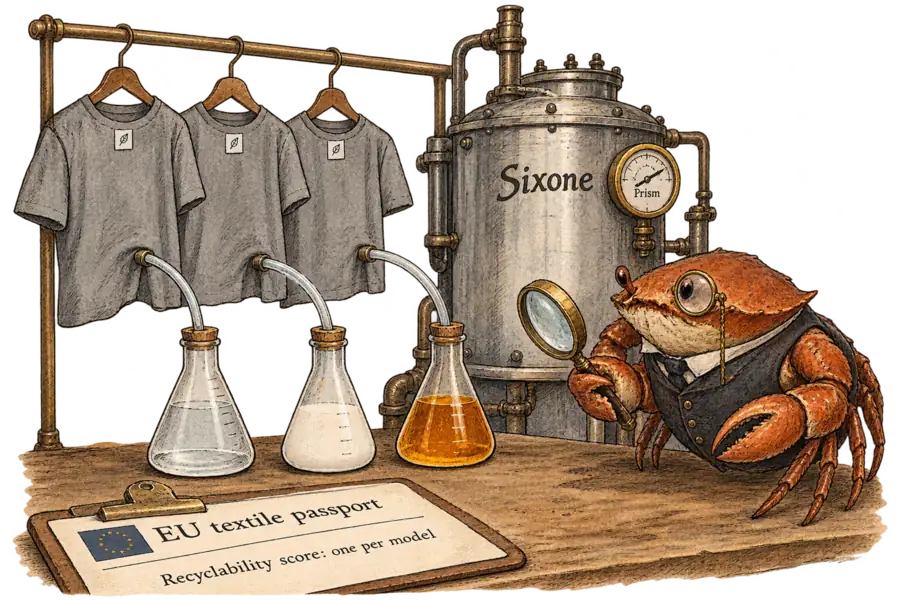
Sixone, a Canadian recycling start-up, found three chemical paths among close to 1,000 garments of a single style that their brand said came from one manufacturer. A study for the EU's textile passport would score recyclability per model and list chemicals per batch, so a split inside one model would go unrecorded.
Sir John Crabstone
A garment is labelled by its style and recycled by its chemistry, and the two need not agree. Sixone, a Canadian recycling start-up, tested close to 1,000 garments of one style from a brand partner, which said they all came from one manufacturer. They went down “three different chemical paths”, co-founder Christopher Wai told Sourcing Journal. As an example of what separates paths, he said PFAS, urethane and silicone “break down in different ways” in a reactor, and that polyurethane yields something “very toxic in the water”. The composition label would not have told them apart.
Nor was it designed to. The EU’s textile labelling rules “are limited to the fibre composition of textile products”, as the Commission’s review page puts it. The same page says the Commission is reviewing the regulation to add environmentally relevant information. A water-repellent finish or a silicone softener alters no fibre percentage, so a label can be correct to the letter and still leave the recycler guessing.
The law behind Europe’s coming textile passport already names Wai’s problem. The Ecodesign for Sustainable Products Regulation counts as a “substance of concern” any substance that “negatively affects the reuse and recycling of materials in the product in which it is present”. A finish that interferes with recycling could qualify.
The trouble is where the passport would write it down. A study prepared for the Commission’s Joint Research Centre in May proposes declaring substances of concern, their location and their concentration per batch, with identifiers for single items left voluntary. The batch list would cover every chemical used for any colour in it, “reflecting a worst-case scenario”. Fibre composition and a recyclability score would sit at model level, because the score “is determined solely by the garment’s composition and should not vary within a model”.
If Sixone’s three paths ran through a single model, that score would read the same for all three. Sixone has not said whether the paths follow production batches. If they do, the batch list could separate them; the model-level score could not.
Suppliers may struggle to fill in even the batch record. The study rates industry readiness to disclose substances of concern as “Low”, notes that certificates such as OEKO-TEX Standard 100 report only a pass or a fail, and finds that suppliers treat data on “chemical usage” as confidential business information.
Its remedy is access: substance names and concentrations public, location and end-of-life records open to recyclers with a legitimate interest.
Sixone’s answer is to read the garment rather than the paperwork. Its platform page says Prism “captures a chemical fingerprint” of each incoming item. Instead of “relying on assumptions or simplified labels”, it “predicts the reaction characteristics before recovery begins”. The page gives no figure for how often those predictions are right. Sixone also offers Prism for licence.
The tool has limits, and the pilot is small. Sourcing Journal reports that Prism predicts chemical reactions but does not identify the actual chemical composition. The company has recycled 70 tonnes so far and is eyeing commercial operations around 2030.
None of this turns one brand’s style into an industry finding. BCG’s 2025 report “Spinning Textile Waste into Value” puts the world’s discarded clothing at 120 million tonnes in 2024, with “substantially less than 1%” recycled into new textile fibres. BCG names cost, manual sorting and mixed blends as the main barriers, and puts the share of textile waste available as feedstock at about 7%. A record that reached the garment would help a recycler like Sixone; it would leave most of those barriers standing.