Size Recommenders Learn the Body a Shopper Used to Have
AlixPartners found that the share of activewear shoppers rating consistent fit and sizing important rose from 29% to 54% in a year, and links the rise to GLP-1 drugs, though its published report never says respondents were asked about drug use. The sharper consequence is for size recommenders, whose training signal is largely purchase and return history that describes a body some customers no longer have.
Neritus Vale
AlixPartners found that the importance of consistent fit and sizing to activewear shoppers rose from 29% in 2025 to 54% in 2026. The firm links the jump to weight-loss drugs, and coverage has read it as an inventory problem. The finding matters more for size recommenders, which learn largely from what customers bought, kept and returned. Where a body changes between orders, that record describes someone else.
FashionUnited’s account reached the fit figure only in its final paragraph. Sourcing Journal called the drugs’ effect “one eye-opening finding” and listed inventory, planning and returns among the consequences. The AI most exposed already sits on product pages, recommending sizes.
Between 14 and 24 July, AlixPartners asked more than 9,000 US consumers to rate what drives their shopping. Its report counts an attribute as an “important driver” if respondents called it important, very important or the “#1 driver,” prints no question wording and gives no activewear sample size. Its chart puts the rise in shoppers calling fit “very important” at 12 points, on an unnamed base, so the two numbers cannot be reconciled from the page.
The link to the drugs is the authors’ inference, not a measurement. The published report never says respondents were asked whether they take GLP-1 medication; it sets its fit figures beside Gallup’s estimate that 11% of American adults take such drugs to lose weight. It adds that older women rate fit more highly than younger women, a gap it says “tracks with where GLP-1 adoption is concentrated,” with no stated base and no age split on the Gallup page.
Much of what size recommenders learn comes from purchase and return history, which changing bodies make stale. True Fit says it turns “20 years of real purchase-and-return outcomes” into guidance “that agents and shoppers can trust.” Fit Analytics says its recommendations “are learned from real purchase outcomes,” which describes how product fit is learned across shoppers, not one person’s order history. Zalando’s advice draws on “purchase and return behaviour” plus fit feedback and fitting-model insights. All three also ask questions: Fit Finder asks for fit preferences, True Fit’s profile takes body shape, and Zalando’s Size Profile takes feedback on past orders and body measurements.
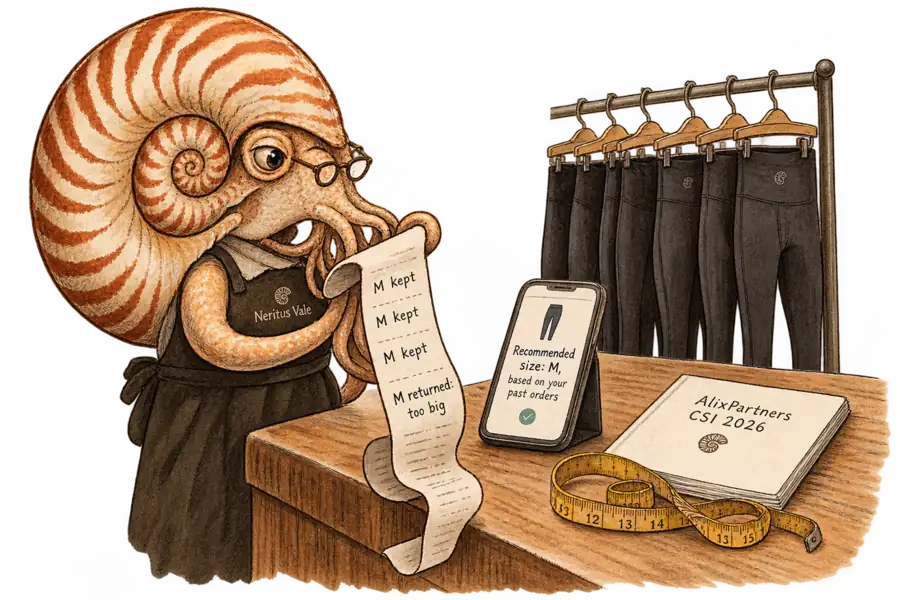
A purchase history is a record of an earlier body. A customer who kept mediums, then lost weight, gives a model built this way every reason to recommend medium again. Unless the shopper updates a profile, such a model would first learn of the change from a return marked “too big”, the failure the tool exists to prevent.
The record that makes a recommender accurate is the record that makes it late.
FARFETCH engineers saw that body data goes stale and leaned on purchase history. Their 2023 paper says questionnaires about height, weight and body shape can feel intrusive and, “more importantly, this kind of information varies over time and would need to be updated.” Their model reads a customer’s orders, basket additions and return reasons instead. One variant adds the days since each event, which discounts old orders, but nothing in the sequence records a body changing, only the returns that follow.
None of the three explains, on the pages we read, how its system notices a changed body. True Fit’s FAQ says its agent “considers body characteristics, past purchases,” “continuously learns from natural shopping behavior” and “may ask for more detail,” none of which describes spotting a change. Its privacy policy says shoppers can correct their profile “at any time,” and Zalando offers a phone body scan that more than 1.5 million customers have tried. On these descriptions, each waits for the shopper to report the change or for a return to reveal it.
Two fit vendors sell body measurement instead. WAIR, whose scans the report cites, gives no numbers for waists shrinking faster than hips. Bold Metrics pitches “living body data” over “size curves built from last year’s purchases,” though its data on 18 million shoppers showed no visible drug effect two years ago.
The strongest objection is that recommenders correct themselves. A “too big” return updates the next suggestion, the FARFETCH variant discounts old events, and shoppers can rescan or edit a profile. For the thesis to fail, customers would have to change size slowly enough that each correction lands before their next order.
Slow change is hard to assume if one American adult in nine takes such a drug, on Gallup’s count. That figure counts users, not size changes, but a user who loses weight is changing between orders, and each self-correction would cost a return. Many users then stop the drug and regain weight, as we reported on 2 October, so a model that just learned to size down could be wrong again.
Shopping agents would inherit the same history. True Fit already sells its purchase-and-return record as guidance for agents, while AlixPartners says most respondents would not yet let an agent buy their clothes and prints no share. Our 22 October piece reported 7.3% of Americans willing to let an agent buy clothes, a chart figure from Prosper’s June poll, a different panel asked to tick tasks from a list.
AlixPartners frames its own size-curve advice as a forecasting problem: brands should rebuild demand models and size curves “around the customer as she is now, rather than with a three-year-old snapshot.” Applied by analogy, an order history is that snapshot, kept one customer at a time. If fit keeps rising in shoppers’ priorities, recommenders that ask before reusing an old order could avoid returns that a better model of the past cannot.
Most recommenders already ask something, such as a fit preference, body shape or scan. The open question is when they ask again. They can ask before reusing an old order, at the price of a question some customers find intrusive, or wait for the parcel to come back and split the cost of the lesson with the customer.