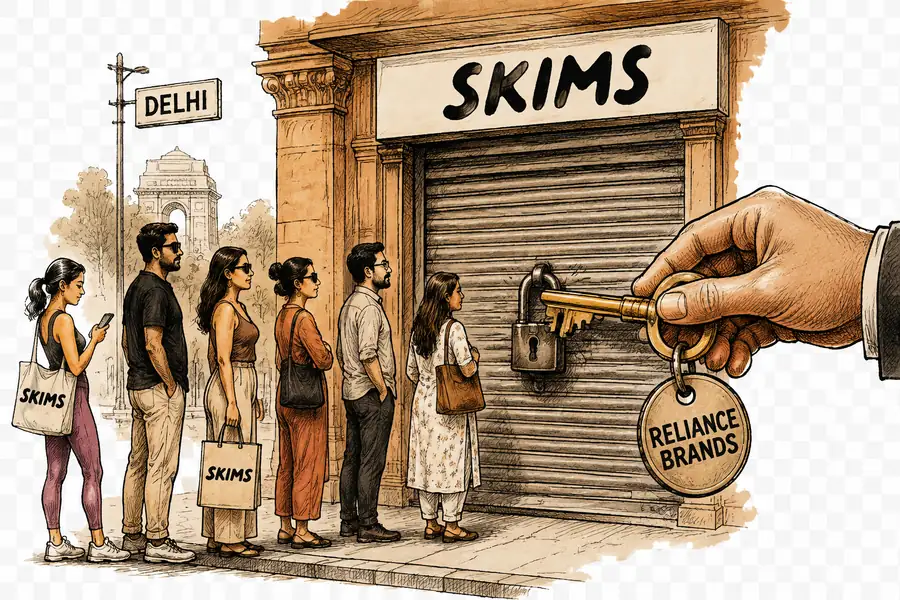
Skims Did Not Enter India. Reliance Did It For Them.
Reliance Brands will operate Skims across retail and e-commerce in India, starting in Delhi and Mumbai. A brand valued at $5 billion, holding capital raised expressly for international expansion, still chose an operator — which tells you the constraint was never demand.
Sir John Crabstone
Reliance Brands will run Skims in India. The exclusive partnership announced on 6 August hands the conglomerate the brand’s Indian retail and e-commerce, starting with stores in Delhi and Mumbai. Skims did not enter India; it hired the company already standing there, which tells you the binding constraint was never awareness. Kim Kardashian’s stated reason for the deal was the interest Indian consumers had already shown. Reliance Brands operates more than 1,855 retail doors across the country. Only one of those two things was scarce.
The headlines made this a celebrity arrival. The famous name is the least useful detail in it. What deserves attention is the party that was structurally required, and that was not the one with the following.
Money was not the obstacle either. Skims raised $225 million at a $5 billion valuation in November, led by Goldman Sachs Alternatives, with proceeds assigned to physical retail and international expansion; net sales were expected to clear $1 billion for 2025. Capital raised to open stores has been spent on a company that already had them.
Watch what the brand does where it can act alone. On 24 July it opened its own 12,000 sq ft flagship at 245–247 Regent Street in London. No operator, no phased rollout. Regent Street sells space; India sells access.
Dubai went the other way. The first Middle East store opened at Mall of the Emirates in December through Al Tayer Insignia, described as the brand’s regional partner. Skims goes direct where the retail system is already built for it, and takes an operator where it is not.
India has written rules that guarantee it is not. The country permits 100% foreign ownership in single-brand retail, but anything above 51% carries a 30% local sourcing requirement, a threshold designed to make pure importers uncomfortable. The same India Briefing analysis notes that foreign brands routinely take franchise agreements with domestic conglomerates instead, for the local expertise a franchise partner brings to a market it calls highly segmented despite its size. The rule does not forbid a brand from owning its Indian business; it prices that ownership high enough that almost nobody does.
Each of these deals is reported as a brand entering India, and each of them is a brand agreeing not to.
The arrangement is not reserved for the premium tier. Shein returned in February 2025 as an app Reliance owns and operates, TechCrunch reported, with Shein reduced to technology partner and denied access rights to Indian customer data. One company now holds the customer at the top of the market and at the bottom of it.
Reliance Retail closed FY26 with 387 million registered customers and 20,160 stores. The brands keep the trademark and the campaign. Nobody has had to ask who owns the shopper yet, because Reliance has not yet had a reason to prefer one of its brands over another.